It sagged in the middle — and other things that are not the problem
Readers report where they noticed something, which is almost never where it broke. What the six commonest complaints actually point at, and the one test that tells a structural fault from a prose one.
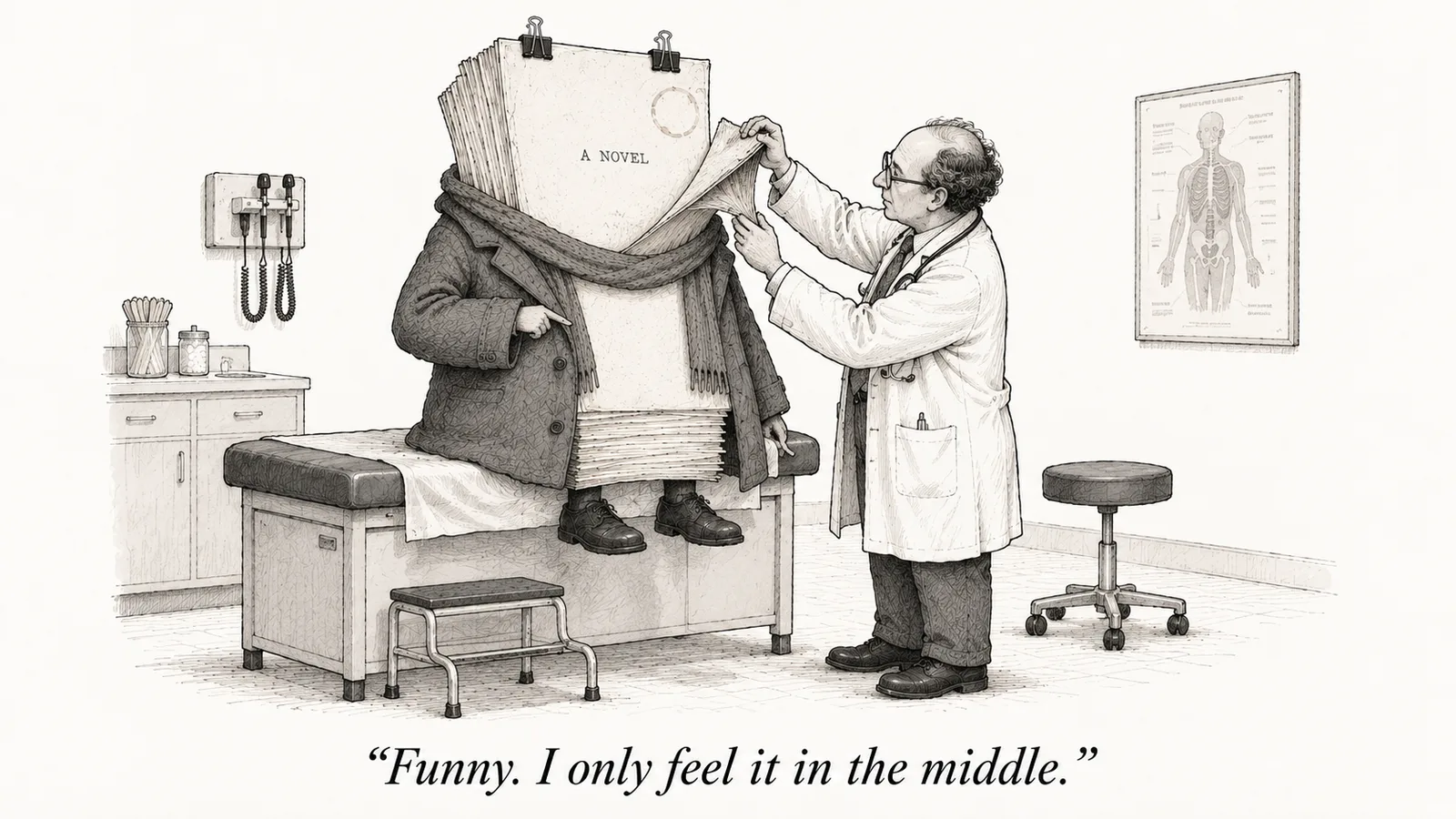
A reader hands your novel back and says it sagged in the middle.
Almost every writer takes this as an instruction about the middle. They go to the middle, find the three slowest chapters, cut a subplot, tighten the prose, move a scene forward. The sag moves. It does not go.
The complaint was accurate and the location was wrong. Readers are reliable witnesses to their own experience and unreliable guides to its cause: they tell you where they noticed, which is usually some distance after where it broke. A novel that sags at chapter fourteen is very often a novel that stopped asking a question at chapter four, and took ten chapters for the reader to feel it.
This matters practically, because the two kinds of fault are repaired by entirely different work, and the cheaper kind of work cannot touch the more expensive kind of fault. So before revising anything it is worth knowing which you have.
What the complaints usually mean
"It sagged in the middle." Look at the first act. A middle feels slack when the reader has stopped knowing what the book is trying to settle — when there is no question live enough to make the next scene feel necessary. The repair is almost never in the middle. It is in whatever should have been established before it.
"I didn't really care about her." Not a likability problem, though it is usually treated as one — writers respond by making the character kinder, funnier, more wounded. Readers care about people who want something and pay for wanting it. A character who wants nothing on the page, or whose wanting costs her nothing, reads as flat however charming she is.
"I got confused." Nearly always the order in which the reader was given information, not the clarity of the sentences that gave it. Confusion is a structural symptom with a prose-shaped feeling: each sentence was perfectly comprehensible and arrived in the wrong place.
"It felt slow." Often not pace at all. A fast sequence in which nothing changes reads as slower than a quiet conversation that alters everything. The question is whether each scene leaves the story somewhere it was not before — and a run of scenes that do not is experienced as slowness, whatever happens in them.
"The ending came out of nowhere." A first-act problem presenting at the finish. Endings feel unearned when what they depend on was never planted, or was planted so lightly that the reader did not keep it. Rewriting the ending rarely fixes it; the material the ending needs has to exist earlier.
"The writing is beautiful, but…" The "but" is the whole note. When a reader praises your prose before raising a reservation, they are telling you that the sentences are not what is troubling them — and they are being kind about the thing they cannot name. Writers who hear this and go back to the sentences are polishing the one part that was working.
Notes on the craft
Occasional letters on what actually breaks novels — and how to fix them. Written for people revising a draft.
No fixed schedule. Unsubscribe in one click. Privacy Policy
The test
There is a single question that separates the two kinds of fault, and it takes a few seconds.
Can the repair be made inside the paragraph?
If what is wrong can be fixed by changing words — a flabby sentence, a repeated construction, dialogue that explains itself, a cliché — it is a prose problem, and line editing is the right tool.
If the repair requires moving a scene, cutting a scene, adding a scene, or changing what a character decides, it is structural. No amount of sentence work reaches it. You can rewrite every line of a chapter that should not exist and it will still not belong.
The test is useful mainly because it is unflattering about the work writers prefer. Sentence work feels productive: it is bounded, visible, and finishes. Structural work means admitting that eleven good chapters sit in the wrong order, which is a worse afternoon.
How to run the diagnosis by hand
This takes an evening on a 90,000-word draft and is worth more than most feedback.
Write one line per scene — not what happens, but what changes. "Maya learns her brother lied" is a change. "Maya and Dan argue in the kitchen" is an event. If you cannot write a change for a scene, mark it. You now have the novel on two or three sheets of paper.
Then read your list and look for three things. Runs of two or more scenes with no change: that is where a reader will feel the slowness, and it is usually several chapters before they report it. The last point at which your protagonist makes a decision that costs her something: everything after it, until the next one, is the stretch the reader is enduring. And the gap between where your readers complained and where the last real change sits — because the second number is where the work is.
Then, and only then, pick one question and revise for it alone. A pass per question beats a sweep for everything, because you cannot hold five criteria in your head across 400 pages and will end up fixing whichever one the current paragraph reminds you of.
Why it is hard to do on your own book
Not for want of skill. You cannot read your own novel the way a stranger does, because your intentions fill in everything the page leaves out. You know why the brother lied. You know what the lighthouse means. The reader has only what is written, and the gap between the two is invisible from the inside — which is precisely the gap a diagnosis has to measure.
This is also why vague feedback is not a failure of your readers. They are reporting a real experience with the only vocabulary available to someone who is not an editor. "It sagged" is good data. It just is not a map.
Where the book shows you this
Novel Maestro reads the complete manuscript and reports the things the exercise above is trying to see: which scenes change the state of the story and which do not, where your protagonist decides and where she is carried, where tension rises and plateaus, which setups are planted and which are never paid off, and where the reader is given information relative to when they need it. Every finding names the passage it came from, so you can check it against your own page and throw it out if it is wrong.
It also asks what you meant. Each step of the reading shows what Maestro took from your pages — your genre, your central question, the promise your opening makes — and where that is not the book you intended, you say so, and the analysis recalibrates around your answer. That matters for a diagnosis more than anywhere else: a structural note measured against the wrong idea of what the book is doing is a confident answer to a question you were not asking.
The reading of your whole novel is free, with no card, and returns Maestro's First Take. The full Developmental Report and the fourteen diagnostic passes are £59 once, for one novel, and do not expire. It is not a human developmental editor — that is a different job, and a better one if you can afford it — but it will find the kind of fault a careful reading finds, and it will show you the page it found it on.
One of these a week, give or take
If this was useful, the letters are more of it: one problem a novel runs into, what it looks like on the page, and what to do about it.
No fixed schedule. Unsubscribe in one click. Privacy Policy