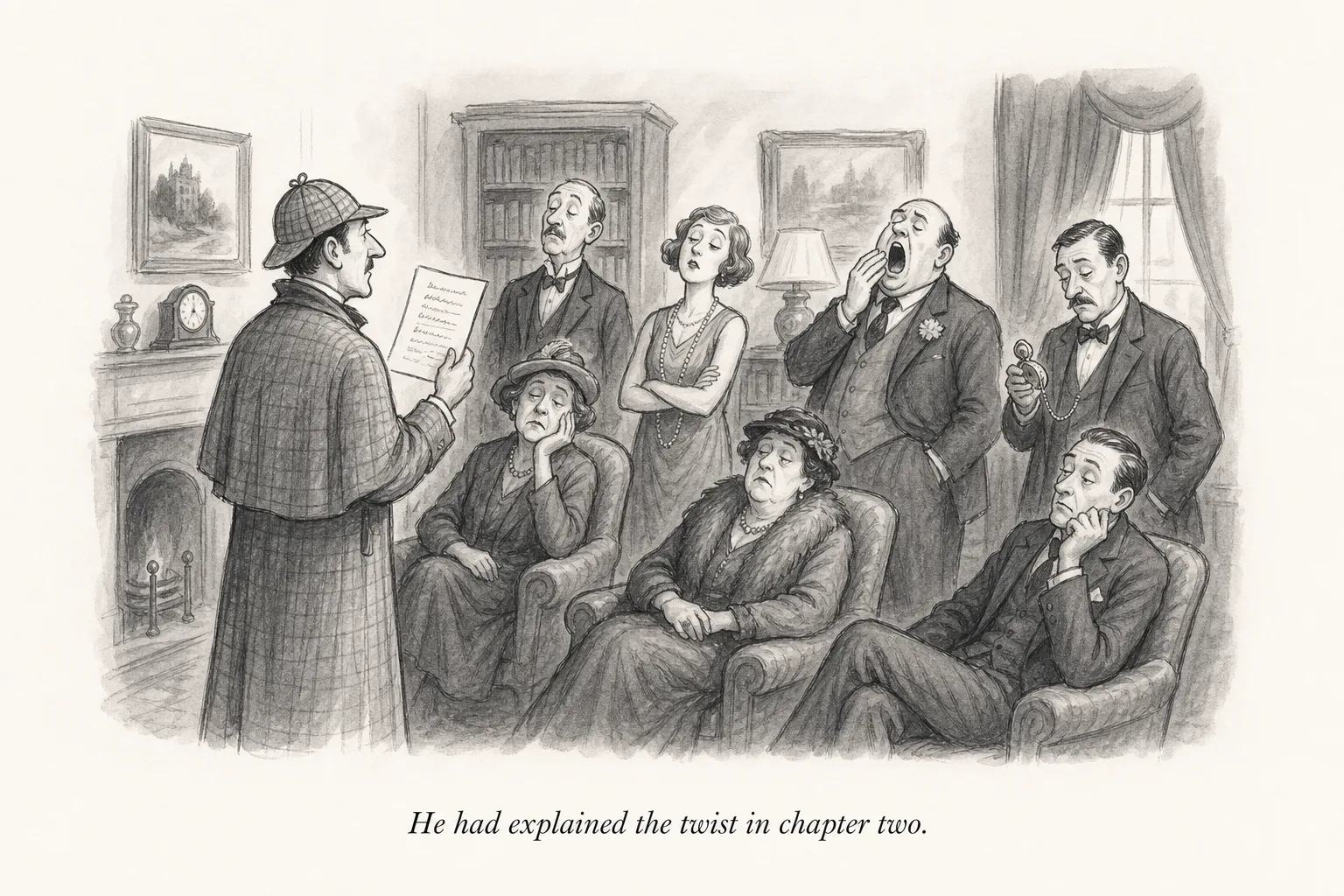
The reader knows too much, too soon
Suspense is not made of secrets but of gaps — and the distance between what the reader knows and what the characters know is one of the six things measured in every scene.
Suspense is not made of secrets. It is made of gaps — the distance between what the reader knows and what the characters know, held open for as long as the writer can bear it.
Get that distance right and a scene of two people discussing the weather can be unendurable. Get it wrong and a murder confession can be flat. And which way it goes is decided almost entirely by information you released in an earlier chapter, often without noticing you had released it.
Revelation is a thing we measure
One of the six measures Narrative Pulse scores for every scene is revelation: how much new information a scene actually delivers to the reader. It sits alongside tension, conflict, stakes, agency and emotional intensity, and it is read scene by scene across the whole manuscript.
Plotted, it is one of the most legible lines in the book, because information release has a natural signature. A healthy manuscript releases in bursts, with pressure building in the intervals. A front-loaded one drops most of its revelation early — chapters one to five explaining, and then two hundred pages of consequences that the reader has already priced in. A withholding one runs almost flat for a long middle stretch, which reads as confusion rather than intrigue.
It is worth noticing what revelation does not feed. Momentum's energy line blends four measures — tension, conflict, stakes and emotional intensity. Revelation is deliberately not one of them, because a scene can be quiet and still change everything the reader understands. That is a different kind of force from energy, and it is measured separately for exactly that reason.
Why you cannot feel your own information curve
Because you have never once read your novel without knowing the ending.
Every re-read you have ever done has been a re-read. You cannot experience the gap, because for you there is no gap; you know who the father is, what is in the box, which of them is lying. So a chapter that spends nine pages circling a fact the reader worked out in chapter three feels, to you, like restraint.
The reverse error is just as common and harder to spot. Writers who fear being obvious often hold information so long that the reader has nothing to hypothesise with. Curiosity needs material. A reader who does not know enough to be wrong about anything is not intrigued; they are waiting.
How to test it by hand
Make a two-column list, one row per chapter. Left column: what the reader now knows that they did not know at the start of the chapter. Right column: what the reader now suspects but cannot confirm.
Then read down both columns. Long runs of empty left column are your flat stretches. An empty right column anywhere is more serious — it means that for that stretch the reader has no live question, and no amount of incident will substitute.
The second test is one sentence per major reveal: who knew this before the reader, and who learns it after? If the answer is that the reader learned it first and no character ever catches up, you have information the book never used.
What it looks like when it goes wrong
The briefing scene. Two characters discuss a fact they both already know, purely so the reader can find out. The dialogue conveys rather than enacts, and everyone in the scene is politely waiting for the exposition to end.
The vault. Readers report confusion rather than suspense. Secrets are clearly being kept, but the middle third has no urgency, because the reader has not been given enough to form a theory.
The early confession. A secret the reader has been anxiously holding gets handed to the point-of-view character almost immediately, and the tension that depended on the gap evaporates a hundred pages before the book needed it to.
The orphaned reveal. A fact the reader learns that no character ever catches up to — reader-only knowledge that was never designed to pay off, sitting in the narrative doing nothing.
Where the book shows you this
Narrative Pulse plots revelation across the manuscript as its own line and lists the scenes at the bottom of its range, so a front-loaded opening or a long silent middle is visible as a shape rather than as a suspicion. Read it against tension: revelation high and tension low usually means information is being delivered rather than dramatised, and the pair of lines together tells you more than either alone.
Setups & Payoffs covers the mechanical companion question — which promises you made and what became of them — and between the two you can usually locate both halves of an information problem: what was released too early, and what was never collected at all.
The judgement, as ever, stays with you. No tool knows which of your secrets is the one worth holding for another eighty pages. What it can do is show you where the curve went flat, which is the part you are structurally unable to feel.
Held information is also the engine of the thing readers call tension, which is not the same as conflict.
Notes on the craft
Occasional letters on what actually breaks novels — and how to fix them.
No fixed schedule. Unsubscribe in one click. Privacy Policy