Eight ways a character can change
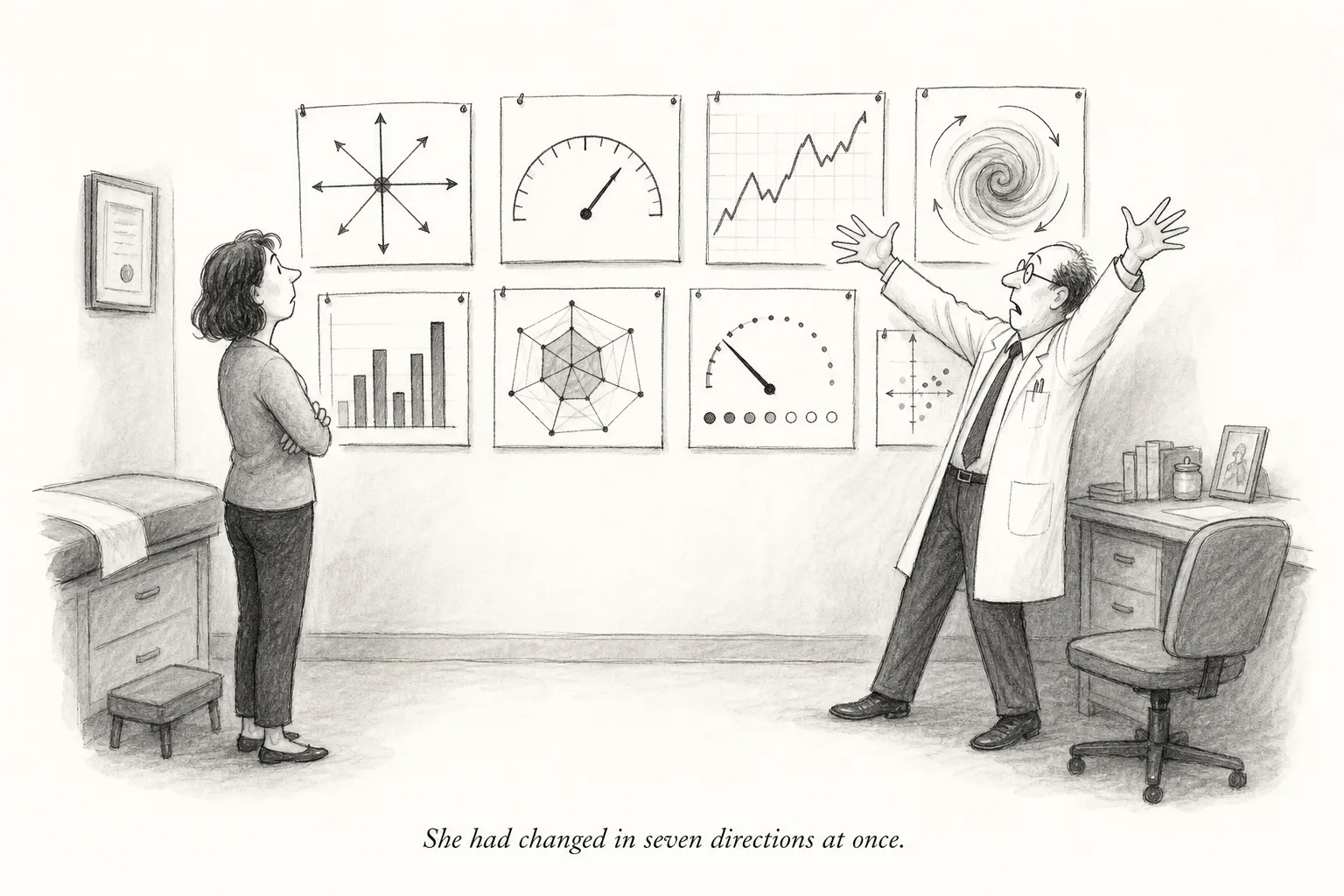
"Change" is not one quantity. It is at least eight, they move independently, and averaging them destroys exactly the finding an editor would lead with.
Ask a writer whether their protagonist changes and you will get a confident yes. Ask them in which respect, and the answer usually arrives more slowly — because "change" is not one quantity. It is at least eight, and they move independently.
This matters practically, not theoretically. Most of the notes writers get about arcs — she doesn't really grow, I didn't believe the turn, it all happens in the last chapter — are not observations about one thing failing. They are observations about the wrong dimension carrying the weight.
The eight measures
When the app reads a character across the manuscript, it scores each of their scenes on eight separate axes, every one running from −5 to +5:
- Want/Need — serving the conscious want at the deeper need's expense, through to acting on the need even where it costs them the want.
- Moral — corruption and moral collapse through to moral clarity and integrity.
- Emotional — despair or numbness through to joy and fulfilment.
- Agency — completely passive through to fully in control.
- Power/Status — powerless and marginalised through to dominant and influential.
- Relationship — isolated or hostile through to connected and loved.
- Knowledge — ignorant or deceived through to enlightened and aware.
- Thematic — embodying the anti-theme through to embodying the theme.
Read that list slowly and a useful thing happens: you start to notice which of them your novel is actually about. A revenge plot moves Power/Status and Moral. A grief novel moves Emotional and Relationship while Power/Status stays flat all book, correctly. A detective story is largely Knowledge.
Why they are never averaged
This is the most important thing to say about the eight, and it is a lesson learned the hard way in building the tool.
The measures are not commensurable. Want/Need is a tension between two forces. Power/Status and Knowledge are states. Emotional is a valence. Moral is an alignment. Averaging them produces a number that means nothing — and worse, it cancels real movement out. A character who becomes far more powerful and far more isolated has moved enormously; the mean says they have not moved at all.
So the app deliberately does not plot a single composite arc line. It shows three separate readings, in this order:
The arc. A belief line built only from Want/Need (weighted double) and Moral, plotted against the shape the character's arc type expects. This is the one that answers is this character's change happening?, because the arc shapes writers use — lie to truth, truth refused to ruin, disillusionment — are belief trajectories.
How far they move. Distance travelled: a direction-free figure from 0 to 5, measuring displacement from the character's first scored scene. It cannot cancel out, so a character pulling in opposite directions reads as high transformation rather than as none.
What's underneath. The eight measures, examined one at a time — never two superimposed, because a crossing point between two incommensurable axes means nothing.
Why you cannot see this yourself
Because you experience your character's change as a single intention, so any movement anywhere reads to you as the arc progressing.
That produces a very specific and very common fault: the character is unmistakably changing — warmer, braver, more open — while the axis the book is actually about sits still. Something is moving. It is not the thing the ending needs.
The other pattern is the flatline protagonist, who survives betrayal and loss and victory and holds exactly the same beliefs, priorities and blind spots at the end as at the start. Plot happened to them. Nothing happened in them. From inside the manuscript this is almost impossible to detect, because you know what they came to understand — you simply cannot read your own book cold.
How to test it by hand
Pick your protagonist and write the eight labels down the margin of a page. Beside each, put a number from −5 to +5 for the first chapter, and another for the last.
Now look at the differences. Which axis moves most? Is it the one your novel is about? A romance whose largest movement is Knowledge, or a coming-of-age story whose largest movement is Power/Status, is telling you something about where the book's attention actually went.
Then take the axis that should move and find the three scenes where it moves. If you cannot name three, the change is being asserted rather than dramatised — and that is the fault behind the epiphany that arrives in one concentrated burst in the final chapters with nothing preceding it.
Where the book shows you this
Character Arcs plots all of this per character: the belief line against the expected shape for their arc type, distance travelled beneath it, and the eight measures one at a time, with the specific scenes where two measures pull against each other flagged as findings you can promote straight to a revision task.
Those conflicts are usually the most editorially interesting output, because they name the thing you half-noticed and could not articulate: rising in status while falling morally, growing in knowledge while losing every relationship. That is not noise. In most novels, that is the arc.
Want and need are the axis the arc shapes are built on, which is why they get a piece of their own.
Notes on the craft
Occasional letters on what actually breaks novels — and how to fix them.
No fixed schedule. Unsubscribe in one click. Privacy Policy