What a machine can measure — and what only you can judge
Editing a novel is not one job. It is a stack of them, and they are not the same kind of job.
Most of the public argument about AI and fiction is about whether a machine can write a novel. It is a loud argument, and it has crowded out a more useful one.
Editing a novel is not one job. It is a stack of them, and they are not the same kind of job. Some are measurement problems: how often does this character appear, where does the tension flatten, was that promise ever kept. Some are judgement problems: is this good, is it moving, is it the book I meant to write. Until very recently, machines were no help with either. That has changed for exactly one half of the stack — and it is worth being precise about which half, and why.
What actually changed
Software could check spelling in the 1980s and flag a passive construction by the 1990s. What it could never do was hold a novel.
A 90,000-word manuscript is not a long sentence, and the faults that sink a draft rarely live inside a sentence. They live in the distance between the parts: a detail planted in chapter two and forgotten, a character who disappears for eleven scenes and returns as though nothing happened, a middle that goes slack, a motif abandoned at the halfway mark, a rule of the world broken two hundred pages after it was set. To see any of that, you have to hold the whole book at once and compare chapter three with chapter twenty-one.
That is what became possible. Not because machines became wise — they didn't — but because they can now read an entire manuscript, apply the same criteria to scene one and scene seventy-one without tiring or drifting, and hold every one of those readings side by side.
It's a change of scale, not of insight. And as we've seen while developing Novel Maestro, scale turns out to matter far more than anyone expected.
Notes on the craft
Occasional letters on what actually breaks novels — and how to fix them. Written for people revising a draft.
No fixed schedule. Unsubscribe in one click. Privacy Policy
Four things that were not possible before
1. Measuring what you can otherwise only feel
Ask a novelist where the tension in their book is highest and you'll get an answer about where they meant it to be highest. That's not evasion. It's the condition of having written the thing: you cannot read your own manuscript cold, because you always know what is coming.
Novel Maestro's Narrative Pulse diagnostic tool scores every scene on six dimensions — tension, conflict, stakes, agency, revelation and emotional intensity — and plots them across the book. The number on any single scene is not the point. The shape is. A run of eight scenes in which every line stays flat is not a matter of opinion, and it is very hard to see from the inside.
The discipline that matters here is comparative rather than absolute. There is no such thing as a scene that scores seven out of ten in some universal sense. What is meaningful is that this scene runs cooler than the rest of your book, or that your stakes peak forty pages before your climax.
2. Counting the things nobody would count by hand
Some editorial questions are pure bookkeeping, and the bookkeeping is so tedious that nobody does it. Which of your named characters actually earn their place? At what point does a subplot go quiet for so long that the reader loses the thread? How many of your scene-to-scene transitions are causal — this happened, therefore that — and how many are merely sequential: and then, and then, and then?
All of that is countable. Novel Maestro's Ensemble tool builds a presence timeline for every character across every scene, so an eleven-scene absence stops being a vague worry and becomes a visible gap. The Cause & Effect diagnostic tool marks each transition in the book as causal or sequential, gives you the ratio, and highlights the weak runs.
The Scene Ledger is the plainest example of the principle: one row per scene, and three columns — who makes a decision, what changes, what the reader learns. The finding is the empty cells. A stretch of scenes in which nothing changes is a sagging middle, and a table shows it in a way that fifteen thousand words of prose never will.
3. Finding patterns across distance
Recurring images, echoes and symbols only become motifs through repetition, and repetition is precisely what a writer cannot audit from memory. Novel Maestro's Motifs pass surfaces every pattern it finds and gives each one a trajectory: consistent, emerging, fading or one-time. Writers tend to be surprised twice — once by the motif they thought ran through the whole book and which in fact stops at chapter nine, and once by the pattern they never consciously planted, which turns out to be the truest thing in the draft.
Setups & Payoffs does the same work for promises. Every planted detail, every question raised, every threat introduced is tracked against its resolution and marked resolved, hanging, late or forgotten, with a timeline showing how long the reader is left waiting. The Continuity Check cross-references the facts of the story against each other — eye colour, timelines, distances, the rules of a world — and names both of the scenes that contradict each other, so you can decide which one is wrong.
None of this requires taste. All of it requires an attention span no human reader has, including the one who wrote the book.
4. Connecting one measurement to another
This is the newest capability, and the most interesting. Any single number is weak evidence. Numbers that agree with each other start to look like a diagnosis.
"The pacing sags in the middle" is a feeling. But when the Momentum tool shows the composite energy line dropping across the second act, and the drop traces back to one specific dimension — stakes, say, rather than conflict — and the Scene Ledger shows six consecutive scenes in which nobody makes a decision, and the same stretch is where a subplot has gone dormant, you no longer have a feeling. You have a place to stand and a reason to stand there.
The Value Arc goes further and looks for disagreement between layers, laying the charge each scene carries, the emotional temperature of the prose and the presence of the theme over one another. The findings that fall out are ones a writer cannot reach any other way: a scene where the dramatic turn is a defeat but the prose reads warm and comfortable; forty pages in the middle where the theme the whole book is about goes silent.
And because the shape a story wants is partly a function of what it has promised, all of this can be read against genre expectation rather than against nothing at all. Novel Maestro's Genre Promises tool checks the manuscript against the conventions, essential scenes and character roles that readers of your genre arrive with, and marks each one kept, bent or broken.
What a machine cannot do — and should not be asked to
Everything above is instrumentation. None of it is editing. Editing is what happens when someone decides what the instruments mean.
Decide whether a flaw is a flaw
The thing measurement gets wrong most often is intent. A broken genre convention might be a mistake, or it might be the entire reason the book exists. A protagonist who stays passive for a hundred pages is a serious fault in a thriller and the whole point in a novel about paralysis. A flat stretch may be the quiet a reader needs before the last act.
Novel Maestro is built on the assumption that only you can settle this, which is why a genre finding can be logged as deliberate rather than corrected, and why every reading it forms of your characters and your intentions can be overruled by you — with your correction carried forward into everything that follows.
Judge whether it is any good
Measurement can tell you a scene runs cooler than the rest of your book. It cannot tell you it is the best scene you have written. Nothing in the numbers knows what it is like to be moved. There is no metric for the sentence that makes a reader put the book down for a moment, and no scoring system that will forgive a technically immaculate novel for being dull.
Set the terms
What the book is for, what it is arguing, what you are prepared to risk in order to say it — none of that is discoverable from the text by counting. It is a decision, and it is yours. Every diagnostic is only as useful as the question it is being asked to serve, and you are the only one who knows the question.
Write the sentences
The gap between knowing what is wrong and fixing it is where novels are actually made. A note saying the stakes flatten between chapters twelve and eighteen is not a rewrite. The rewrite is invention: a new complication, a decision the character makes differently, a scene cut, two chapters reordered. That is authorship, and handing it over is the one exchange that costs a writer everything they came for.
The division of labour
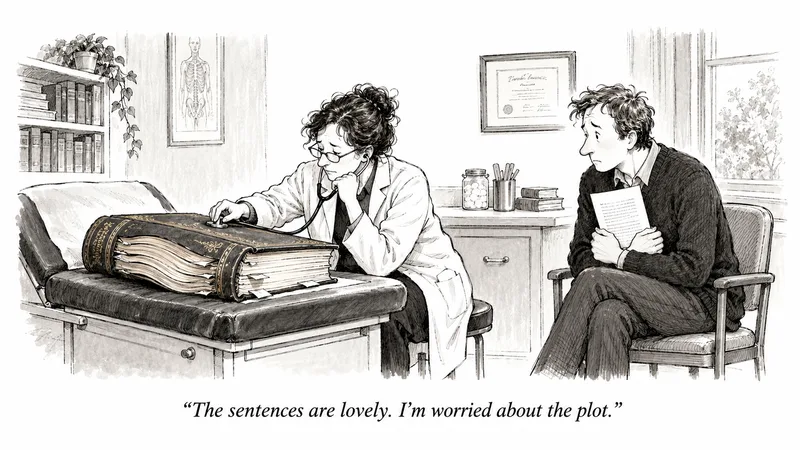
The closest analogy is diagnostic imaging. A scan does not decide on the operation. It tells the surgeon where to look, precisely and without flattery, and the judgement stays with the person trained to make it.
What is new is not that machines have opinions about fiction. It is that a writer can now get an honest map of their own manuscript — where the energy is, who is on the page, which promises are outstanding, where a pattern breaks — before deciding what to do about any of it. Every claim Novel Maestro makes is grounded in a quoted passage and a link straight to the scene, for exactly that reason: so you can look, and disagree, and be right.
Which leaves the writer with the harder half, and the better half. "Where do I start?" is a question a machine can now answer. "What should this book be?" was never going to be automated, and it is the question that makes the novel yours.
One of these a week, give or take
If this was useful, the letters are more of it: one problem a novel runs into, what it looks like on the page, and what to do about it.
No fixed schedule. Unsubscribe in one click. Privacy Policy