What does a developmental editor do? Mostly, they diagnose
A developmental editor diagnoses a novel's structure before anyone touches its sentences. What the job involves, how it differs from line and copy editing, and how to start doing it yourself.
On 20 November 1924, Maxwell Perkins wrote to F. Scott Fitzgerald about the typescript of The Great Gatsby. He admired it enormously. He also told Fitzgerald that "Gatsby is somewhat vague. The reader's eyes can never quite focus upon him, his outlines are dim." Perkins did not rewrite a sentence. Fitzgerald went back into the book at the galley stage and rebuilt his central character.
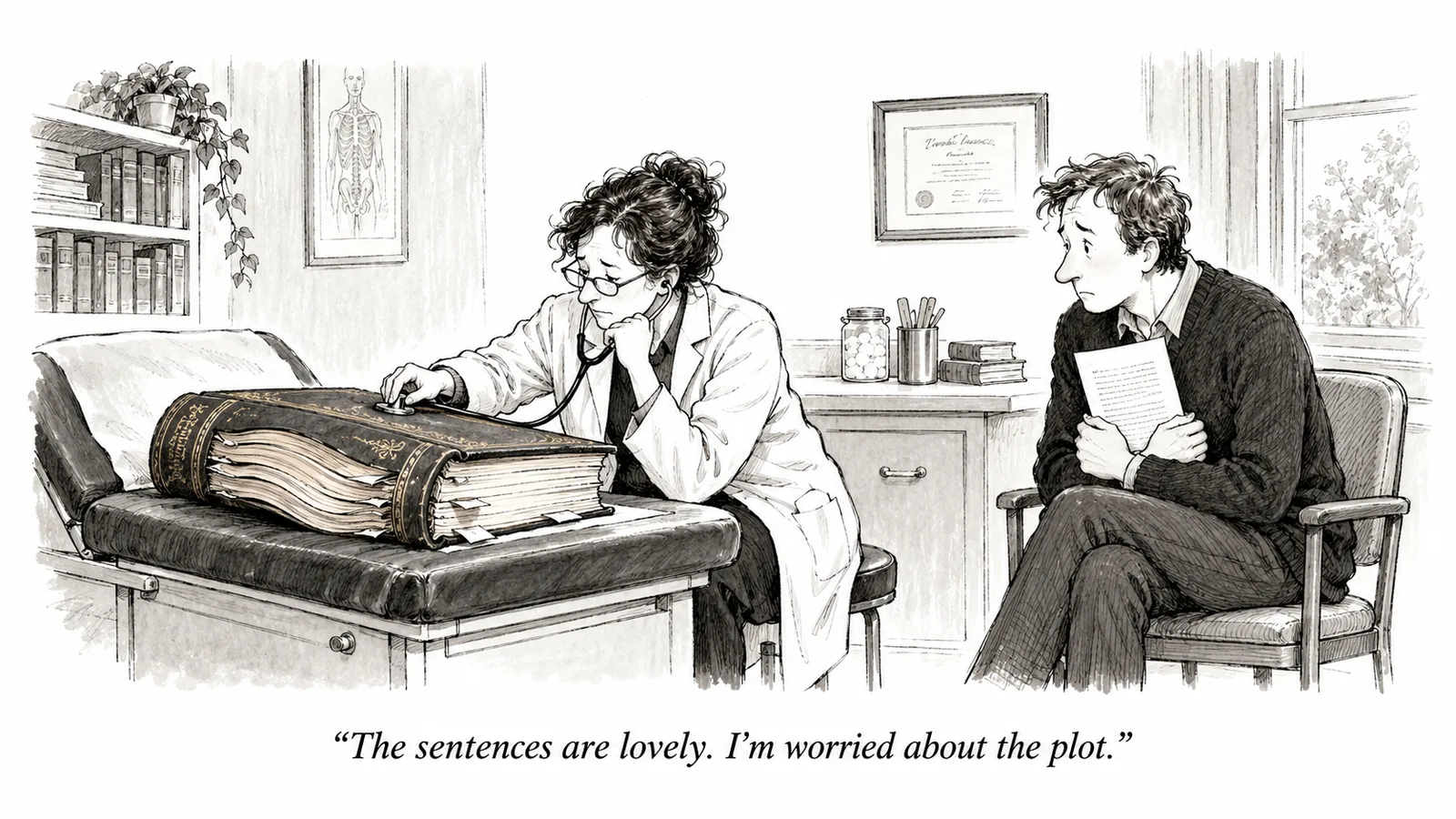
Anyone asking what a developmental editor does will find most of the answer in that letter. A developmental editor reads a whole novel and tells the writer what the book is doing to its reader: where it holds, where it loosens, and why. The repair, in the best tradition of the job, stays with the author.
That sounds modest. It is the hardest reading a manuscript will ever receive, and it is the kind most writers never pay for.
Three kinds of editing, and the one writers usually buy
Editing a novel happens in tiers, and the tiers have an order.
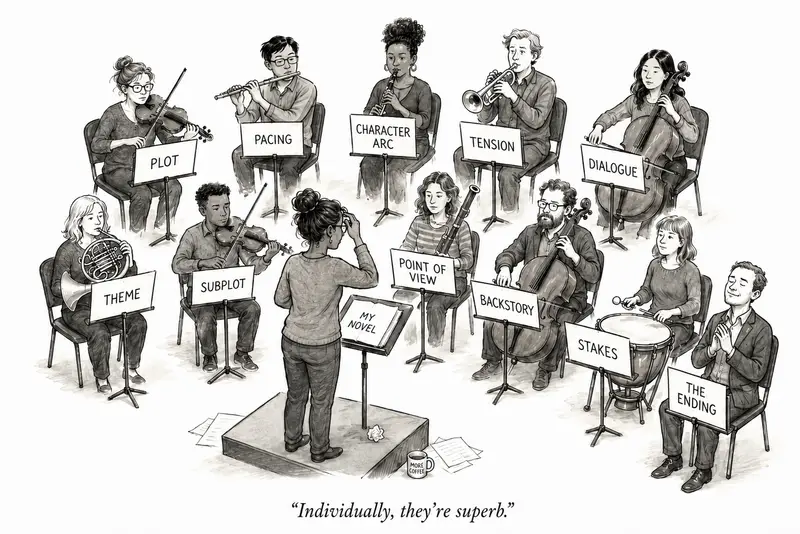
Developmental editing works on the book as a structure. It asks whether the story's central question is clear and whether it moves, whether scenes change anything, whether the protagonist makes decisions or merely has things happen to them, whether subplots touch the main line, and whether the book keeps the promises its opening and its genre have made.
Line editing works on the sentence as a unit of meaning and voice: rhythm, clarity, repetition, the paragraph that says the same thing twice. Copy editing works on consistency and correctness, from a character's eye colour in chapter three to house style on numbers. Proofreading comes last and catches what everyone else missed.
Each tier assumes the one above it is settled. A line edit on a chapter that a structural revision later removes is money spent polishing something that goes in the bin. Yet this is the most common way writers spend their editing budget, and the reason is simple. Writers buy the tier they can see.
A clumsy sentence is visible on the page. A friend who reads chapter one can point to it. A missing midpoint is not visible on any page, because it is a property of the whole manuscript, and nobody reading a chapter at a time will find it. So writers finish a draft, sense that something is wrong, and reach for the kind of help that addresses what they can locate. The sentences get better. The book stays where it was.
What a developmental editor actually reads for
The developmental editor's raw material is the complete manuscript, read as a reader first and then taken apart. The questions are structural. The editor wants to know what the book promises in its first fifty pages and whether it pays that promise off, and whether each scene leaves the story in a different state from the one it found it in. They track who decides things, and at what cost, where tension rises and where it plateaus, and whether the reader has the information they need at the moment they need it, not five chapters later. They check whether the point of view belongs to the characters whose book this is, and whether the proportions are right: a first act that consumes half the manuscript is a common and fatal shape.
The output is usually an editorial letter, often running to many pages, sometimes with notes in the margins of the manuscript. The letter is the real product. It describes the book's condition as a whole, which no set of margin comments can do.
Diagnosis, not prescription
The popular picture of an editor is someone who makes your writing better. At the developmental stage, the best editors do less of that than writers expect, and more of something harder.
Go back to Perkins. His letter named the symptom: the reader cannot see Gatsby clearly. He floated one possible remedy, letting the reader learn Gatsby's history in pieces rather than all at once, and left the decision with Fitzgerald. Fitzgerald's reply is the most useful sentence ever written about developmental editing. He wrote back that "I myself didn't know what Gatsby looked like or was engaged in" — and that the uncertainty had communicated itself to the reader, even though he had not been able to name it.
That exchange shows why diagnosis comes first. The problem Perkins identified on the page was a problem in the author's own understanding of his book. No editor could have fixed it by rewriting Gatsby's scenes, because the missing thing was knowledge only Fitzgerald could supply.
A good developmental note has three parts. It names the symptom, which is what the reader experiences. It names the mechanism, meaning what in the manuscript produces that experience. And it names the consequence, what the problem costs the book. What it leaves out is the rewrite. An editor's rewrite solves the problem in the editor's voice, and a novel revised that way is gradually becoming someone else's book. The next post in this series looks at the most famous case of an editor who crossed that line.
This is what we mean when we say diagnosis is half the job. It is the half that requires distance from the manuscript, and the half a writer finds hardest to do alone. It should also be done without judgement: a diagnosis describes what the book does, not whether the writer is any good.
It also explains why two familiar pieces of advice take writers only part of the way. Beta readers are valuable, but they report symptoms, not mechanisms. They can tell you they lost interest around page 180. They rarely know why, and when they guess, they tend to guess wrong. Putting the manuscript in a drawer for six weeks helps with sentences, which start to look like someone else's. It helps much less with structure, because you still remember what you meant, and what you meant fills the gaps that a stranger would fall into.
A worked example: one chapter, two edits
Here is an extract from chapter seven of Fernhill, a 94,000-word novel. Marianne has come back to the family house after her father's death. Her brother Gareth wants to sell it, and Ray has kept the orchard going for thirty years.
The orchard had not changed, or it had changed so slowly that change was the wrong word for it. Marianne walked between the rows of Bramleys with her hands in her coat pockets and thought about the summer she was nine, when her father had let her climb the tallest tree and then stood beneath it for an hour, pretending not to watch. The grass was long. Somebody, Ray probably, had left a ladder against the old Cox at the end of the row, and she found that she was thinking about her father again, about the way he used to stand at the kitchen window in the evenings and count the trees as if one might have left.
A line editor would tighten it, and rightly:
The orchard had changed so slowly that change was the wrong word for it. Marianne walked the rows of Bramleys, hands in her coat pockets, and remembered the summer she was nine: her father letting her climb the tallest tree, then standing beneath it for an hour, pretending not to watch. Someone, Ray probably, had left a ladder against the old Cox at the end of the row. In the evenings her father used to stand at the kitchen window and count the trees, as if one of them might have left.
That is a good line edit. The repetition has gone, the rhythm is cleaner, and the final image lands harder. It may also be wasted work. Here is the developmental note on the same chapter:
Chapter seven is the fourth consecutive chapter in which Marianne's main activity is remembering. The question the book raises in chapter two, whether Gareth will force the sale of Fernhill, has not moved since chapter three, and nothing in this chapter moves it. However good the prose, readers are likely to experience chapters four to seven as a pause rather than a deepening.
Separately, the ladder against the Cox is the first sign that Ray is still working the orchard without being paid. That fact reframes his argument with Gareth in chapter two. The reader needed it then, and receives it five chapters later.
Two questions. What does Marianne want by the end of chapter three? And which of the memories in chapters four to seven would she still need if she were actively pursuing it?
The note does not touch a sentence. It names two symptoms, a stall and a late disclosure. It locates their mechanisms, a protagonist without a goal and information placed after the scene that needed it. It states the cost, a reader's patience in the middle third. It ends in questions because the answers are the author's to find.
The likely outcome is that chapters four to seven become one chapter, the ladder moves to chapter two, and the paragraph the line editor improved is either rewritten for a new purpose or cut. The line edit was competent. It was just early.
Doing it yourself
You can begin developmental editing your own novel with nothing more than the feedback you have already received.
Take every comment from your last round of readers, whether a writing group, beta readers or an agent's rejection with a line of explanation, and sort each one into one of three piles: structure, sentences, or correctness. Most writers find the sentence pile crowded and the structure pile nearly empty. That is rarely because the book has no structural problems. It is because nobody was reading for them.
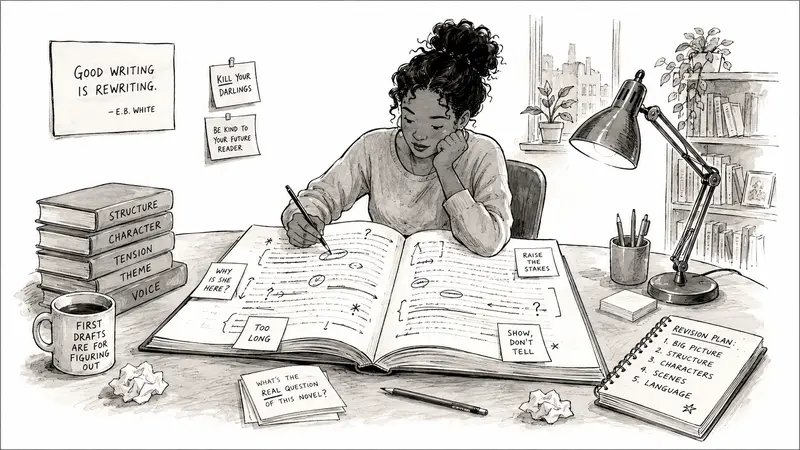
Then choose one chapter from the middle of your book and write a developmental note on it in three parts: symptom, mechanism, consequence. Resist the urge to write the fix. You will probably find that the symptom comes easily and the mechanism does not, because a mechanism usually lives somewhere else in the manuscript. The stall in chapter seven is caused by a missing goal in chapter three. Seeing that requires the whole book in view at once, which is why developmental editors keep ledgers, charts and maps of the novels they work on. Later posts in this series cover each of those instruments, and how to build them by hand.
The deeper difficulty is that you know what you meant, and your intentions quietly supply everything the page leaves out. The third post in this series starts there, with a simple exercise: writing down the book you think you wrote before you read the one you actually did.
Where Novel Maestro fits
Novel Maestro was built to do the diagnostic half of this work with evidence. It reads a complete manuscript, with no word limit, and runs around 175 analytical passes and fourteen whole-book diagnostics across it. It reports what the book does to a reader, set against what the writer set out to do. It does not write or rewrite prose, because the second half of the job belongs to the author.
If you have a finished draft and a suspicion that its problems are larger than its sentences, Maestro's First Take is a free reading of your complete manuscript. It is not a sample chapter or an opening-pages teaser.
This is the first post in "Over the Editor's Shoulder", a series on what developmental editors do and how to do it for your own novel.
Notes on the craft
Occasional letters on what actually breaks novels — and how to fix them.
No fixed schedule. Unsubscribe in one click. Privacy Policy