Why every developmental editor keeps a scene ledger
A novel can only be read in order. A scene ledger turns it into a document you can scan, and shows what the draft actually does.
A novel cannot be seen. It can only be moved through, one sentence after another, in the order the writer chose. That is what makes it a novel, and it is also what makes its structure so hard to judge. By the time you reach chapter twenty, chapter four is a memory, and memory is a poor instrument for comparing things.
This is why developmental editors, sooner or later, stop reading and start listing. The scene ledger is the humblest document in the trade: one line per scene, written after the fact, recording what actually happens on the page. It is also the tool that most often shows a writer something they could not have found by rereading. A book you move through becomes a document you can scan, and problems that were invisible across three hundred pages become obvious across three.
Writers have always needed to see the whole
Novelists have long reached for some way of making a book visible at once. Vladimir Nabokov composed his novels on index cards, writing scenes out of order and shuffling them until the sequence held. His last, unfinished novel, The Original of Laura, was published in 2009 as facsimiles of the cards themselves. William Faulkner outlined A Fable on the walls of his study at Rowan Oak. Joseph Heller tracked Catch-22, a novel whose chronology is deliberately scrambled, on a hand-drawn grid that set his characters against the months of 1944.
These are writers organising books they had not yet finished. An editor's ledger does something different. It records a book that already exists, and that difference is the whole point.
A ledger is not an outline
Most writers who hear "scene ledger" assume they already have one. They plotted the novel before drafting it, and the outline is somewhere in a folder.
An outline is a plan. It records what you meant to write. A ledger is a record. It describes what you actually wrote. The two are rarely the same, because drafting is a long process of discovery, and every draft drifts from its plan in ways the writer half-notices at best. A scene outlined as "Marianne confronts Gareth about the sale" may have become, somewhere in the third rewrite, a scene in which Marianne thinks about confronting Gareth and then goes for a walk.
In the language of this series, the outline is intent and the ledger is reality. Comparing the two is one of the fastest ways to find a structural problem. But the ledger has to be written from the page, not from memory, and never by copying the outline across.
The same thing is sometimes called a reverse outline, and the name is useful because it makes the direction clear. You are not planning forwards. You are recording backwards, from the text.
Notes on the craft
Occasional letters on what actually breaks novels — and how to fix them. Written for people revising a draft.
No fixed schedule. Unsubscribe in one click. Privacy Policy
The discipline of the single line
The value of a ledger is not only in the finished document. It is in the act of writing each line.
The rule is one sentence per scene, describing what happens and what changes. That constraint does two kinds of diagnostic work before you have looked at the ledger as a whole.
Some scenes cannot be summarised in one sentence because nothing happens in them. You find yourself writing "Marianne remembers her father" or "Gareth and Marianne talk about the house". These are descriptions of activity, not events. If the most honest line you can write for a scene contains no change, the scene is probably not doing structural work, however good its prose.
Other scenes will not fit into one sentence because they are doing two jobs. You find yourself writing "and" or "while": Marianne meets the solicitor and learns about the lower field while Ray waits outside. That is sometimes fine, since rich scenes do more than one thing. But it is worth noticing, because a scene doing two jobs often buries the second, and readers will miss it.
If you cannot write the line, the scene does not know what it is for.
A few rules keep the lines honest. Describe what is on the page, not what it means. Write in the present tense. Name the change, if there is one, in terms of what a character now knows, wants or has lost. And do not write the line you wish were true. The ledger is only useful if it is less flattering than your memory.
What a ledger reveals
Once each scene is a line, several kinds of problem become visible that are almost impossible to see from inside the prose.
Repetition. Two or three scenes turn out to be doing the same job: establishing the same relationship, delivering the same pressure, dramatising the same feeling. Each seemed necessary on its own. Seen together, all but one can usually go.
Stalls. A run of lines with no change in them is a stall, and the ledger shows exactly how long it lasts.
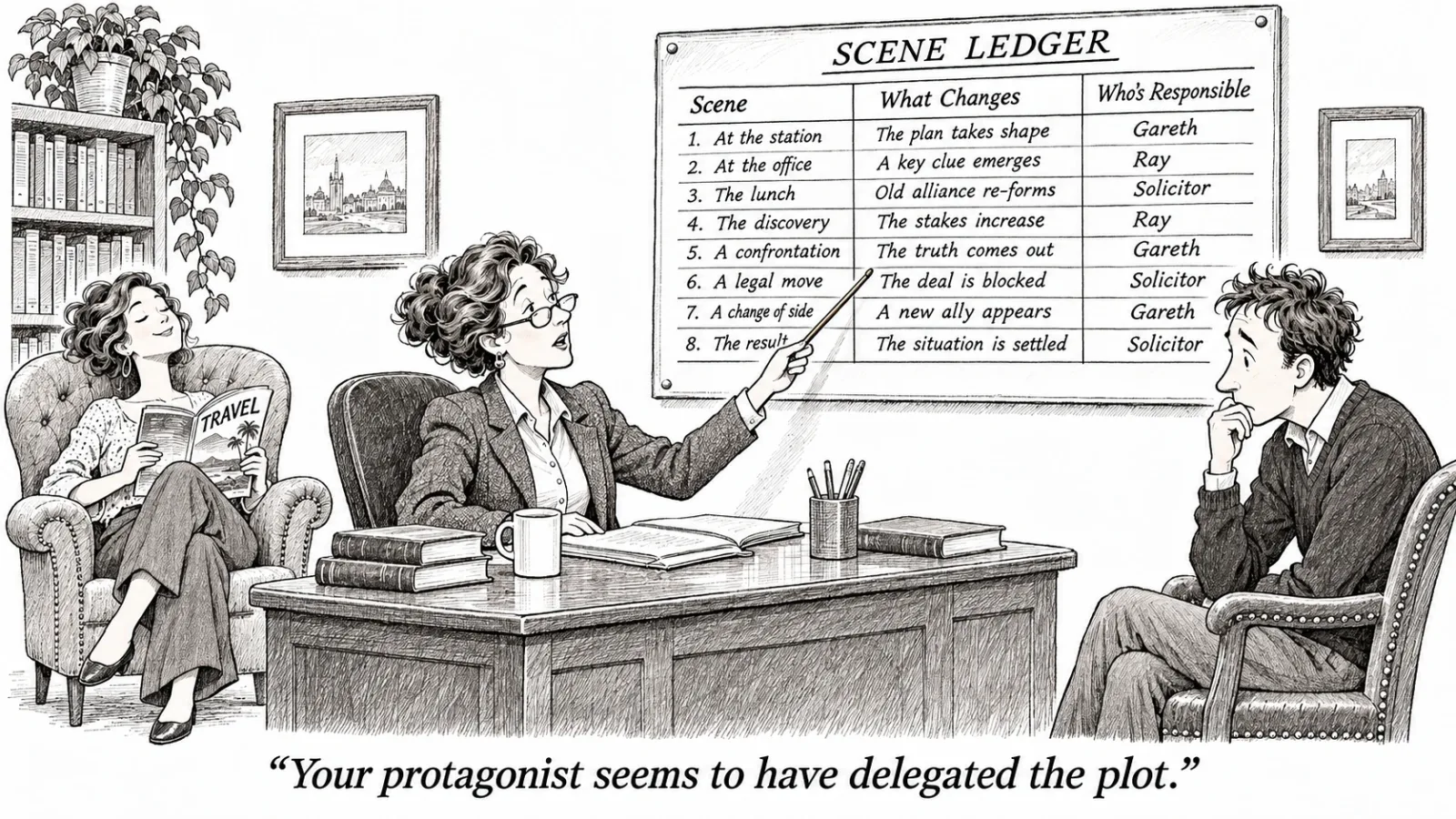
Ownership. If you note who causes each change, the ledger shows who is actually driving the book. It is often not the protagonist.
Proportion. Add a word count to each line and you can see where the manuscript spends its length. The distribution rarely matches the importance of the events.
Absences. A character, subplot or question that disappears from the ledger for forty lines has disappeared from the book for as long. On the page it felt like a pause. In the ledger it looks like a hole.
What a ledger cannot tell you
A ledger is a deliberately crude instrument, and its crudeness is what makes it useful. It is also what makes it misleading if you forget what it leaves out.
It records events and strips out everything else: voice, atmosphere, the pleasure of a sentence, and the tension that can build inside a scene where nothing formally changes. Some novels, and some whole genres, depend on exactly the qualities a ledger cannot see. A quiet scene of two people washing up can carry the emotional weight of a book, and in a ledger it will look like a blank.
So a line with nothing in its change column is a question, not a verdict. The question is whether the scene is doing work the ledger cannot record, or whether it only feels as though it is because you wrote it. The fast first read described in the previous post is the check. If a no-change scene drew an M mark, it is probably earning its place. If it drew a B, the ledger has confirmed what your attention was already telling you.
The ledger shows you where to look. Your judgement, and your readers' responses, decide what to do there.
A worked example: 10 rows of Fernhill
Here are ten consecutive scenes from the first draft of Fernhill, a novel about a woman returning to her family's house after her father's death while her brother tries to sell it. This is a stripped-down ledger, with a line for what happens, a line for what changes, and a note of who causes it.
Scene | What happens | What changes | Caused by |
|---|---|---|---|
3.1 | Gareth shows Marianne the Ashcombe offer letter | Marianne learns the offer has a deadline | Gareth |
3.2 | Marianne sorts her father's desk | Nothing | — |
4.1 | Marianne walks the orchard, remembers climbing the tallest tree | Nothing | — |
4.2 | Marianne watches from the window as Gareth measures the barn | Marianne suspects Gareth has already agreed a price | Gareth |
5.1 | The solicitor phones about probate | Sale pressure increases | Solicitor |
5.2 | The solicitor phones again about the lower field | Marianne learns the lower field is disputed | Solicitor |
6.1 | Ray mentions the estate agent's visit last spring | Reader learns father had contacted an agent | Ray |
6.2 | Marianne finds her father's coat in the hall, remembers him | Nothing | — |
7.1 | Marianne walks the orchard, remembers her father at the window | Nothing | — |
7.2 | Marianne sees the ladder against the Cox | Reader infers Ray is working unpaid | Ray |
Read as prose, these chapters feel like a slow, reflective middle section. Read as a ledger, they show four specific things.
First, there are four scenes with no change in them: 3.2, 4.1, 6.2 and 7.1. Three of them do exactly the same job, which is dramatising Marianne's attachment to her father through a memory triggered by an object or place. Each of those memories is well written. Together, they are one scene written three times.
Second, the solicitor's two calls in chapter five overlap. Both apply sale pressure, and the second carries the only new information. They can probably be merged into one.
Third, in the "caused by" column, of the six scenes that change anything, Marianne causes none. Gareth, the solicitor and Ray drive every development. The protagonist of this section is a witness.
Fourth, the two most important revelations, that the father had contacted an agent and that Ray is working unpaid, both come from Ray, sideways, as things the reader infers. Neither is noticed by Marianne herself.
None of this required a clever reading. It required ten lines, written honestly.
Doing it yourself
Do not start by ledgering the whole novel. Start with one act, ideally the middle one, where problems concentrate and memory is weakest. Most novels run to somewhere between sixty and a hundred scenes, so an act is likely to be twenty or thirty lines, which is an evening's work.
Write each line from the page, with the manuscript open, not from your memory of it. Keep to one sentence. Add a column for who causes each change. When you have finished, look for runs of empty change columns, for lines that could be swapped without the story noticing, and for names that never appear in the "caused by" column, especially your protagonist's.
Where Novel Maestro fits
Novel Maestro began as a ledger. Before it was software, it was a set of diagnostic questions worked through on paper for friends' manuscripts: a primitive scene ledger, subplot diagrams, crude charts of each scene's emotional charge. The product measures the same things, across the whole manuscript, with evidence from the text. It builds its scene-by-scene record from what is on the page, not from the author's outline, and it does not rewrite prose.
If you have a finished draft and want to see its structure laid out, Maestro's First Take is a free read of your complete manuscript. It is not a sample chapter or an opening-pages teaser.
This is the latest post in "Over the Editor's Shoulder", a series on what developmental editors do and how to do it for your own novel.
One of these a week, give or take
If this was useful, the letters are more of it: one problem a novel runs into, what it looks like on the page, and what to do about it.
No fixed schedule. Unsubscribe in one click. Privacy Policy