What a developmental report actually looks like
Most writers have never seen one, which makes it hard to know what you are buying.
Most writers have never read a developmental report. They have read advice about them, and quotes for them, and arguments about whether they are worth the money — but the document itself is private by nature. It goes from one editor to one writer and is rarely shown to anyone else.
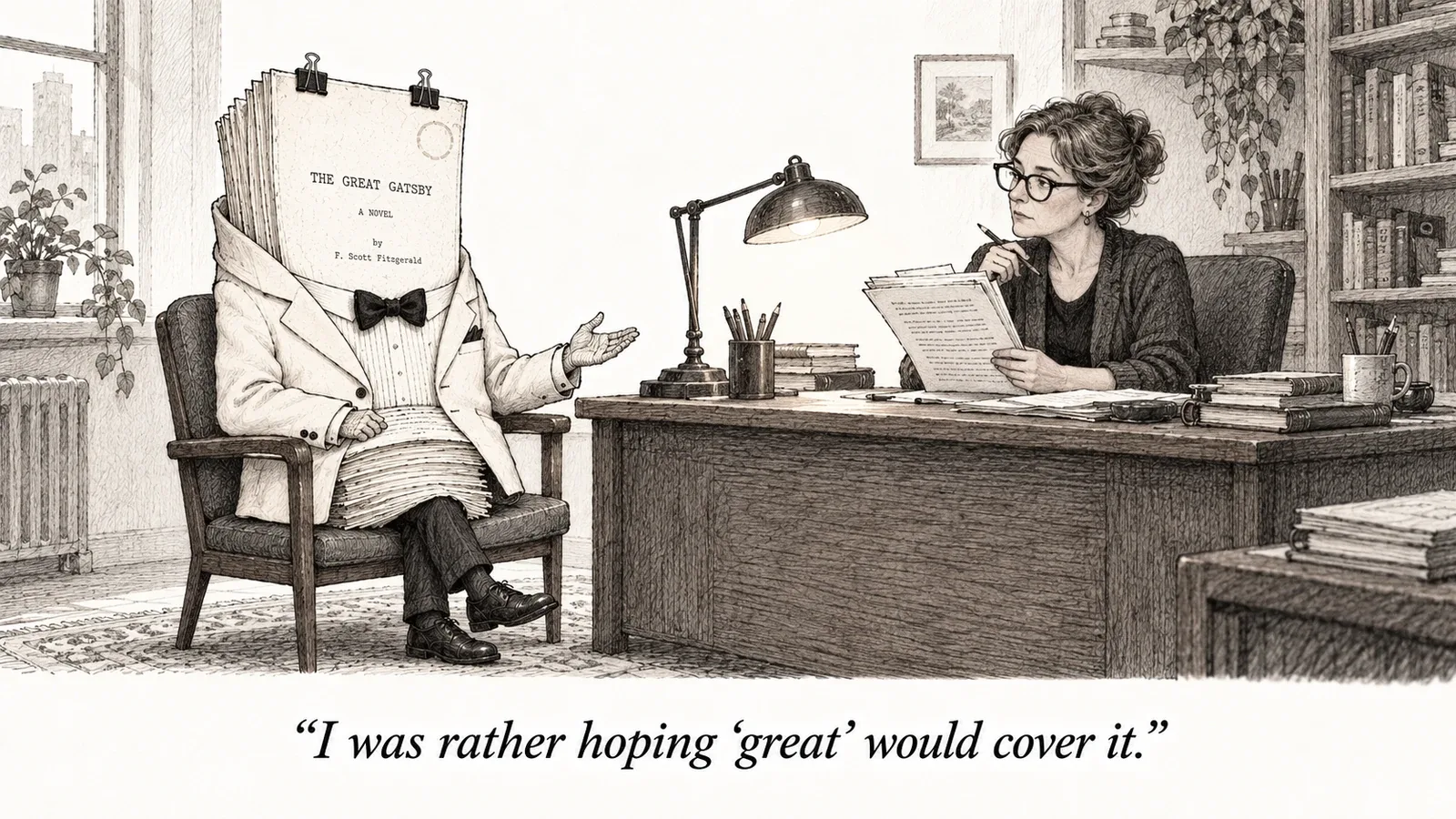
That makes it oddly difficult to know what you are buying. So here is a whole one, free and without an account: the complete Developmental Report Novel Maestro produced for The Great Gatsby. Thirty-three scenes, 266,000 characters, read start to finish, with nothing removed for the website.
Why Gatsby
Because you have read it, and that is the only way the example is worth anything.
A sample report on a stranger's unpublished manuscript proves nothing. You cannot tell whether the notes are shrewd or hollow, because you have no idea whether the book does what the report says it does. On a novel you know, every observation is checkable: you can decide for yourself whether the reading is right, which is the only test that matters.
It is also a fair test in the other direction. Gatsby is a finished, canonical novel, so a report that merely flattered it would be useless, and one that pretended it was broken would be absurd.
Notes on the craft
Occasional letters on what actually breaks novels — and how to fix them. Written for people revising a draft.
No fixed schedule. Unsubscribe in one click. Privacy Policy
The shape of the document
The report opens with a one-sentence verdict. On Gatsby: "Nick's retrospective voice carries a fully resolved tragedy to a devastating, earned close, with only mid-book pacing and one flat secondary arc left to sharpen."
Then the editorial letter, which on this book runs to about 3,000 words of continuous prose. It is the part that most resembles what a human editor sends: an argument about what kind of book this is reaching to be, and whether it gets there. It begins by naming the promise the opening makes — Nick's "extraordinary gift for hope" for his subject and "unaffected scorn" for everything around him — and treats that promise as the engine the rest of the novel has to run on.
After the letter come five sections, each a few hundred words: What's Working, Character and Relationships, Shape and Momentum, The World and What Holds Together, and Prose and Voice.
Then the structural apparatus, which is the part no letter can carry. Four revision priorities in the order they should be tackled. Three unresolved threads, each marked open or resolved. Two scenes whose purpose the reading could not establish. Six one-line verdicts from the diagnostic passes the letter did not cover. And a market positioning section: comparable titles, readership, length, submission readiness.
What a real note looks like
The useful thing about a report is not its structure but its specificity. Three of the risks it raises about Gatsby:
"The extended catalogue of Gatsby's party guests slows momentum noticeably just as the central mystery should be tightening."
"Nick remains almost entirely silent through the Plaza confrontation, which can read as reportage rather than the complicity his final judgement implies."
"Jordan Baker's dishonesty is named outright but never costs her anything on the page, leaving the carelessness theme's secondary echo incomplete."
That third note becomes a revision priority phrased as a task: give Jordan one visible moment of cost. Whether or not you agree, notice the shape of it. It is not "develop Jordan more". It identifies a theme the novel is arguing, finds the character who is carrying its secondary line, observes that she pays nothing, and proposes the smallest intervention that would close the gap. That is what a developmental note is supposed to do.
The strengths are reported with the same specificity, which matters more than it sounds — a report that cannot say precisely what is working cannot be trusted about what is not. On Gatsby: a dog leash bought on a whim early in the novel resurfaces as the clue that convinces Wilson of his wife's affair, a planted setup paid off two hundred pages later.
The part that makes it a report rather than praise
A developmental report has to be willing to say something a writer will not enjoy, and this one says that one of the most admired novels in English sags in the middle and has a flat secondary character.
You may think that is wrong. Plenty of readers would argue that the guest-list catalogue is doing deliberate work — that the tedium is the point, that a list of people who come to a dead man's parties and not his funeral is thematic rather than slack. That argument is available, and a writer who made it would be engaging with the report exactly as intended.
This is the part writers most need to understand before buying one. A developmental report is an informed reading, not a verdict. Its value is that it is specific enough to argue with. A report you cannot disagree with in detail has told you nothing in detail.
What is not in it
No rewriting. Not a sentence of the novel is altered or replaced, and none is offered back improved. Diagnosis rather than prescription is the tradition the document belongs to, and the repair stays with the author.
No line editing, no grammar, no copy-editing. The report measures prose — rhythm, the balance of long sentences against short, readability — and reports what it finds, but it does not touch a line.
And no decision about whether to publish. Submission readiness is assessed; the choice is not made.
How to read one about your own book
Three things, learned from watching writers do it.
Read the letter first, whole, without taking notes. The apparatus underneath it is organised by category, and reading it first turns a coherent argument about your novel into a list of complaints to be processed.
Then read the strengths twice, and resist the urge to skip them. They are not consolation. They are the part that tells you what must survive the revision, which is the single most common thing a writer destroys while fixing something else.
Then take exactly one priority and work only on that. A pass per question beats a sweep for everything. The priorities are ordered because the earlier ones change what the later ones mean: fix the first and the fourth may dissolve on its own.
Reading your own novel
The Gatsby report is the paid document, and it is on the site in full so that nobody has to take our word for what it contains. On your own manuscript, the reading of the whole book is free and returns Maestro's First Take — the strengths and soft spots, the one thing to fix first, and a concrete first move. The complete Developmental Report, the fourteen diagnostic passes, your beta readers' responses and the revision board are £59 once, for one novel, and do not expire.
One difference between the sample and the real thing is worth stating. In the report above, every quoted passage names the scene it came from, and on the public page those references are inert, because the manuscript they point at is Fitzgerald's rather than yours. In your own workspace each one opens the scene — which is the whole mechanism by which a structural claim becomes something you can check against your own page and reject if it is wrong.
One of these a week, give or take
If this was useful, the letters are more of it: one problem a novel runs into, what it looks like on the page, and what to do about it.
No fixed schedule. Unsubscribe in one click. Privacy Policy