Author intent vs. reader experience: Write down the book you think you wrote
You cannot reread your own novel the way a stranger does, because your intentions fill every gap. The fix is to write down the book you meant before you read the one you wrote.
Every finished novel exists in two versions. One is on the page. The other is in the writer's head, and it is always better. It has the scene you cut but still remember, the motivation you understood but never dramatised, the backstory that explains why the ending lands. When you reread your manuscript, the second version quietly fills every gap in the first.
The distance between author intent and reader experience is where almost every structural problem in a novel lives. It is also the one distance a writer cannot see unaided, and this post is about how to measure it anyway.
Why you cannot read your own book
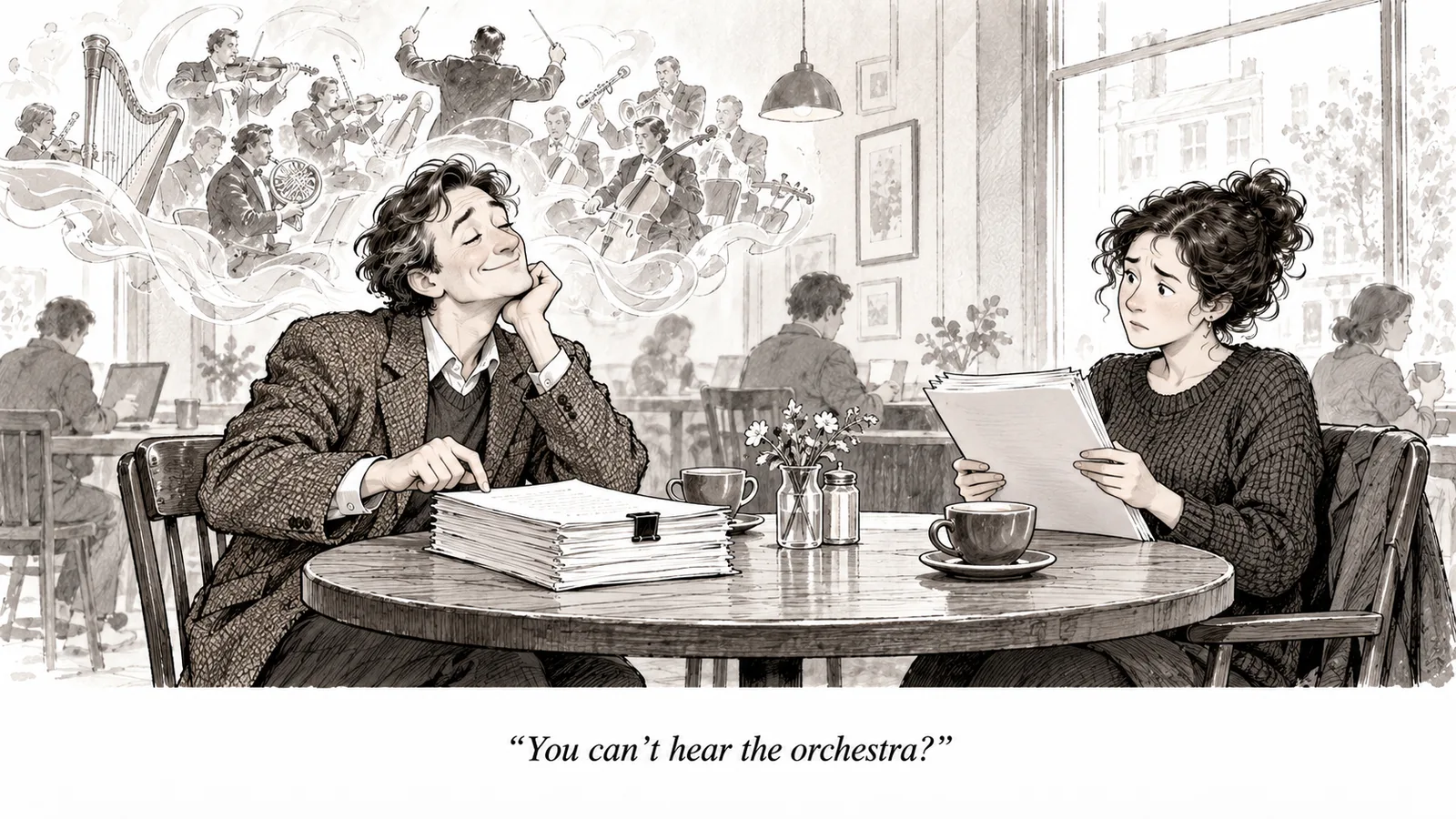
In 1990, a Stanford graduate student named Elizabeth Newton ran an experiment that has since become famous. She asked one group of people to tap out the rhythm of well-known songs on a table and another group to identify the songs from the tapping alone. Before starting, the tappers predicted that listeners would get about half of them right. The listeners got about one in forty.
The tappers were not bad at tapping. The problem was that they could hear the melody in their heads as they tapped, and they could not imagine what the tapping sounded like without it. Psychologists call this the curse of knowledge: once you know something, you lose the ability to perceive the situation of someone who does not.
A novelist rereading a manuscript is a tapper. You hear the melody. The reader hears knuckles on wood. That is why a chapter that moves you on the sixth reread can leave a stranger bored, and why you can read past a missing motivation twenty times without noticing it is missing. You are not failing to concentrate. You are unable to switch off what you know.
Notes on the craft
Occasional letters on what actually breaks novels — and how to fix them. Written for people revising a draft.
No fixed schedule. Unsubscribe in one click. Privacy Policy
The advice that doesn't reach the problem
Writers are usually offered two remedies for this, and both help less than they promise.
The first is distance: put the manuscript away for six weeks, or six months, and come back to it fresh. Time does erode your memory of the sentences, which start to look like someone else's. It does very little to erode your memory of what you meant. You will still know why Marianne stays, what the letter says and who the ending is for, and that knowledge will still fill the gaps.
The second is readers. Beta readers do not have the curse of knowledge, which makes them invaluable. But their reports are harder to use than they look. A useful principle, often quoted, holds that readers are almost always right when they tell you something is wrong and almost always wrong when they tell you how to fix it. That is true, and it leaves out something important. A reader's report is only a symptom relative to what you were trying to do.
Suppose a reader tells you she was confused throughout chapter three. If chapter three was meant to orient the reader, that is a problem. If it was meant to unsettle her, that is the book working. Feedback without a statement of intent is uninterpretable. You cannot tell a failure from a success until you have written down what success would look like.
The instrument: an intent statement
The fix is simple, and almost nobody does it. Before you reread your finished draft, write a one-page statement of the book you think you wrote. Then read the manuscript and measure the page against it.
The statement should be concrete and should describe the reader's experience, not your themes. "A book about grief and inheritance" is not an intent. It tells you nothing you could check. A useful intent statement answers five things.
The question. What does the reader wonder about, and from which chapter? Every novel runs on a central question, and it needs to be raised early and kept alive until near the end.
The want and the turn. What does the protagonist want, when does the reader learn it, and where does it change?
The ending. What gets answered, and how should the reader feel when it is? Name the feeling. "Satisfied" is too vague to be useful. "Relieved, then guilty about the relief" is something you can check.
The promise. What kind of book does a reader think they are holding after the first fifty pages? What shelf would a bookseller put it on?
The peaks. Name three or four moments where the reader's response should be strongest, whether that is fear, grief, laughter or recognition, and say which response belongs to which moment.
Write it quickly and do not revise it to sound better. Its value is that it records what you believe now, before the manuscript has a chance to argue with you.
The most common way to get this wrong is to write a blurb. A blurb is written to sell the book to someone who has not read it, so it describes the premise and hints at the stakes. An intent statement is written to test the book against someone who has, so it names chapters, feelings and turns. If your statement could go on the back cover, it is too vague to check anything against.
Reading against the statement
Then read the whole draft, and each time the page and the statement disagree, mark the place. Every divergence falls into one of two kinds, and the difference matters.
Sometimes the page falls short of the intention. The question you thought was raised in chapter two is not actually on the page until chapter five. The turn you planned for the midpoint happens in a paragraph of summary. These are repairs to the manuscript.
Sometimes the page is better than the intention. A minor character has become the moral centre of the book. The ending you planned no longer fits the book you actually wrote, and the one that does is already half-written in the final chapter. These are repairs to the statement.
The second kind is the one writers forget, and it is why this exercise is not about making the book obey a plan. Fitzgerald admitted to Maxwell Perkins that he had not himself known what Gatsby looked like or was engaged in, which is why the page could not show it. Drafts regularly know things their authors have not yet noticed, and they regularly fail to know things their authors assume are there. Intent vs. reality is a comparison, not a verdict, and sometimes reality wins.
A worked example: the Fernhill statement
Here is the intent statement the author of Fernhill wrote before rereading the first full draft. It is lightly condensed.
The question: Will Marianne save Fernhill from being sold? Raised in chapter two, when Gareth announces the Ashcombe offer.
Want and turn: Marianne wants to keep the house because it is the last place her father is. At the midpoint she finds his letter and learns he meant to sell it himself. From there she wants something else: to understand why.
Ending: The house is sold. The reader should feel loss, and then a kind of release.
Promise: A quiet literary family novel. The shelf is somewhere between Anne Tyler and Elizabeth Strout.
Peaks: Grief at the funeral in chapter one. Shock at the letter in chapter thirteen. Release at the final orchard scene.
Read against the draft, the statement produced three divergences.
The first was about the question. The book's actual question is not whether Marianne will save Fernhill, because Marianne does not try to save anything until chapter fourteen. For thirteen chapters she remembers and resists. The question a reader actually holds is whether Gareth will sell, which makes Gareth, not Marianne, the engine of the first half. The page falls short, and the fix is in the manuscript: Marianne needs to act, early.
The second was about the letter. Its contents are foreshadowed so heavily in chapter six, where Ray mentions the estate agent's visit the previous spring, that a reader arrives at chapter thirteen already knowing. The planned shock lands as confirmation. The page falls short again, and the fix is to move or cut Ray's line.
The third went the other way. The statement does not mention Ray at all, yet read cold, the draft's strongest moments cluster around him: the unpaid years in the orchard, the ladder against the old Cox, his silence at the funeral. He has become the book's conscience without the author deciding it. This time the page is better, and the statement needs rewriting, with implications for the ending. A novel whose moral centre is a man who worked the land for nothing cannot end with the sale treated purely as release.
None of these three findings would have come from rereading alone. The first two are exactly the gaps the author's knowledge filled, and the third was invisible because the author had not intended it.
Doing it yourself
Write your intent statement before you open the manuscript. Date it, and send it to yourself or seal it somewhere you will not be tempted to edit it.
Read the whole draft as quickly as you can, and mark divergences in the margin with two symbols: one for "page falls short" and one for "page is better". At the end, count them. A draft with many shortfalls needs structural revision. A draft with several "page is better" marks needs you to rethink what the book is before you revise anything.
Then try the reverse exercise with your readers. Give your beta readers no statement at all. After they finish, ask each of them to write one paragraph describing the book: its question, who it belongs to, how it ends and how it felt. Lay their paragraphs beside yours. Wherever their descriptions agree with each other and disagree with yours, you have found the book you actually wrote.
The fourth post in this series looks at the read itself: how to go through your own manuscript fast, as a reader, recording only what you feel.
Where Novel Maestro fits
Novel Maestro is built around the comparison this post describes, which we call Intent vs. Reality. The writer states what the book is meant to be — its premise, its cast, its theme, the promise it makes — and Novel Maestro reads the complete manuscript and reports what the book is actually doing, with the evidence for each finding attached. It supplies the stranger's reading. The intentions stay with the author, and so does the prose: it does not rewrite.
If you have a finished draft and want to see what a stranger's reading of it looks like, Maestro's First Take is a free reading of your complete manuscript. It is not a sample chapter or an opening-pages teaser.
This is the third post in "Over the Editor's Shoulder", a series on what developmental editors do and how to do it for your own novel. The second looked at what happened when Gordon Lish rewrote Raymond Carver.
One of these a week, give or take
If this was useful, the letters are more of it: one problem a novel runs into, what it looks like on the page, and what to do about it.
No fixed schedule. Unsubscribe in one click. Privacy Policy