
Your novel is finished. You know it isn't right yet.
Novel Maestro reads novel drafts from start to finish and tells you, specifically, how to make them the best they can be.
We're giving writers unlimited access to the whole product free for a month, on their own book. All we ask for in return is a little feedback.
This page explains what it does, why we're giving it away, and what that feedback involves.
Two minutes on what this actually is.
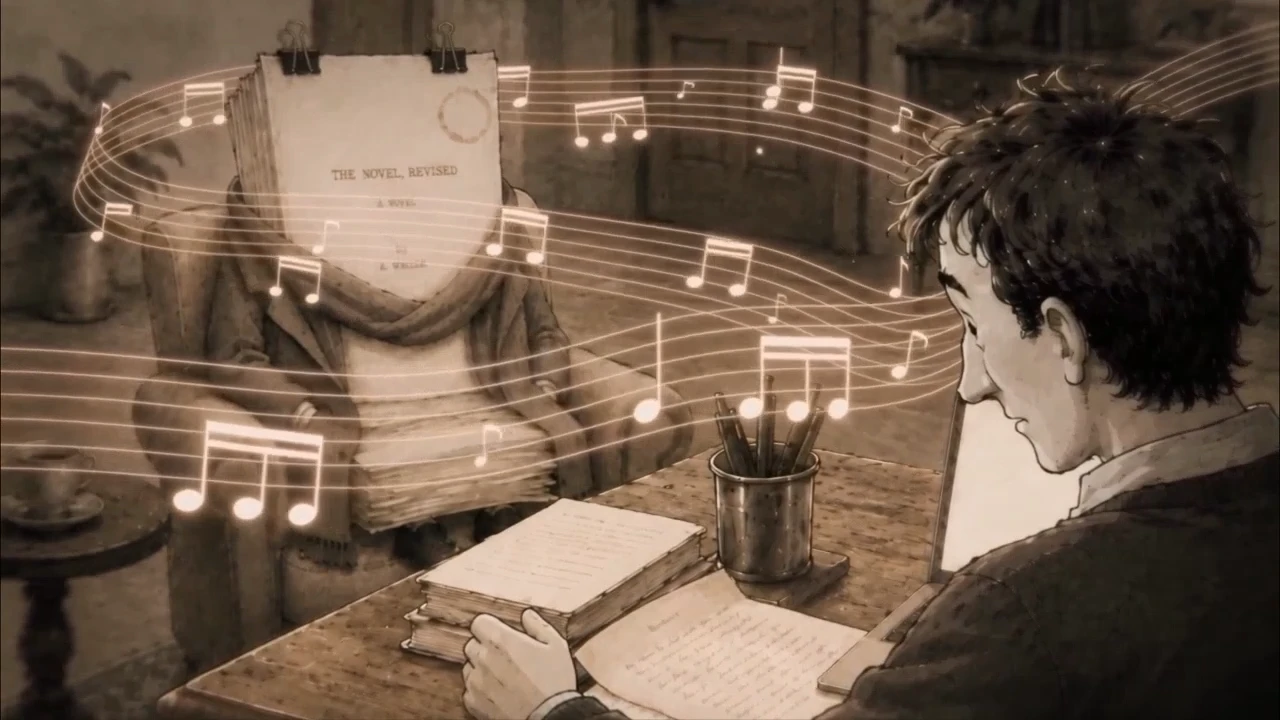
A short film about a finished manuscript stuck in a drawer, and what happens when it finally gets the editorial attention it deserves.
Read the transcript
Once there was a Manuscript. His writer had finished him — more or less. And like manuscripts everywhere, he dreamed of being a book. Of finding his way into the hands of strangers.
Of course, his family loved him. But somehow, other readers didn't quite get him. Something wasn't quite working.
His pacing dragged. His tone wavered. Sometimes the different parts seemed to be playing in different keys. And after reading him a hundred times, his writer could no longer see why.
So into the drawer he went.
But one person never stopped believing in him. Novel Maestro read the manuscript as a whole — not just the words, but the music underneath them.
Every character arc. Every turn. Every thread. The passages that sang. The places where the rhythm faltered. The promises that paid off — and the ones that didn't.
Then it showed his writer what to fix — and how. So instead of guessing, he started rewriting. One problem. One scene. One change at a time.
And whenever the Manuscript changed, Novel Maestro read him again. So they kept going. Reading. Rewriting. Refining. Until he became the best novel he could be.
And he didn't just make it into the hands of strangers. They couldn't put him down.
Novel Maestro. Because every manuscript deserves a good edit.
No, it doesn't write your novel.
Not a sentence. Not a paragraph. Not a suggested rewrite of your opening line.
Novel Maestro is a diagnostic tool, not a ghostwriter. It reads what you've written and tells you what it finds — the way a developmental editor would, if a developmental editor could hold all 90,000 words in their head at once and had a fortnight to think about them.
Every word of your novel stays yours, written by you.
If you were looking for something to generate prose, this isn't it, and we'd rather you knew now.
Here's a real note Novel Maestro produced while reading The Great Gatsby.
You can check it against the book.
This will be pinned to your Tasks board — a place to track every step of your revision.
That's the register. A specific scene, a specific diagnosis, a specific instruction — and a clear statement of what not to touch.
It reads the whole book at once.
When you've lived with a manuscript for months or years, it gets hard to see clearly.
- You know something drags, but not where it starts.
- A character isn't landing.
- A subplot feels unnecessary.
- An ending that should hit hard somehow doesn't.
- Or you simply know the book could be better, and reading it again isn't helping.
Novel Maestro reads your complete manuscript as a single work — characters, scenes, storylines, structure, pacing, tension, point of view, setups and payoffs, and the connections between them.
It runs around 175 analytical passes, drawing on more than 1,400 principles of storytelling craft across 106 genres.
Then it brings that work together into a developmental assessment of the book you actually wrote. Every major finding is tied back to passages in your own manuscript, so you can see exactly what it's responding to.
The first read takes about ten minutes.
It tells you what's working, what's getting in the way, where the novel is strongest, where readers may lose interest, which problems matter most — and what to tackle first.
The point isn't to hand you three hundred observations and wish you luck. It's to answer a more useful question: what should I work on next?
The read is the beginning, not the product.
Your manuscript is divided into scenes, each with its own analysis.
You can go deeper on character arcs, tension, pacing, point of view, structure and narrative obligations.
You get an ordered revision plan, with tasks linked directly to the passages they concern.
You can ask Maestro about a specific problem, challenge an assumption, or think through possible solutions.
And when you've made substantial changes, Novel Maestro reads the whole novel again — so you can see whether the fix worked.
Instead of editing blind: one problem, one scene, one change at a time.
A tour of the actual product.
If you want to see exactly what you're applying for, this video covers ten things that happen when you upload your manuscript to Novel Maestro.
Read the transcript
What happens when you upload your novel to Novel Maestro?
For starters, it reads the entire book — studying its characters, scenes, storylines, structure, setups and payoffs across scores of analytical passes.
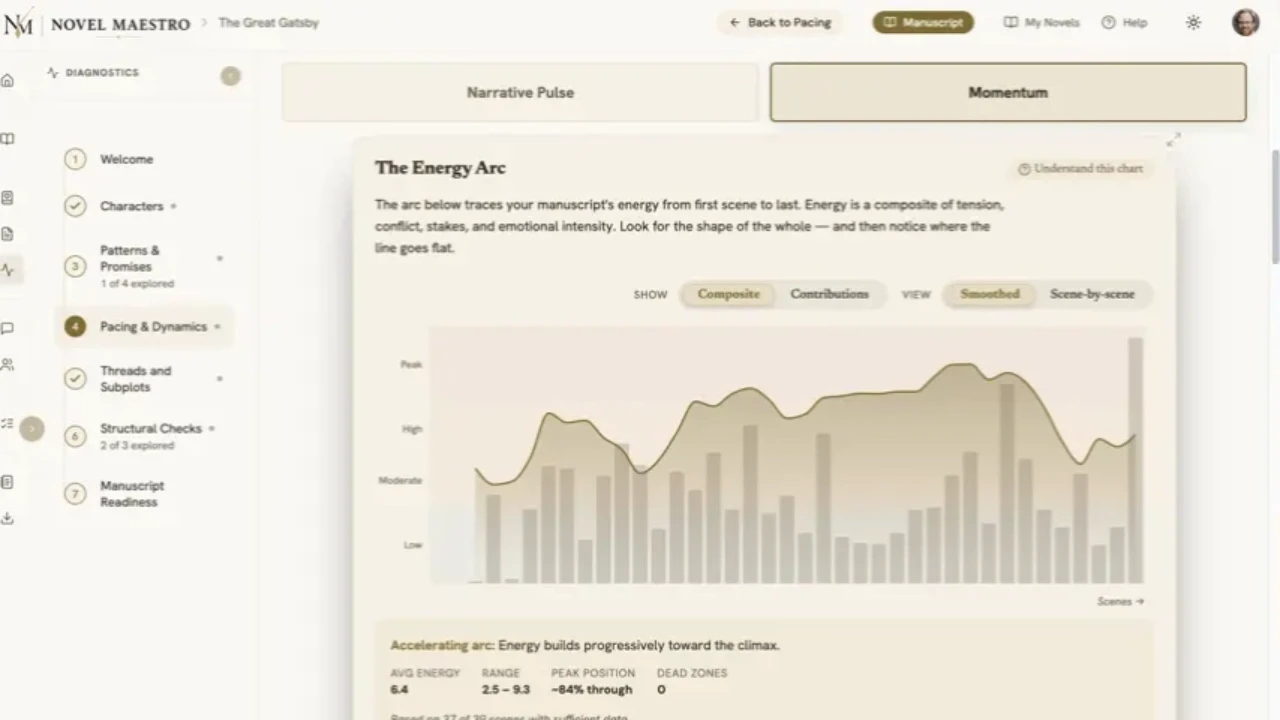
It assesses the manuscript against more than 1,400 rules of storytelling craft and over 100 genres. And it measures every scene for conflict, tension, stakes and many other indicators.
Next, it turns your manuscript into a smart workspace, divided into scenes, each with its own Scene Intelligence.
Look beneath the surface of the action to see the anatomy of each scene, the undercurrents driving the narrative, and the inner lives of your characters — their wants, needs, wounds, flaws and more.
You can also access revision tasks pinned directly to the passages they relate to.
Maestro’s First Take gives you the big picture across your entire novel: what’s working, what isn’t, and the single issue most worth your attention.
This free review reflects back key insights — from your novel’s genre and voice to the central question at the heart of your story.
And if something doesn’t read as you intended, just say so. Novel Maestro will recalibrate its thinking.
The Developmental Report goes deeper: a detailed editorial assessment of the kind a professional developmental editor might charge thousands for, together with a clear roadmap for the rewrite ahead.
Fourteen deep diagnostics let you investigate your novel from almost every developmental angle — from character arcs and subplots to narrative pulses and momentum.
Each diagnostic comes with detailed analysis and practical revision ideas.
Ask Maestro about any problem to diagnose it, challenge it, explore alternatives or strengthen what’s already there.
You can ask about anything from a single character or scene to the entire story.
Turn any feedback into a revision task, with the original finding, recommendation and relevant passage attached.
Organise your tasks on the Revision Board, then click straight through to the passage in question and edit your manuscript with your notes at your fingertips.
Beta Readers show you how different kinds of readers may actually experience your novel, with detailed feedback on what works, what doesn’t and where they may struggle.
And as the manuscript changes, Novel Maestro can read it again — so the feedback evolves with the book.
Finally, when you’re ready, export your manuscript along with publishing assets such as a blurb and synopsis, and take your next draft wherever you want.
One manuscript. A whole new way to rewrite it.
Most novels never get a developmental edit at all.
Not because writers don't want one. Because of the arithmetic.
A freelance developmental edit runs at roughly 3 to 3.5 cents a word in the US. On a 90,000-word manuscript that's somewhere between $2,700 and $3,150. The Editorial Freelancers Association's published range for developmental work is $52.50 to $70 an hour, and reading a novel properly takes a very long time.
Those are fair rates. Developmental editing is slow, difficult, unglamorous work, and the good ones are worth every penny.
They are also more than most novels will ever earn back.
So the majority of manuscripts get read by a partner, a writing group, and the writer's own exhausted eyes — and are then submitted, or shelved.
Novel Maestro is not a replacement for a good editor. It has no taste. It has never sold a book. It cannot tell you what publishers will want in eighteen months.
What it can do is give you a rigorous structural read of the entire novel for $199 — or, if we take you on as a beta tester, for nothing at all for a month.
And for that month there are no limits on it. Not one manuscript — as many as you like, read as often as you like. If you have three drafts sitting in a drawer, put all three through.
When the month ends, $69 buys one of them outright — chosen by you, and yours for good. The others would go back to the usual $199 each. So the month is worth using to find out which book deserves it.
If you were never going to hire an editor, that's the difference between a diagnosis and a guess.
And if you are going to hire one, turning up with the obvious structural problems already fixed is the cheapest decision you'll ever make. Editors charge by the hour.
Because published novels are useless to us.
We've read a great many of them through Novel Maestro — classics, contemporary fiction, genre bestsellers, anything we could get our hands on. That's where the Gatsby note above came from.
They're useful up to a point. They also share one fatal flaw as test material: somebody already fixed them.
Editors got to them. Agents got to them. The writer went through eleven drafts and quietly cut the subplot that wasn't earning its place.
The manuscript we actually need is the one nobody has fixed yet.
- Where the middle sags and the writer knows it but can't say why.
- Where a character is doing three jobs and none of them well.
- Where the ending arrives at about seventy per cent of the force it should have.
There is no way to buy that. Nobody sells unfinished novels.
We can only ask — and offer something worth having in exchange.
You get a month of serious help with your book. We find out what our product does when it meets real manuscripts instead of finished ones.
Your book stays your book.
Your manuscript is processed so Novel Maestro can analyse it and produce your editorial feedback. That is the only thing it is used for.
Your manuscript is never used to train AI models.
We will not publish it. We will not claim any ownership of it. We will not use your name, your review or your comments publicly without asking you first.
The complete product, for a month.
- A whole-manuscript read — your novel analysed as a single work, not chapter by chapter in isolation.
- A full Developmental Report — an editorial assessment of the manuscript, its strengths, its biggest risks, and where to focus.
- Every deep diagnostic — all 14 of them, for examining specific aspects of the novel in much greater detail.
- Scene Intelligence — what each scene is doing, what's driving it, and where it may be falling short.
- An ordered revision plan — so you know which problems deserve attention first.
- Ask Maestro — put a question to your editor and test an idea before you commit to it.
- Unlimited whole-manuscript reads — most writers use two or three. We'd rather you had room without worrying about a counter.
Use it. Then tell us the truth.
No calls. No check-ins. No weekly meetings. Three things only.
We're not asking you to like Novel Maestro. We're asking whether it understands your novel.
- If it misunderstands the book, say so. That may be the single most useful thing you can tell us.
- If it identifies a problem you already knew about, tell us.
- If it sends you down the wrong path, tell us.
- If it produces a beautiful analysis that turns out to be no use at all, tell us.
And if you upload your manuscript, read the verdict and feel absolutely nothing — please tell us that too.
A product that only hears from people who liked it can go wrong for a very long time without knowing why.
Novel Maestro exists to give writers an honest read. It would be strange to ask you for anything less in return.
This works if:
- You have a complete or nearly complete novel manuscript.
- You've reached the point where another read-through by yourself isn't enough.
- You suspect something isn't working, even if you can't quite name it.
- You have time to spend on the book over the next month.
- You're willing to hear criticism of the manuscript.
- You're willing to tell us when Novel Maestro gets something wrong.
This isn't for you if:
- You're still writing the first half. Novel Maestro is built around understanding complete manuscripts.
- You want something to write or rewrite your prose. It won't.
- You mainly need spelling, grammar or proofreading help. That's not what this does.
- You simply don't want to think about the novel right now. Entirely reasonable — a free month of editing software isn't a gift if all it does is sit there making you feel guilty.
Your manuscript doesn't need to be polished, professionally edited, or ready to submit. It needs to exist as a substantially complete novel.
We especially want the unusual ones.
Novel Maestro's reference framework spans 106 genres across 8 genre families.
So yes: crime, romance, literary fiction, fantasy, historical, science fiction.
But also hybrids. Oddities. Books that don't sit neatly on a shelf.
Unusual structures. Multiple timelines. Big casts. Tiny casts. Quiet novels. Very long novels.
The corners are the most useful part of the map, and we want as much variety as we can get.
It's a small operation.
Novel Maestro is built by a small, nimble team with decades of editorial experience between them, and a long time spent thinking about why manuscripts fail in ways their writers can feel but can't locate.
We read every piece of feedback that comes in, because at this stage there aren't enough of us for anyone to hide behind.
Got a novel in the drawer?
Tell us a little about it. It takes about a minute.