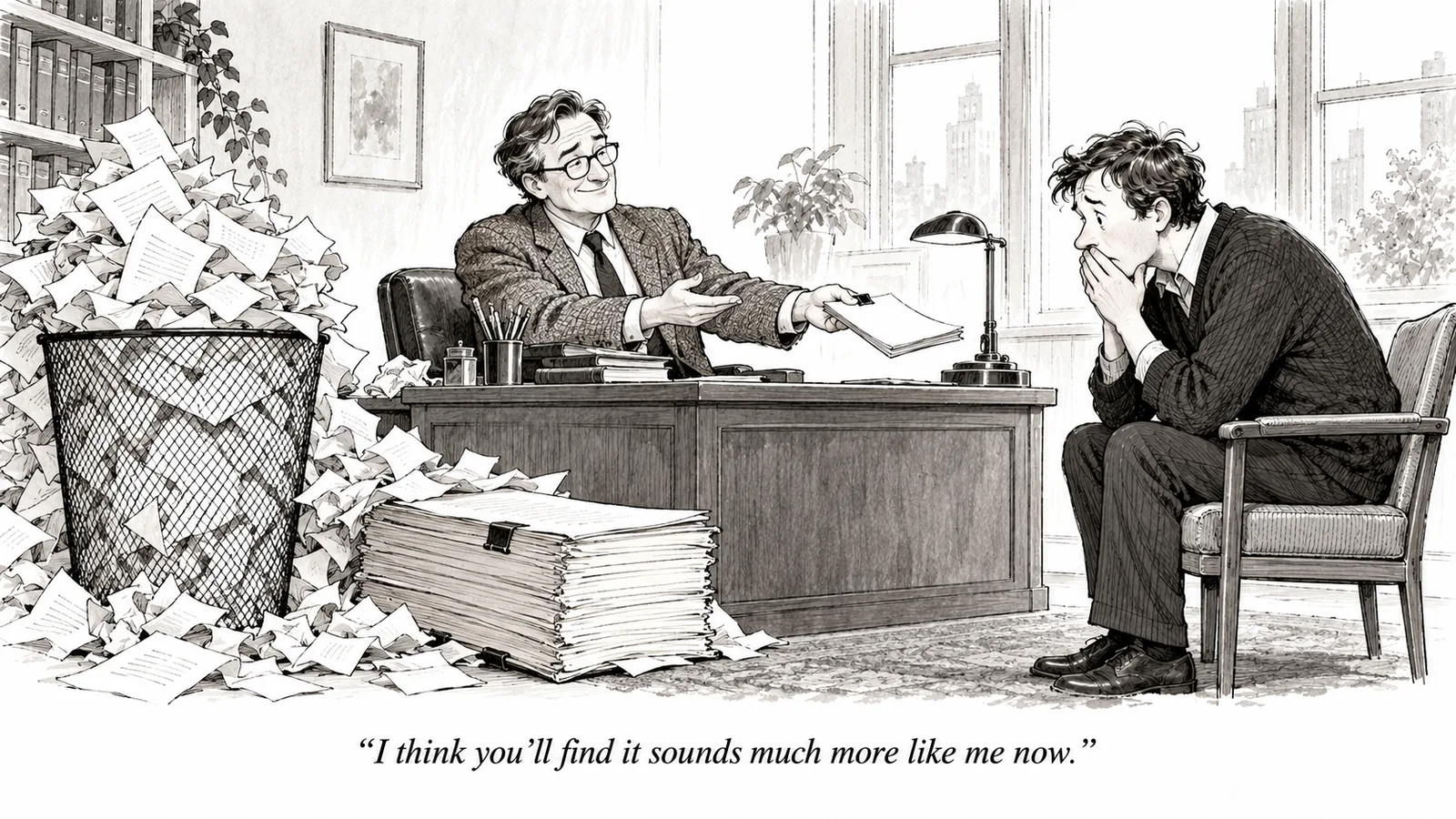
Gordon Lish wasn't editing Raymond Carver. He was rewriting him.
Gordon Lish's cuts made Raymond Carver famous and nearly broke him. What the Lish–Carver case teaches novelists about the line between developmental editing and rewriting.
On 8 July 1980, Raymond Carver wrote to his editor at Knopf and begged him to stop production of his next book. The editor was Gordon Lish. The book was the collection that would appear the following year as What We Talk About When We Talk About Love, the book that made Carver's reputation. Carver had just seen what Lish had done to it.
The story of Gordon Lish and Raymond Carver is usually told as a literary scandal or as a vindication of a brilliant editor, depending on who is telling it. For a novelist with a finished draft, it is something more useful. It is the clearest case on record of the line between developmental editing and rewriting, and of what happens to a writer's book when that line is crossed.
What Lish did
Lish had been cutting Carver's work since he became fiction editor at Esquire in 1969. Carver accepted it. Other writers did not. Don DeLillo pulled a planned excerpt of Great Jones Street from the magazine in September 1972 rather than accept Lish's expurgations.
By the time Carver submitted the manuscript he called Beginners, the editing had become something else. Lish cut the collection roughly in half. The most heavily edited stories lost close to eighty per cent of their text. He rewrote endings, changed characters' names — Herb became Mel, Carl became Ed — and gave stories new titles, often more oblique ones. "The Fling" became "Sacks". The title story, "Beginners", became "What We Talk About When We Talk About Love".
Carver's letter did not stop the book. It was published in 1981, acclaimed as a landmark of American minimalism, and fixed Carver's reputation as the master of the bare, bleak, elliptical short story. Carver later complained, in a phrase that has stuck, of a kind of "surgical amputation and transplant" performed on his work.
In 2009, after a long campaign by Carver's widow, Tess Gallagher, the original manuscript was published as Beginners, and the Library of America printed both versions in Carver's Collected Stories. Anyone can now compare them.
Notes on the craft
Occasional letters on what actually breaks novels — and how to fix them. Written for people revising a draft.
No fixed schedule. Unsubscribe in one click. Privacy Policy
The story that shows the difference
The single most instructive comparison is one story in two versions.
In Carver's manuscript, a boy is hit by a car on his birthday. His parents keep vigil at the hospital while a baker, who has not been paid for the birthday cake they ordered, keeps phoning the house with menacing calls. The boy dies. The parents drive to the bakery in the night to confront the man. He listens, apologises, and sits them down to eat warm bread with him. The story ends in grief shared with a stranger, and something close to consolation.
Lish's version, published as "The Bath", is a fraction of the length. It ends before the boy's fate is known, with the mother home from the hospital and the phone ringing. There is no bakery, no apology, and no bread. What was a story about consolation became a story about dread.
Carver restored his version and published it in his next collection, Cathedral (1983), under the title "A Small, Good Thing". It is one of his most admired stories. Reviewing Beginners in 2009, Blake Morrison concluded that the true Carver is "gentler, fleshier, less brutal" than Lish's Carver.
The case for Lish
It would be dishonest to present this as a simple case of a vandal and a victim. Many serious readers prefer the Lish versions. When Beginners appeared, several critics argued that it made the case for Lish rather than against him: the originals were longer, looser and more sentimental, and the edited stories were the ones that changed American fiction. Lish has made the argument himself, and without much hedging. "Had I not revised Carver, would he be paid the attention given him?" he asked an interviewer in 2015. "Readers were seduced, and, I'm sorry, but it was my intervention that seduced them." Nobody can settle that question, and it may be that the minimalist Carver the world knows is, in a real sense, a collaboration.
The argument of this post does not depend on the Lish versions being worse. It depends on something else.
Better is the wrong question
When an editor rewrites a story, the question that matters is not whether the new version is better. It is whose story it now is.
"The Bath" may be a finer piece of prose than the story Carver wrote. It is also a different story, with a different meaning, reached through a different sensibility. Lish's instinct ran towards bleakness and omission. Carver's, at least by 1980, was moving towards the possibility of consolation, which is exactly where Cathedral went. The rewrite did not fix Carver's story. It replaced his intention with Lish's.
That is the line. A developmental editor works on the gap between what the writer intended and what the page delivers. A rewriter closes the gap by changing the intention.
In practice, editorial help falls somewhere along a spectrum with three distinct positions.
Diagnosis names a problem the reader will experience, explains what in the manuscript produces it, and leaves the solution to the author.
Suggestion adds one or more possible remedies, clearly marked as options, as Maxwell Perkins did when he proposed revealing Gatsby's past in instalments.
Substitution hands back the text already rewritten.
Substitution is seductive because it is efficient, and because the rewritten version is often, sentence by sentence, better. But every rewritten sentence carries the rewriter's idea of what the book is for. Accept enough of them and you have a polished manuscript that is no longer yours.
The temptation is strongest at exactly the point where a novelist is most likely to seek help. A finished draft represents years of work. By the end of it, most writers are tired of their own sentences and uncertain about their own judgement, and a confident rewrite feels like relief. Carver was in a version of that position in 1980: not yet established, dependent on an editor who had championed him, and grateful for the attention. His letter is remarkable precisely because it cost him something to write. Most writers in that position simply accept the changes, and some of them spend years afterwards trying to find their way back to the book they meant.
A worked example: one scene, three responses
Here is the end of chapter nine of Fernhill, a novel of about 94,000 words in twenty-six chapters. Marianne and her brother Gareth have spent eight chapters fighting over whether to sell the family house to Ashcombe Homes.
Gareth came out at dusk with two mugs of tea and stood beside her at the end of the Bramley row without saying anything. After a while he handed her one. It was too sweet; he had always made it too sweet, and she had never told him. "I rang Ashcombe again," he said. "I told them we need until the spring." She looked at him. He was watching the trees, and she saw that he was counting them, the way their father used to, and something in her chest that had been clenched since the funeral let go. "The spring," she said. "All right." They stood there until the tea was cold, and neither of them went in.
A reader might feel that something is wrong here, even in a scene this well made. Here is a rewrite in the Lish manner:
Gareth came out with tea. It was too sweet.
"I rang Ashcombe," he said.
She did not ask what he had told them.
He was counting the trees.
She poured the tea out on the grass.
It is sharper. It is colder, more menacing, arguably more "literary". It has also changed the meaning of the scene entirely. A reconciliation has become an estrangement, and with it the whole arc of the novel.
Here is the developmental note:
This scene resolves the central conflict between Marianne and Gareth in chapter nine of twenty-six. From this point the sale is deferred and the siblings are allies, which means the question the book raised in chapter two has effectively been answered with more than half the manuscript still to go. Readers are likely to feel tension drain out of the middle third.
The reconciliation itself is one of the strongest passages in the draft. The problem is its position, not its content.
What would Marianne and Gareth have to go through before this moment is earned? And where in the book does that happen?
Both the rewrite and the note respond to the same real problem. The book's tension collapses in chapter nine. The rewrite solves it by deleting the reconciliation and substituting a different book. The note solves nothing. It identifies the mechanism and hands back a question, and the likely answer is that this scene, almost untouched, belongs in chapter twenty-two.
The rewrite would have produced a better chapter nine and a worse version of the author's novel. The diagnosis keeps the author's intention and repairs the structure around it.
Doing it yourself
Most writers never meet a Gordon Lish, but they meet his method constantly. It arrives as workshop feedback that rewrites your paragraph "to show what I mean", as a tracked-changes pass from a well-meaning friend, and as any tool that hands your prose back improved. The rewritten sentences are often good. That is the danger.
When feedback arrives as substituted text, translate it back into diagnosis before you do anything with it. For each rewritten passage, set the two versions side by side and ask three questions. What symptom was the rewriter responding to? What in your version produced it? And does the rewrite solve that problem, or does it change what the passage means?
You will often find that the rewriter was right about the symptom and wrong about the meaning. That is the pattern of the Lish–Carver case in miniature, and of the Fernhill example above: the reader's discomfort was real, and the remedy changed the book. Occasionally you will find that the rewrite does preserve your meaning and simply expresses it better. Then the honest thing is to learn what it did, rather than to paste it in.
Keep the symptom. Discard the rewrite. Then write your own repair, in your own voice, for the book you meant to write.
This exercise depends on knowing what you meant, which is harder than it sounds. The third post in this series deals with that directly, by asking you to write down the book you think you wrote before you reread it.
Where Novel Maestro fits
Novel Maestro is a diagnostic instrument. It reads a complete manuscript and reports what the book does to a reader, set against what the writer set out to do — the comparison we call Intent vs. Reality. It does not write or rewrite prose. The Lish-Carver case is the reason: the gap between intention and page can be diagnosed from outside, but it can only be closed by the author.
If you have a finished draft and want to see where the intention and the page have diverged, Maestro's First Take is a free reading of your complete manuscript. It is not a sample chapter or an opening-pages teaser.
This is the second post in "Over the Editor's Shoulder", a series on what developmental editors do and how to do it for your own novel. The first asked what a developmental editor actually does.
One of these a week, give or take
If this was useful, the letters are more of it: one problem a novel runs into, what it looks like on the page, and what to do about it.
No fixed schedule. Unsubscribe in one click. Privacy Policy