Revision in passes, not in panic
Revision feels impossible because you are asking one brain to fix structure, character, pacing and prose at once. The cure is passes — and a test for knowing when to stop.
There is a particular kind of exhaustion that comes from revising a novel, and it is not the exhaustion of hard work. It is the exhaustion of a job with no edges.
You open chapter one meaning to fix the structure. Four hours later you have rewritten a paragraph six times, cut a line of dialogue you liked, added a comma, taken it out, and looked at the same page for so long that it has stopped meaning anything. The structure is exactly as it was. Tomorrow you will do it again.
You cannot hold five questions at once
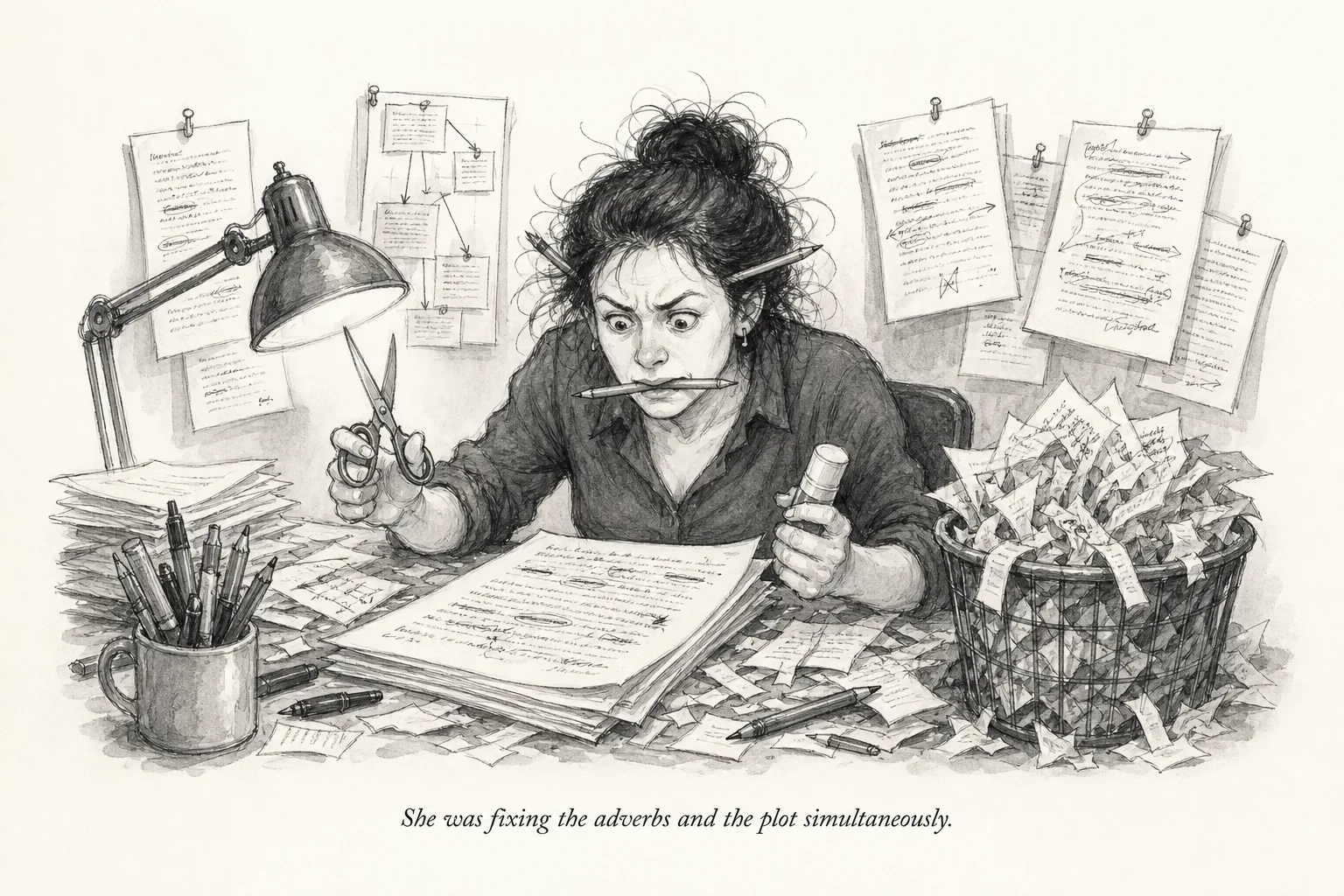
Most writers revise by reading start to finish and fixing whatever catches the eye. It is the obvious method, and it is why revision feels impossible: you are asking one brain to hold structure, character, pacing, dialogue and prose simultaneously, over four hundred pages, for weeks. Nobody can do that. What actually happens is that attention collapses to the smallest available problem, which is always the sentence in front of you.
The alternative is a pass: one full read of the whole manuscript asking one question only. A character pass follows a single arc from the first page to the last and notices, because it is looking for nothing else, that the protagonist vanishes for sixty pages in the middle. A dialogue pass reads spoken lines with the surrounding prose stripped away and hears that two characters share a vocabulary. Neither of those findings can be reached from inside a sentence-level read, however careful.
The discipline is the difficult part, and it is the whole method: do not fix what you are not currently looking for. Take notes. Move on. A pass that stops to repair things is a fix-everything read wearing a lanyard.
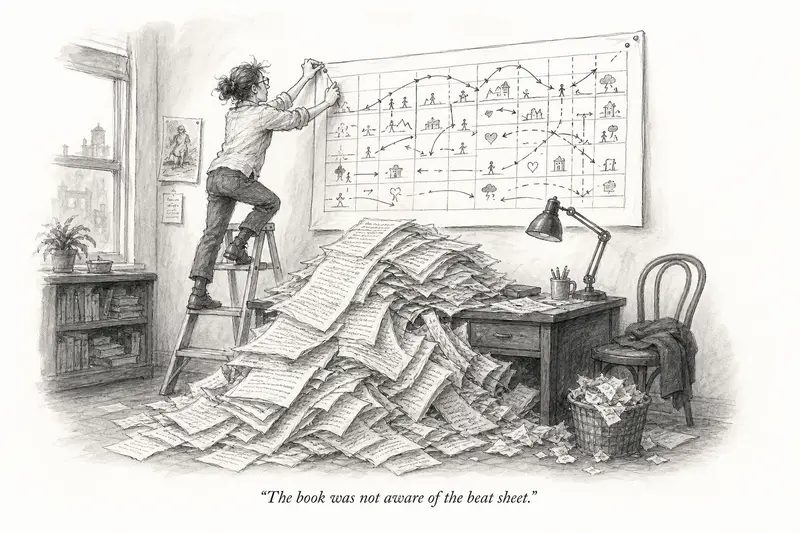
A workable order runs from largest to smallest — structure, then character, then pacing, then scene, then dialogue, then line — for the simple reason that a beautifully polished chapter is easier to delete when it has not yet been polished.
Why the panic version feels productive
Because it produces visible change on every page you touch, and structural work produces none for days.
It also lets you stay in the layer you are best at. Almost every writer has a comfortable pass — usually prose, sometimes dialogue — and returns to it repeatedly while the pacing problem sits untouched at the bottom of the list, growing. If you cannot remember the last time you did a structural read, that is not an oversight. It is the pattern.
And underneath all of it is the difficulty this series keeps coming back to: you cannot read your own book cold. Fixing sentences is at least a job you can definitely do. Judging whether the middle third earns its length is a job that requires a reader you do not have.
How to run a pass by hand
Name the question before you open the file, and write it at the top of a blank page: Where does the protagonist decide something? Nothing else counts during that read.
Read with a pen and a single-column list. One line per chapter, in the manuscript's order. No fixing.
Then — and this is the part that repays the discipline — read the list rather than the manuscript. Patterns only exist at list scale. Six chapters in which your protagonist reacts and never chooses is a finding. The same six chapters read individually are six perfectly reasonable chapters.
Then fix, in a separate sitting, working from the list.
One useful piece of self-diagnosis before you start: name the pass you have been avoiding, and do that one next.
Knowing when to stop
The other half of the problem is the one nobody teaches, because it sounds like a feeling: how do you know when the book is done?
It is not a feeling, and it is certainly not the absence of things you could still change. A novel is finished when the questions it leaves open are the ones you chose to leave open.
That test has a practical form. List every question your ending leaves unanswered — plot, relationship, motive, thread. Beside each one write either chosen, with the reason a reader benefits from the openness, or unresolved. If you cannot state the reader's benefit in a single sentence without describing how hard the scene was to write, it is unresolved. Deliberate ambiguity and an abandoned thread look identical on the page and feel entirely different to read: the first is confident, the second reads as a manuscript that ran out of road.
Two failure patterns bracket the ending. The merciful ending declines to state an outcome — does the marriage survive, does she forgive him — and calls it ambiguity, when the evidence on the page runs three to nothing in one direction and the reader simply wants it said. The answered question nobody asked is the opposite: every motif and minor character tied off in the last chapters, including several that carried no weight, leaving the ending airless.
And then the honest one: the deadline close. Revision stops because a submission window opened or because you could not face another pass. That is a legitimate reason to stop working. It is not the same as being finished, and it is worth knowing which one has happened.
Where the book shows you this
Manuscript Readiness is the capstone built for exactly this moment. It reads for the things a book cannot be finished with: unresolved threads, forgotten characters, broken promises, dangling setups and missing payoffs — each one graded critical, moderate or minor, pointed at the scene it belongs to, and paired with a suggested repair. It ends on a plain verdict: ready, nearly ready, needs work, or not ready.
Beside that sits a plainer checklist that answers the questions writers lose track of during a long revision: where the word count stands against your target, how many revision tasks are still open, how many continuity flags remain, and — the one people forget — whether your last full read is still current or whether you have edited so many scenes since that it is describing a book that no longer exists.
You can see the shape of that kind of assessment before you own an account: the sample report is a full developmental read of a finished novel, written up the way yours would be.
What no tool can do is decide that you are done. That verdict is yours, and it should be — but it is a decision worth taking with the list in front of you rather than at eleven o'clock at night, in the state of mind that produces both premature submissions and eighth drafts.
Notes on the craft
Occasional letters on what actually breaks novels — and how to fix them.
No fixed schedule. Unsubscribe in one click. Privacy Policy