Stakes are not danger
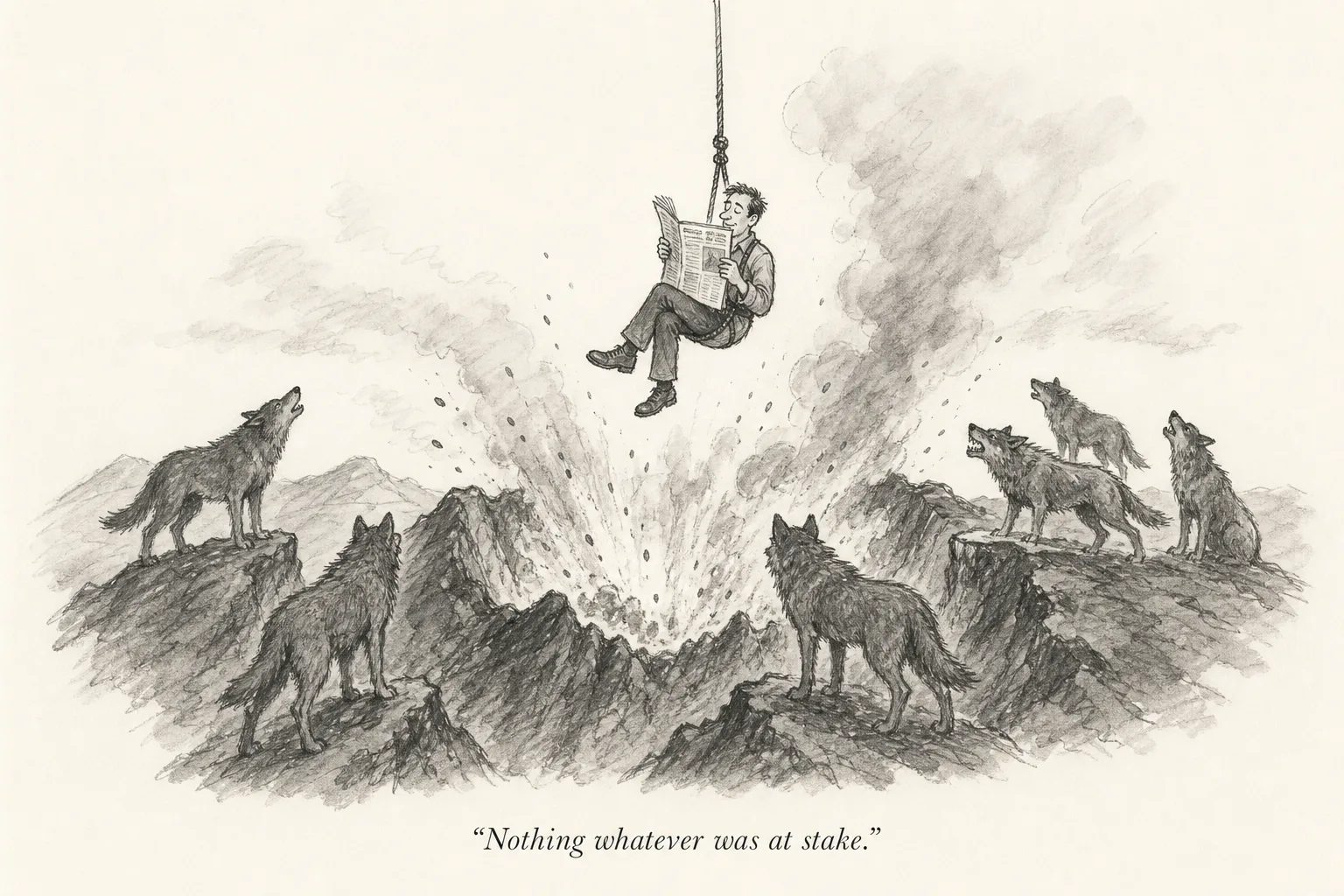
A man hangs over a volcano and the reader is bored. Danger is a property of the situation; stakes are the cost of failure — and only one of them grips.
A man is hanging from a rope over a volcano. Wolves are circling the rim. And the reader is bored.
This happens more often than it should, and it is one of the most useful puzzles in revision, because it separates two things writers routinely treat as one: how dangerous a scene is, and how much is at stake in it. They are not the same measurement, and only one of them is what readers mean when they say they were not gripped.
Stakes are the cost of failure
Danger is a property of the situation. Stakes are a property of the consequence: if this character fails here, what specifically happens, to whom, and why can they not simply live with it?
Notice how much of that is invisible from the outside. Peril is easy to render — anybody can put a cliff in a chapter. Stakes require the reader to already care about a particular person losing a particular thing, which is slow work done earlier in the book, usually in quiet scenes.
Which is why the volcano fails. The situation is maximally dangerous and the cost of failure is unknown, so there is nothing for the reader to dread.
Where this is one of the things we measure
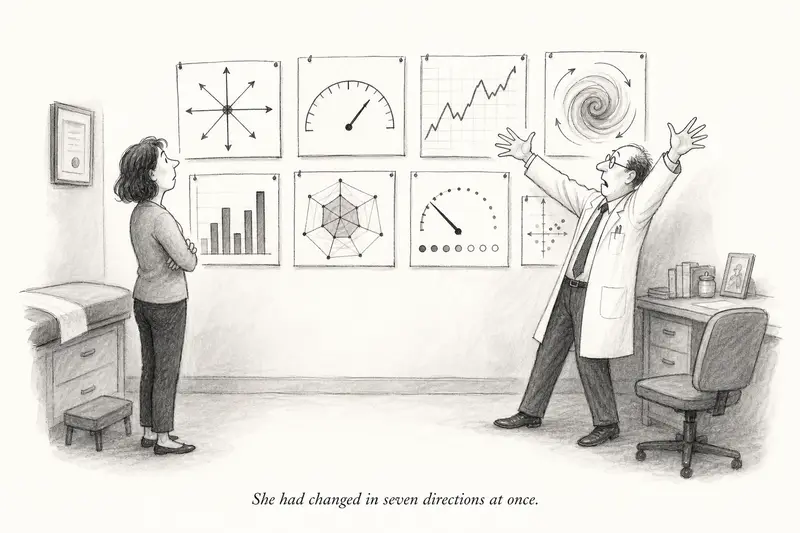
Stakes is one of the six measures Narrative Pulse scores for every scene in the manuscript, alongside tension, conflict, agency, revelation and emotional intensity. Each is read scene by scene and plotted across the whole book, which is the only scale at which the interesting failure — a long level stretch — becomes visible.
It also does quiet work elsewhere. The energy line in Momentum, the composite that shows where a book drives and where it stalls, is a weighted blend of four measures: tension at thirty per cent, conflict at twenty-five, stakes at twenty-five, and emotional intensity at twenty. Stakes carry a quarter of it. That is worth knowing, because it explains a reading writers often find baffling — a stretch of manuscript full of incident that still registers as a dead zone. Plenty happens. Nothing costs anything.
Why you cannot see your own stakes
Because you know what your character stands to lose. You invented it. You have probably known it since before the first draft.
So when your protagonist stands to lose the house, you read every scene set in that house with the loss present in it. The reader has the house and nothing else. This is the ordinary and unfixable condition of writing a novel — you cannot read your own book cold — and stakes are where it does the most damage, because the missing information is precisely the information that makes a reader turn the page.
How to test it by hand
Take ten scenes at random from across the manuscript. For each, complete this sentence using only what is on the page in that scene: if this goes wrong here, then ___.
You will find three kinds of answer. Some scenes complete easily. Some complete only with information from your notes — those are the scenes where the stakes exist in your head. And some cannot be completed at all, because nothing in the scene can go wrong, which is a different problem and usually a scene-purpose one.
Then do the escalation check. Write your ten answers in manuscript order and read them as a list. The cost of failure should rise. If the answer at seventy per cent is roughly the answer at twenty per cent, you have a book with steady risk, and steady risk stops being felt as risk within about fifty pages.
What it looks like when it goes wrong
The stated-not-felt stake. The narration explains what is at risk in a line of exposition early on and never dramatises it again. The stake exists as a fact on record rather than as pressure in the scenes.
The generic threat. The stakes are real but interchangeable — any character losing any job, any relationship, any case. Nothing in the prose says why this particular loss would be unbearable for this particular person.
The life-or-death substitute. Physical danger standing in for tension. This is the volcano. It is especially common in a second draft, because it is the obvious fix when a reader says the middle dragged.
The flatlined stake. The same level of risk sustained for long stretches without escalating, until the reader reclassifies it as ambient background and stops responding to it.
Where the book shows you this
Narrative Pulse plots stakes across the manuscript as its own line, next to the other five measures, with the scenes at the bottom of the range listed so you can go straight to them. What you are looking for is not a low score in a single scene — a quiet scene should be quiet — but a long flat run, or a line that never climbs.
Momentum answers the other half, showing where the energy drains and which of its four contributing measures is responsible. A dead zone attributed to stakes is a very different note from a dead zone attributed to conflict, and it calls for a different repair.
One caution, and it applies to every measure in the app: these scores are read against your own book, not against a standard. There is no correct level of stakes for chapter eleven of a novel. What is meaningful is the shape — where the line sits relative to your own average, and whether it rises.
Stakes are also inseparable from tension, and the two get conflated constantly, which is its own piece of the puzzle.
Notes on the craft
Occasional letters on what actually breaks novels — and how to fix them.
No fixed schedule. Unsubscribe in one click. Privacy Policy