What a developmental edit actually costs
The interesting part is why the quotes you receive vary — and why buying the cheaper kind of editing first saves almost nothing.
A developmental edit of a novel costs between three and three and a half cents a word. On a 90,000-word manuscript that is $2,700 to $3,150 (£2,020 to £2,350).
That figure comes from the 2026 rate chart published by the Editorial Freelancers Association, which surveyed more than 1,100 editors between November 2025 and mid-January 2026 — the largest response since the survey began in 1991. The EFA is careful to say the rates are for guidance rather than recommendation, and they are American figures in dollars. They remain the best published dataset on what editing actually costs.
So the headline number is not really in dispute. What is worth understanding is why the quotes a writer actually receives are spread much wider than that, and why the most common way of economising on editing does not economise at all.
The same job, quoted two ways
Most editors will quote you either by the word or by the hour, and the two methods do not agree.
By the word, using the chart's fiction range, a 90,000-word novel is $2,700 to $3,150. A spread of about $450.
By the hour, the same chart puts fiction developmental editing at $52.50 to $70.00 an hour, at a working pace of 5.5 to 10 manuscript pages an hour. At 250 words to the page, 90,000 words is 360 pages — so somewhere between 36 and 65 hours of reading and writing. Multiply that out and the same novel costs between roughly $1,900 and $4,600.
That is a spread of $2,700, which is to say the uncertainty is larger than the whole per-word quote. And it is not slack in the chart. It is the honest range of how long it takes one person to read a novel properly and write up what they found, which depends on the editor, on the genre, and above all on the state of the draft. A clean manuscript with a structural problem in one place is a different job from a manuscript whose every chapter needs interrogating.
This is the first thing worth knowing before you ask for quotes: a cheap quote and an expensive quote are often not offers of the same work. The question to ask is not what it costs but how many hours the editor expects to spend, and what they will hand you at the end.
Notes on the craft
Occasional letters on what actually breaks novels — and how to fix them. Written for people revising a draft.
No fixed schedule. Unsubscribe in one click. Privacy Policy
The cheaper tier is not cheaper
Editing happens in tiers, and they have an order: developmental editing works on the book as a structure, line editing on the sentence, copy editing on consistency, proofreading last. Each tier assumes the one above it is settled.
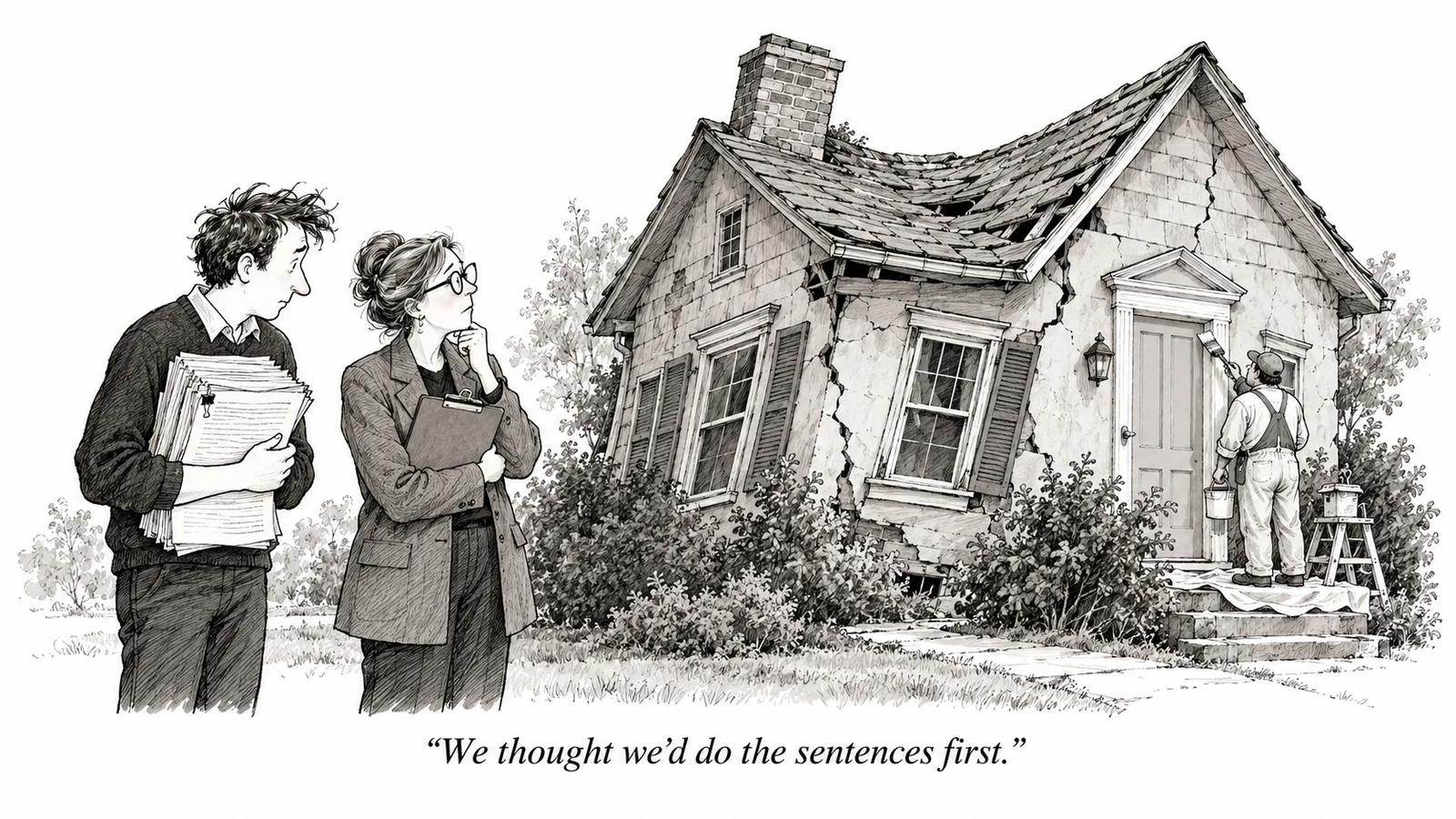
Writers routinely buy them in the wrong order, and the usual explanation is money — developmental editing sounds like the expensive one, so a writer starts with a line edit and hopes it will do. The chart does not support that reasoning at all.
For fiction, developmental editing runs 3.0 to 3.5 cents a word. Line editing runs 2.7 to 3.5 cents. The ranges overlap almost completely. Copy editing is 2.0 to 2.7 cents and proofreading 1.2 to 2.0, so those genuinely are cheaper — but they are also the two tiers that cannot tell you anything about whether your novel works.
Which means the writer who buys a line edit instead of a developmental edit is not saving money. They are spending roughly the same money on the wrong question, and then, if the structural problem turns out to be real, spending it again — because a line edit performed on chapters that a structural revision later removes is work that goes in the bin with them.
One more thing the chart shows, which novelists may find either reassuring or galling: fiction is among the cheapest categories on it. Developmental editing of academic work runs 4.0 to 7.8 cents a word, medical 5.3 to 6.8, memoir 3.5 to 4.5. Novels are the least expensive serious thing an editor can be asked to read.
What the money buys, and what it does not
A developmental edit buys you a reading of the whole manuscript by one experienced person, and a written account of what the book is doing to its reader. Where the central question is unclear. Which scenes change nothing. Whether the protagonist decides things or has things happen to them. Where the tension plateaus. Which promises the opening makes and whether the ending pays them.
Most editors deliver this as an editorial letter, often with a manuscript marked up in the margins, and most will include a call to talk it through. Some include a follow-up read of the revised draft; many do not, and a second pass is usually quoted separately.
What it does not buy is the repair. A developmental editor tells you what is wrong and leaves the fixing to you — and that is the job done properly rather than a limitation of it. When Maxwell Perkins told Fitzgerald that Gatsby was "somewhat vague", he did not rewrite a sentence of him. Fitzgerald rebuilt the character himself at the galley stage.
It also does not buy certainty. One reader, however good, is one reader. A developmental edit is an informed opinion about your book, and the most useful thing you can do with it is argue with the parts you think are wrong.
What pushes a quote up
Length, obviously, since most quotes are per word. Beyond that: memoir and narrative non-fiction cost more than fiction on the chart, because the editor is weighing what actually happened against what makes a book. A fast turnaround costs more, as it does in every trade. A second read of the revised draft is usually a separate line. And editors who work regularly with a particular genre, or who have a list of acquisitions behind them, charge what that record is worth.
A quote well below the chart is worth a question or two rather than instant acceptance. Developmental editing is slow work by nature — 5.5 to 10 pages an hour, on the chart's own figures — and an editor promising a full structural read of a 90,000-word novel for a few hundred dollars is either not reading all of it or not spending long on what they read.
Spending less without buying the wrong thing
There is one honest way to reduce what a developmental edit costs you, and it is not to buy a cheaper tier. It is to arrive with the obvious problems already found.
An editor's hours go on two quite different activities: noticing what is wrong, and judging what to do about it. The first is pattern recognition across a whole manuscript — the thread that stops paying off, the subplot that never touches the main line, the four scenes in a row where nobody decides anything. The second is editorial judgement, which is what you are really paying for and what no amount of preparation replaces.
If you can hand an editor a draft in which the first kind of problem has already been found and dealt with, their hours go on the second kind. That is a cheaper edit and a better one.
Doing that pass yourself is hard, for a reason that has nothing to do with skill: you cannot read your own novel the way a stranger does, because your intentions fill in everything the page leaves out. It is why writers are consistently wrong about their own books in predictable directions.
This is the gap Novel Maestro was built for. It reads the complete manuscript and reports what it found, with the passage behind each finding, so you can check it against your own page. The reading of your whole novel is free, with no card, and returns Maestro's First Take. The full Developmental Report, the fourteen diagnostic passes and the revision board are £59 once, for one novel, with nothing that renews.
It is not a human developmental editor, and if you can afford one you should hire one. What it does is the structural pass first, so that the hours you pay a person for are spent on their judgement rather than on finding the things a careful reading would have found anyway.
Three questions before you pay anybody
How many hours do you expect to spend on this manuscript? The answer tells you more about the quote than the quote does.
What will I receive? An editorial letter, a marked-up manuscript, a call, or some combination — and roughly how long is the letter?
Does the fee include a look at the revised draft? If not, what would that cost? A developmental edit you cannot afford to act on twice is a diagnosis without a follow-up appointment.
Rate figures throughout are from the Editorial Freelancers Association's 2026 Editorial Rate Chart, surveyed from November 2025 to mid-January 2026, and were checked on 26 October 2026. The EFA states that its rates are for guidance only.
This is the latest post in "Over the Editor's Shoulder", a series on what developmental editors do and how to do it for your own novel.
One of these a week, give or take
If this was useful, the letters are more of it: one problem a novel runs into, what it looks like on the page, and what to do about it.
No fixed schedule. Unsubscribe in one click. Privacy Policy