The scene that changes nothing
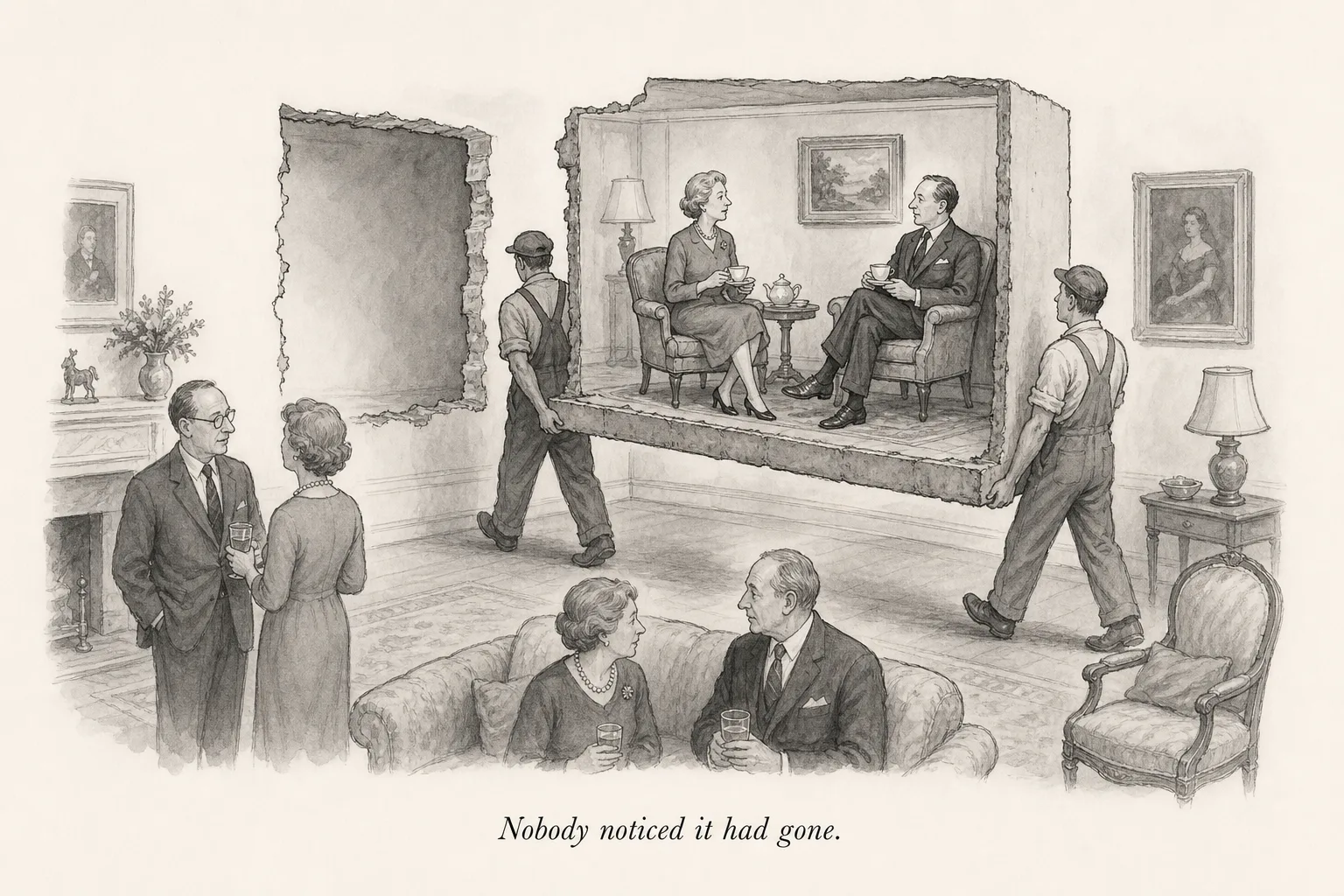
If a scene can be lifted out without disturbing the one after it, it is not a scene. It is a briefing.
There is a chapter in your novel that you are quietly proud of. The dialogue is the best in the book. Your writing group said so. It is also, you have noticed, the chapter readers refer to vaguely or not at all, and the one where somebody admitted they had started skimming.
Nothing is wrong with it. That is the difficulty. It is well made, it is in the right place, and it goes nowhere.
A scene is a unit of change
The most useful test of a scene is not whether it is good. It is whether it can be removed.
Lift the scene out and read the scene before it straight into the scene after it. If the join holds and nothing downstream needs repairing, the scene was not carrying anything. It was a briefing: a delivery of information dressed in furniture and weather.
What a working scene does can be put as three questions, and they are worth asking in exactly this order. Who decides something? What changes as a result? What does the reader now know that they did not know a page earlier?
A strong scene answers all three. A serviceable one answers two. When only the third question has an answer — the reader has learned something, nobody chose anything, nothing moved — you have a scene that exists to inform, and information alone does not hold a reader for four hundred pages. It is not a question of conflict, exactly. Nobody has to shout. But someone has to want something in the room, and the scene has to end somewhere other than where it began.
Notes on the craft
Occasional letters on what actually breaks novels — and how to fix them. Written for people revising a draft.
No fixed schedule. Unsubscribe in one click. Privacy Policy
Why you cannot see it from inside your own draft
Two reasons, and they compound.
The first is that the scene is doing real work in your head. You know it establishes the friendship that matters in chapter twenty-nine. You know it is the quiet before the raid. You know the reader needs the business with the will explained before the funeral. All of that is true, and none of it is on the page in a form the reader can feel, because what you have written is a scene in which two people who like each other have a pleasant conversation about a will.
The second is that writing it went well. Fluency is a treacherous signal. The scenes that come easily are often the ones with nothing at stake in them — nothing resisting you, because nothing is resisting anybody. It is the same blind spot that makes a passive protagonist so hard to spot in your own manuscript, and the reason a second reading of the whole book is worth having: the fault is invisible to the person who supplied the missing half from memory.
How to test it by hand
A spreadsheet, three columns, one row per scene. Half a day for a novel.
Label the columns Who decides, What changes and What the reader learns. Go through the manuscript in order and fill each row with a short phrase, honestly. If nothing belongs in a cell, leave it empty. The discipline is in the honesty: she realises she is unhappy is not a decision, and the tension rises is not a change.
Then stop looking at the scenes and look at the shape of the grid.
Empty rows are the scenes to interrogate first. Rows with only the third column filled are your briefings. And read the first column downwards on its own, as a list of names: if the same secondary character keeps appearing there, or if your protagonist appears in it four times in ninety scenes, you have found something more serious than a slow chapter.
What it looks like when it goes wrong
The weather scene
Rich, well-observed prose — atmosphere, sensory detail, interiority — in which the point-of-view character is not pursuing anything. They are simply present. The repair is rarely to cut the description but to anchor it: let the detail accumulate while somebody is trying to get, avoid or discover something, so the room is being noticed by a person with a purpose rather than by the author.
The loop
The character wants what they wanted last scene, meets the same flavour of resistance, and exits in roughly the same position. Two scenes are doing one scene's work. Either the second has to cost more than the first, or it goes.
The catch-up coffee
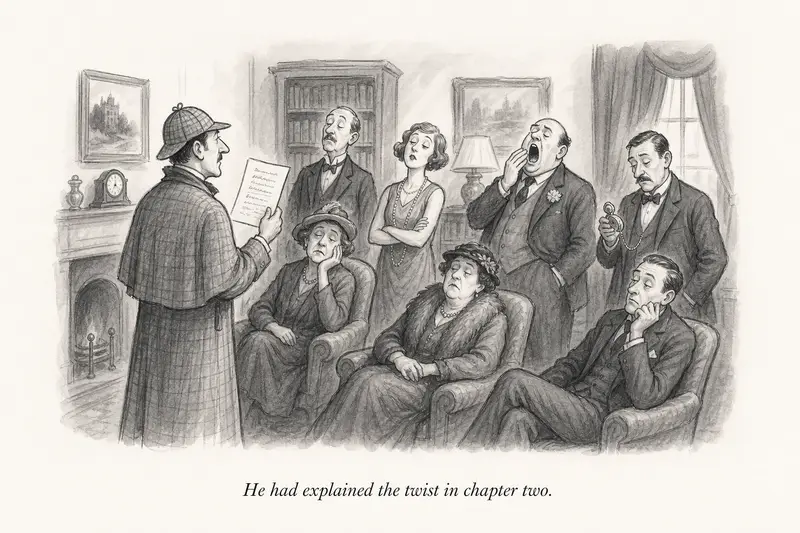
Two characters meet so that one can bring the other up to date, and by the end they both know something they did not know before — and nothing else has moved. The fix is not less exposition, it is exposition under pressure: give the speaker a reason the listener's reaction matters, and give the listener a want that is not to understand the plot, so the facts have to be prised out rather than handed over.
The puppet scene
Your protagonist is on the page throughout, but another character's decision resolves the scene's tension. This is the one writers argue about most, and the argument is usually about likeability. It does not need to be a grand intervention: staying silent is a decision, and refusing to act is a decision, provided the story treats it as one and makes it cost something.
And the scene that only looks like one
Contrast all of that with the first dinner at the Buchanans' in The Great Gatsby. On the face of it, it is an evening of small talk and heat and furniture. But Tom is telephoned by his mistress in the middle of it, Daisy knows, Jordan tells Nick what it is he has just witnessed, and Nick leaves the house holding information he did not arrive with and will have to do something about. Atmosphere, exposition and a turn, all inside one dinner party. Fitzgerald is not writing scenes about how the room felt.
Where the book shows you this
In Novel Maestro this is the diagnostic called The Scene Ledger, and it is the grid above, built for you across the whole manuscript. It reads each scene in order and fills in the same three columns — who decides, what changes, what the reader learns — then counts how many scenes came back empty and how many came back part-empty.
Two of its findings are worth more than the individual rows. It shows the distribution of deciding across the entire cast, which is how you discover that the person driving your novel is your protagonist's best friend. And it finds the information-only runs: consecutive stretches of scenes that inform without changing anything, listed with the scenes attached, which is what a reader is describing when they say the middle sagged.
What no measurement can settle is whether a particular quiet scene has earned its place — the lull before the raid, the last ordinary morning, the chapter that is doing something to the reader rather than to the plot. Finding the scenes where nothing changes is a measurement problem. Deciding which of them your novel needs anyway is the writing.
One of these a week, give or take
If this was useful, the letters are more of it: one problem a novel runs into, what it looks like on the page, and what to do about it.
No fixed schedule. Unsubscribe in one click. Privacy Policy