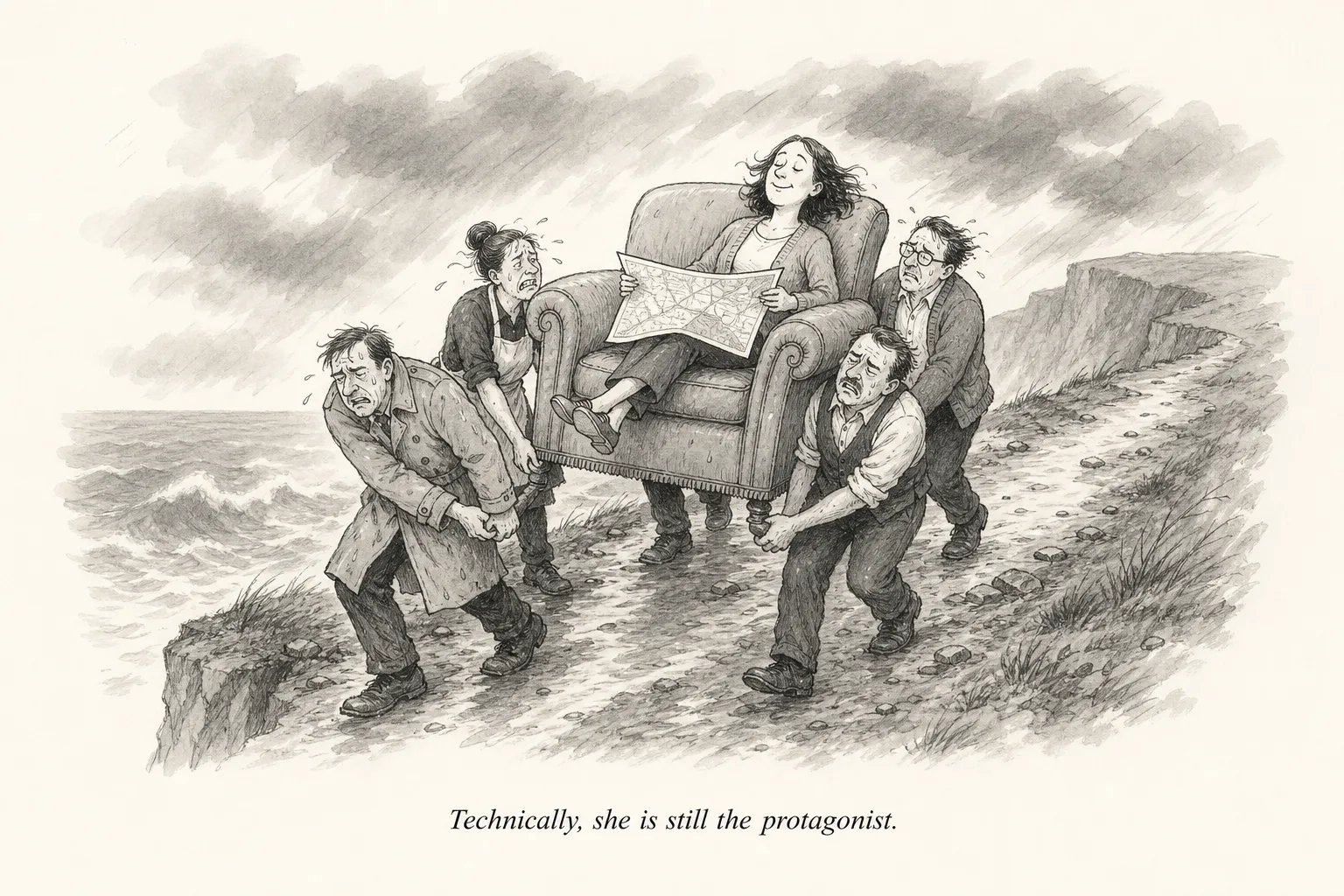
Your protagonist is being carried
A beautifully written novel can still drift, because activity is not agency: running from a threat is motion, but choosing where to run is a decision.
Everybody who reads it says something kind about the prose. Then they say something vaguer. It's beautifully written — I did drift a bit in places. I kept waiting for her to do something. And if you are lucky, one reader gives you the useful version: things sort of happen to her.
Which cannot be right, because your protagonist is extremely busy. She travels. She interviews people. She is nearly killed twice, breaks into the office at night, uncovers the will and confronts her mother about it. The chapters are full of event.
Activity is not agency
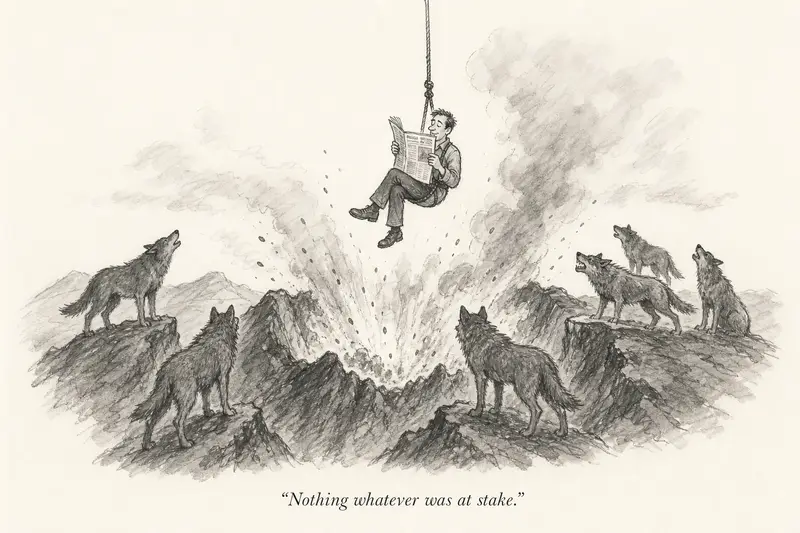
Motion and choice are different measurements, and a novel can carry a great deal of the first while running almost entirely short of the second.
Agency is the difference between a character who chooses and a character who is carried, and it shows up in one place only: a decision that changes what happens next, made by the protagonist, at a cost. Running from a threat is activity. Deciding where to run, and knowing what you give up by running there, is agency. The cost is the load-bearing part — a choice with no price attached is an administrative act, which is why agency and the gap between want and need tend to fail together. If nothing is being traded, nothing is being decided.
This is also why the fault is so rarely a matter of personality. Writers defend a static protagonist on characterisation grounds: she is shy, she is grieving, she has no standing in this institution. All of that can be true, and none of it is the problem. A frightened, powerless, grieving character has agency the moment the story makes her choose between two options that both cost her something. The trouble is almost never who she is. It is that the scene gives her nothing to decide.
Notes on the craft
Occasional letters on what actually breaks novels — and how to fix them. Written for people revising a draft.
No fixed schedule. Unsubscribe in one click. Privacy Policy
Why you cannot see it from inside your own draft
Because you can see her deliberating.
You wrote the paragraph where she weighs it up. You know what she nearly said in that meeting, what she is protecting, and why she went along with a plan she thought was a bad plan. Re-reading the scene, all of that plays behind the dialogue like a soundtrack, and the scene feels like a choice.
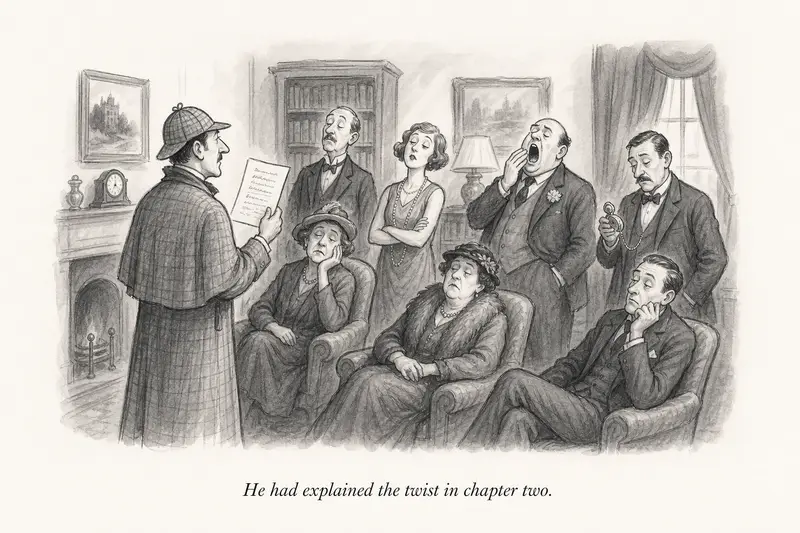
Take the soundtrack away and read what the page actually records: four people worked out what to do, and she agreed. Reaction is not decision, and interiority is exactly where the difference hides. It is the recurring difficulty of reading your own manuscript — you supply the missing half from memory every time, and only you do.
How to test it by hand
One column, or one index card per chapter.
Go through the manuscript in order and write a line only where the protagonist makes a decision that changes what happens next. Name the decision and name the cost. Nothing else earns a line: not travel, not emotion, not arriving somewhere, not being told something important, and not agreeing to a plan somebody else made without raising an objection.
If the list is short, that is the finding. But the shape of the list matters at least as much as the length, so look for the gaps — five, six, nine consecutive scenes with no entry against them. A run like that is what readers experience as drift, no matter how much is happening inside it.
Then take a second pass over the scenes that failed to earn a line, and ask one question of each: who was driving? In every scene where information changes hands, did she extract it — through a trade, a lie, a risk, a confrontation — or did she receive it? The content can stay exactly as it is. What has to change is which end of the exchange your protagonist is standing at.
What it looks like when it goes wrong
The briefing scene
A mentor, an expert or an ally sits the protagonist down and explains the situation, the danger or the plan, while she listens attentively and asks clarifying questions. It happens because exposition is most efficiently delivered by whoever knows most, which is dramatically convenient and puts your protagonist in a purely receptive role. She can learn the same facts while prising them out of someone who did not want to part with them.
The rescue loop
Across several scenes she is put in danger and then saved by someone else's timely arrival, with her own actions largely irrelevant to how it comes out. Jeopardy is being mistaken for drama. The repair is not less danger but a different causal chain: let her decision cause either the danger or the escape, so the outcome traces back to her rather than to whoever turned up in time.
The research montage
Long stretches in which she gathers information, travels, interviews sources — plainly busy, plainly advancing the plot — without ever reaching a moment where getting one thing means losing another. This is the hardest one to spot in your own book, because it reads as diligence. Every one of those chapters should end on a decision prompted by what she has just learned, not on her reaction to it.
The observer by accident
The Great Gatsby is narrated by a man who mostly watches. Nick Carraway does not drive the plot; Gatsby and Daisy and Tom do. That is a deliberate structure, not a fault, and it works because the agency is emphatically present in the book — it is just held by someone other than the narrator, and Nick's few real decisions (arranging the reunion, staying in the room) are placed exactly where they will do the most damage. The problem is not writing an observer. The problem is writing one by accident, and finding at the end that nobody in the novel is choosing.
Where the book shows you this
In Novel Maestro this is the diagnostic called Character Agency. It goes through the manuscript scene by scene and marks each one, for each significant character, as proactive or reactive, with a one-line reason for the call so you can argue with it. Then it does the thing that is almost impossible by hand across four hundred pages: it finds the passive runs — the consecutive stretches where a character does not decide anything — and gives you their length and the scene titles.
A bad result does not look like a low score. It looks like a run of nine scenes in the middle third with your protagonist's name on it, which is the drift your beta reader felt and could not place, converted into a list of chapters you can open.
What the measurement cannot tell you is whether a particular passive stretch is a fault or the point — a character discovering she has no power, a lull the book has earned, a narrator who is meant to be watching. Counting the scenes in which nobody chooses anything is a measurement problem. Deciding which of those scenes your novel needs is the writing.
One of these a week, give or take
If this was useful, the letters are more of it: one problem a novel runs into, what it looks like on the page, and what to do about it.
No fixed schedule. Unsubscribe in one click. Privacy Policy