Two characters, one job
The trouble is rarely the size of your cast. It is two people doing one person's work, and neither of them getting the room to land.
The note comes in some version of this: I kept forgetting who Marcus was. Or worse, from a generous reader trying to be helpful: I got the two brothers mixed up.
The instinct is to reach for distinguishing detail. Give one of them a limp. Give the other a Yorkshire accent, a hobby, a scar. It never works, because the reader was not confused about how they looked. They were confused about what they were for.
Cast economy
Page time is finite. Every character you keep on stage costs attention that some other character loses — which means a cast is not a collection but an economy, and the useful question about any named person in your novel is not whether they are interesting. It is: what does this character do that nobody else in the book does?
Answer it in one phrase, for everyone. The friend who tells her the truth. The rival who wants the same job. The one who pays for it.
Where two phrases match, you have found your problem. Two characters serving the same function do not add up to twice the presence; they split one character's worth of attention in half, and the reader remembers neither. This is why merging two secondary characters is the single most transformative move available in revision, and the one writers resist hardest — because both of them are, individually, quite good.
There is a second half to the same law, and it is about absence rather than duplication. A character the reader is meant to care about who leaves the page for a hundred and fifty pages has to be reintroduced when they return, and reintroduction is a tax: a line of dialogue or narration reminding us who this is and why they matter. It is most costly with opposition. An antagonist does not need to be present to be felt, but they do need to keep acting — otherwise the obstacles arriving in their absence read as generic bad luck rather than as a person working against your protagonist, and the pressure quietly drains out of the middle of the book.
Notes on the craft
Occasional letters on what actually breaks novels — and how to fix them. Written for people revising a draft.
No fixed schedule. Unsubscribe in one click. Privacy Policy
Why you cannot see it from inside your own draft
Because every character in your novel is vivid to you, and for reasons the reader has no access to.
You know the backstory you wrote and cut. You know what the aunt did in 1979. That knowledge makes each person on the page feel three-dimensional to you while the reader is working from four appearances and a name, so you consistently overestimate how much room a minor character needs — and underestimate how much room they are taking.
Absence is even harder to feel. You have never read your novel the way a reader reads it: in one continuous stretch, at a reader's pace, with no memory of the outline. You have read chapter nineteen and chapter thirty-one in the same working week for two years. The hundred and fifty pages between an antagonist's exit and their return are a gap you have literally never experienced, which is the specific thing a reading of the whole book at once gives you.
How to test it by hand
Two lists, an afternoon.
The first is the function list. Every named character in the manuscript, and beside each one a single phrase describing what they do for the story. Not who they are — what they do. Any duplicated phrase is a merge candidate, and when you merge, keep the more distinctive voice and fold in the other's best scenes.
The second is a presence strip. Take the five or six characters who actually matter and mark, against a list of your chapters, which ones they appear in. Read each strip across for the gaps, and note the longest one. Then look at the top of the strip: count how many named characters arrive in the first two chapters, before the reader has had the chance to attach to anyone at all.
Then a third pass, on anyone you are unsure about — the same test that works on scenes, applied to people. In each of their scenes: what did they decide, what changed because of them, what did the reader learn through them? A character who returns nothing on all three counts, across every appearance, is being carried by the book.
What it looks like when it goes wrong
The warning chorus
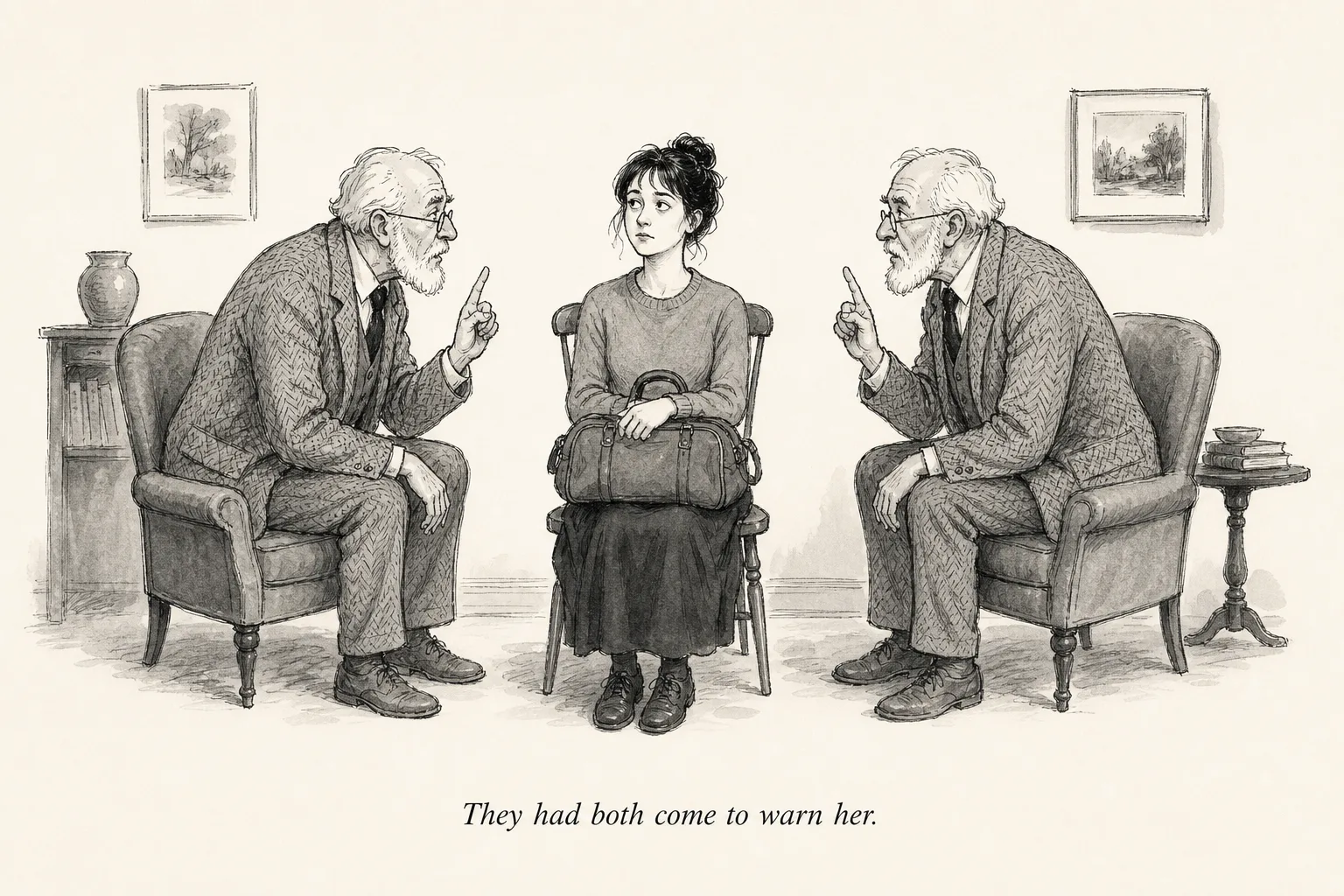
Three or four different characters each get one scene telling the protagonist she is making a mistake. None of them recurs, none of them is changed by being ignored. Route every warning through the one character who has real standing with her, in escalating form, and the last one lands with the weight of all the others.
The interchangeable mentor
Two older, wiser figures each deliver a chunk of what the protagonist needs to know, and either could plausibly have delivered either speech. Merged, the second piece of information reads as a mentor finally trusting her with more — which is a relationship rather than an errand.
The bookend antagonist
Vivid in the opening chapters, absent through the middle, back for a climax that is supposed to carry maximum weight and instead has to spend half a page reminding us who this is. The repair is not more antagonist scenes near the return; it is one offstage action, back where the silence began, whose consequence the protagonist has to deal with directly.
The freeloader
A character appears in a dozen scenes and never decides anything, never changes anything, never gives the reader anything. They are not badly written. They are simply present, and presence is the one thing a novel cannot afford to give away free.
A cast with no duplicates
The Great Gatsby runs on eight people, and not one of them shares a function. Nick observes and measures. Daisy is the thing wanted. Tom is the opposition, and the specific brutality of old money. Jordan supplies the moral weather of the class — and, structurally, is the mechanism by which Nick learns things. Myrtle and Wilson are the cost. Wolfshiem is where the money came from. Remove any one of them and something the novel needs goes with them. That is what a small cast buys you: everybody gets enough room to be unforgettable.
Where the book shows you this
In Novel Maestro this is the diagnostic called The Ensemble. It builds the presence strip for you: for every character, the share of scenes they appear in, their first and last appearance, and — the number nobody works out by hand — their longest continuous absence.
Alongside that it names the role overlaps: which characters are sharing a function, and a suggestion for what to do about it. And it raises specific issues by type — a passive protagonist, an absent antagonist, a character with no discernible function, a duplicated role, behaviour that does not match the character as established — with the scenes attached, plus observations about the relationships between pairs.
What no measurement can settle is whether a redundancy is a fault. Sometimes two characters doing one job is precisely the point: twins, a double act, a committee, a chorus of interchangeable officials. A tool can tell you that two people occupy the same space in your novel. Whether that is your weakness or your design is the writing.
One of these a week, give or take
If this was useful, the letters are more of it: one problem a novel runs into, what it looks like on the page, and what to do about it.
No fixed schedule. Unsubscribe in one click. Privacy Policy