Every detail you plant is a promise
A setup is a contract. Every promise a novel makes has one of four fates, and only one of them costs you the reader.
Two notes, from two different readers, that sound like opposite complaints. I kept waiting for the locket to come back. And: the ending felt like a coincidence — it came out of nowhere.
They are the same fault, seen from either end. Something was promised and never delivered; something was delivered that was never promised. Both are failures of the same small, unglamorous discipline, and it is the one most likely to survive a dozen drafts untouched, because it lives in the gaps between chapters rather than in any chapter you could open and fix.
A setup is a contract
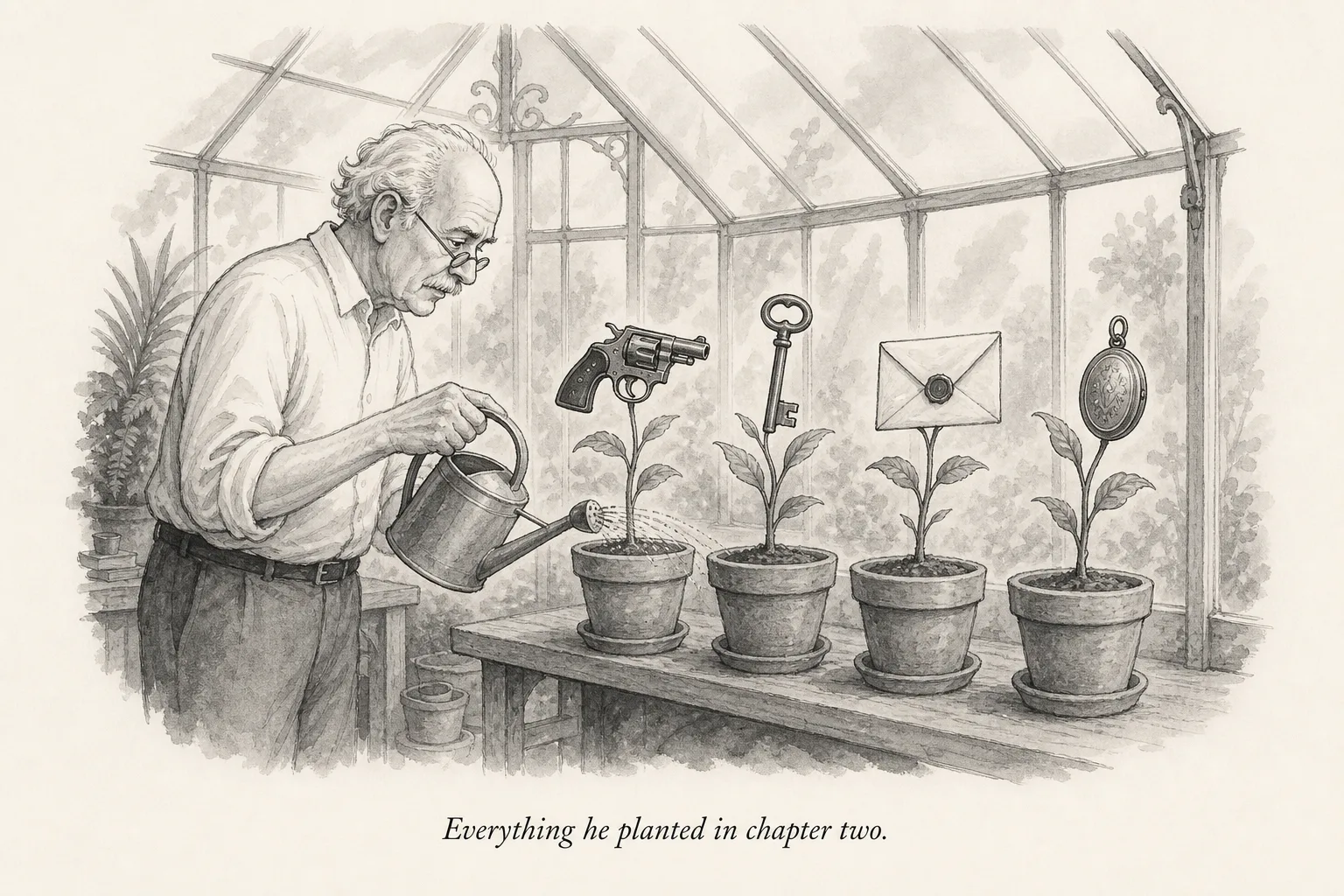
A narrative promise is anything the book introduces that creates an expectation. An object described more closely than the furniture around it. A question a character asks out loud and nobody answers. A threat spoken and not carried out. A stranger who arrives with more weight than a stranger needs.
The crucial thing is that you make the promise with emphasis, not with intention. Readers cannot see your outline. They can only see what the prose lingers on, returns to, or has somebody react to — and from that they keep a running ledger of things owed to them, without being asked and mostly without noticing they are doing it. The ledger is why a reader who cannot tell you a single thing about your structure can tell you, unerringly, that something was dropped.
Every promise in a novel ends up with one of four fates. It is resolved. It is paid late — the payoff comes, but so long afterwards that the reader had put the promise down. It is left open on purpose, which is legitimate and sometimes the whole point. Or it is forgotten, which is the only one of the four that costs you something you cannot get back, because it does not read as mystery. It reads as carelessness, and carelessness makes a reader stop trusting the rest.
Notes on the craft
Occasional letters on what actually breaks novels — and how to fix them. Written for people revising a draft.
No fixed schedule. Unsubscribe in one click. Privacy Policy
Why you cannot see it from inside your own draft
Because you know which details were meant.
You remember planting the locket. You also remember that the scar on the barman's hand was just a barman with a scar, put there to make the room feel real. Your reader has no access to that distinction and judges purely by weight of attention, which means half your accidental promises were made by good writing — a nicely observed detail, held a beat too long.
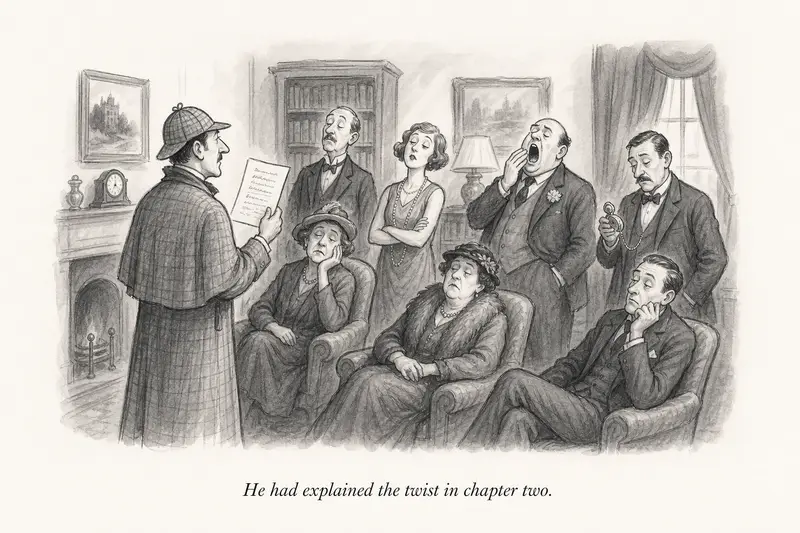
The second problem is that you never read your novel the way a reader does. You read it in passes, in sections, out of order, over years. The two hundred pages between a setup in chapter three and its payoff in chapter twenty-six take a reader nine days to cross. For you they are adjacent, because you were working on both last Tuesday. This is the same trick of memory that makes a scene that changes nothing feel purposeful to its author, and it is the one thing a reading of the whole book at once can give you that another pass of your own cannot.
How to test it by hand
Two columns, one re-read. This is the cheapest high-value audit in revision.
Read the manuscript as a reader, at a reader's pace, with a notebook ruled into two columns. On the left, write down every point at which you notice the book giving something weight, with the chapter number. On the right, leave a space for the payoff, and fill it in with its chapter number when it arrives.
One rule makes or breaks the exercise: write on the left when you notice the emphasis, not when you remember the intention. You are trying to record what a stranger would be owed.
Then mark each row. Resolved. Late — the gap ran long and nothing reminded the reader on the way. Open on purpose. Forgotten. The forgotten rows are your repair list, and the repair is a genuine choice, not automatically a new scene: write the payoff, flatten the emphasis back to a single neutral mention so it stops reading as a plant, or cut the detail altogether. Cutting is usually the cheapest and most honest option.
Then run the same test backwards, which almost nobody does. Take the last three chapters and, for every resource, skill, object or revelation that helps resolve the book, find its first appearance in the manuscript. If the first appearance is in the scene where it was needed, you have found the coincidence your reader felt.
What it looks like when it goes wrong
The loaded drawer
A detail is described closely, mentioned twice, reacted to by a character — and then never appears again. This is the classic, and the reason Chekhov's remark about the rifle has outlived nearly everything else he said about craft. Note that his point was not that objects must be used. It was that emphasis is a promise, so unearned emphasis has to go.
The rescue from nowhere
A problem is solved by a skill, contact or object appearing for the first time in the scene that needs it. The repair is almost absurdly cheap: one glancing, unweighted mention several chapters earlier converts pure convenience into a payoff, and it takes an afternoon.
The whispered threat that evaporates
Somebody makes a vow, states a consequence, or promises to come back for what they are owed — and the book never confirms, denies or enacts it. Spoken promises need tracking with the same rigour as physical objects, and readers hold them just as firmly. If it is not going to be paid, rewrite the line so it reads as venting rather than intention.
The overloaded detail
The opposite failure, and the one writers never suspect: a piece of background texture gets so much sensory attention that readers file it as a plant and spend a hundred pages waiting for a return that was never planned. Every unfired promise in this category is doing quiet damage to the ones you did plan.
What a kept promise looks like
The Great Gatsby is short and almost nothing in it is unpaid. The green light, the eyes of Doctor T. J. Eckleburg, the bad driving established as a character trait in chapter three and then handed the entire climax in chapter seven — each is planted with visible emphasis and each is used. Fitzgerald even pays off Gatsby's ludicrous shirts, which is why the book feels tighter than novels a third longer.
Where the book shows you this
In Novel Maestro this is the diagnostic called Setups & Payoffs. It reads the whole manuscript and returns the two-column ledger you would otherwise build by hand: every setup it can find, paired with its payoff where one exists, and each pair marked resolved, late, hanging or forgotten, with the scene where the promise was made and the scene where it was kept, so both ends are one click away.
Each pair also carries a confidence rating, which matters more than it sounds. Some of what it flags will be texture you never intended as a plant — and if the analysis read it as a promise, there is a decent chance a reader will too, so those rows are worth a look before you dismiss them.
A bad result usually has a shape. A run of forgotten promises clustered in the first fifty pages, because opening chapters make the most promises and get revised the most often, so the plants survive while the intentions behind them are quietly rewritten away.
What no measurement can tell you is which questions your novel should leave open. The distinction between a promise forgotten and a silence held on purpose is not in the text; it is in what you meant. Tracking four hundred pages of promises is a measurement problem. Deciding which ones the book should keep is the writing.
One of these a week, give or take
If this was useful, the letters are more of it: one problem a novel runs into, what it looks like on the page, and what to do about it.
No fixed schedule. Unsubscribe in one click. Privacy Policy