Your ending was in your first chapter
An ending is judged against the promise its opening made — which is why so many unsatisfying endings are caused by a first chapter written before the writer knew what the book was about.
Endings get blamed for problems they did not cause.
A reader closes the book and says it felt rushed, or unearned, or somehow beside the point — and the writer goes back and rewrites the last three chapters, again, and the note comes back unchanged. This is because an ending is almost never judged on its own terms. It is judged against the promise the opening made, and that promise was made two hundred pages before anybody started worrying about the ending.
One problem, examined from both ends
Openings and endings are the two places a reader makes a decision: first whether to go on, finally whether it was worth it. They are bound together, because an ending can only pay off the promise its opening made.
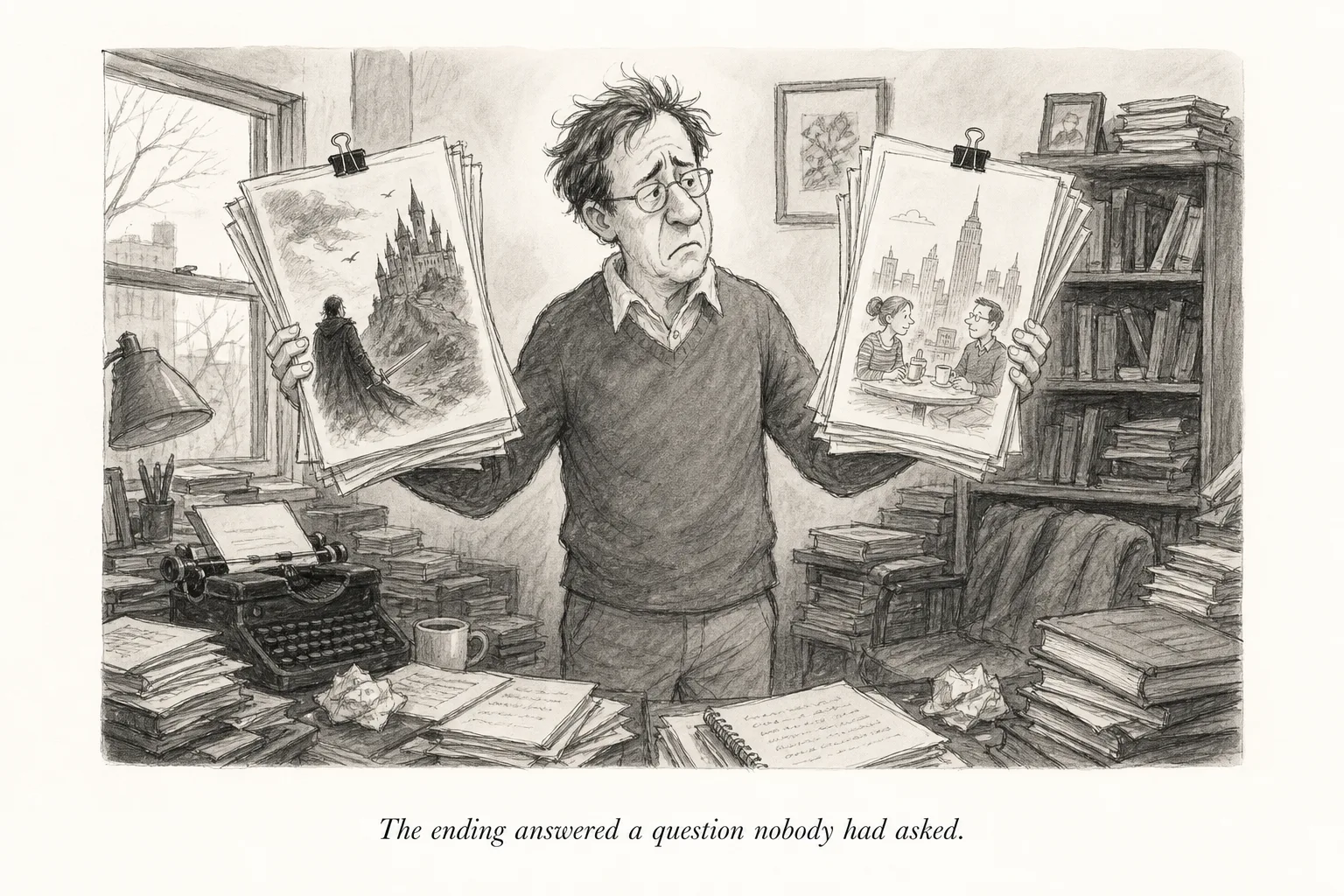
Which reframes both of the usual complaints. A flat opening is rarely a tension problem — it is a promise problem. Nothing has been proposed, so there is nothing to be curious about; assured prose about a place and a mood proposes nothing. And an unsatisfying ending is rarely a plot problem. The mechanics resolve perfectly well. What fails is the match: the book answers a different question from the one it raised.
The test is small enough to write on an envelope. What question does your first chapter ask? What question does your last chapter answer? If they are not the same question, you have found the fault, and it is at the front of the book rather than the back.
Why the mismatch is invisible to you
Because you did not read your opening. You wrote it, probably several times, and most likely before you knew what the book was about.
Opening chapters are frequently the oldest text in a manuscript, written when the novel was still an intention. Then the book found its real subject somewhere in the second act, and the writer — who now knows what the story is — reads that old opening as though it were already about the thing it became. Every reader who has never met the book before reads it as what it says.
This is the version of the series' recurring problem that costs writers the most, because the gap between intention and page is widest exactly where the reader is deciding whether to continue.
How to test it by hand
Two sentences, written in one sitting, no cheating.
Sentence one: the question the first chapter asks — not the theme, not the premise, the thing a stranger would be curious about at the end of page twelve. Sentence two: the question the last chapter answers.
Then compare them. If they differ, resist the reflex to defend the opening because it is polished. Trust the ending: it is where the book got to under its own power, and it is usually a better guide to what the novel is about than the plan you started with.
There is a second version of the test that catches the subtler failure. Write each question twice — literally and emotionally. Will she find out who killed her brother is the literal question; will she be able to stop looking is the felt one. A great many technically-resolved endings answer the first and leave the second in the air, which is precisely the ending a reader calls hollow without knowing why.
Finally, read your first three pages and ask a blunter question: what has been proposed here? If the answer is atmosphere, you have your opening note.
What it looks like when it goes wrong
The scenic opening. Assured, often beautiful prose establishing setting, backstory or mood for several pages before anything is put at risk. Readers admire it and do not commit to it. The want and the obstacle usually exist already, a chapter or two in; the repair is generally to move them forward rather than to write something new.
The bait and switch ending. The plot resolves, but it resolves a different concern from the one the opening raised — a book that opens on a private betrayal and closes on public vindication. Everything works. Nothing lands.
The technically-resolved ending. The literal question is answered — the case solved, the marriage ended — while the emotional question the middle of the book spent three hundred pages building gets no reckoning at all.
The epilogue apology. A late coda that tries to supply retroactively the emotional payoff the climax skipped. Occasionally a coda genuinely earns its place. More often it is evidence that the writer sensed the gap and repaired it in the wrong room; the reckoning belongs inside the climax.
Where the book shows you this
Two tools between them cover it, and they answer the two halves.
Setups & Payoffs tracks every promise the manuscript makes and what became of it — resolved, still hanging, paid off late, or forgotten entirely — which is the mechanical half of the question. An opening is a dense cluster of promises, and it is startling how many of them a finished draft never revisits. Every detail you plant is a promise, and the ones planted in chapter one are the ones the reader remembers longest.
Narrative Pulse covers the felt half: how tension and stakes actually run across the book's first pages and its last. Openings that propose nothing and endings that release their pressure a chapter early both have a very recognisable signature once the line is drawn.
What neither can tell you is which of your two questions the novel should have been about. That is the decision the whole revision turns on, and it belongs to you. But it is a decision best taken with both sentences written down side by side — because until they are, the temptation is always to keep rewriting the ending, which is the one part of the book that was probably never the problem.
Notes on the craft
Occasional letters on what actually breaks novels — and how to fix them.
No fixed schedule. Unsubscribe in one click. Privacy Policy