You don't need a beat sheet, you need a shape
Structural models describe shapes that have worked. Used as instructions, they produce beats that land on schedule and feel arbitrary.
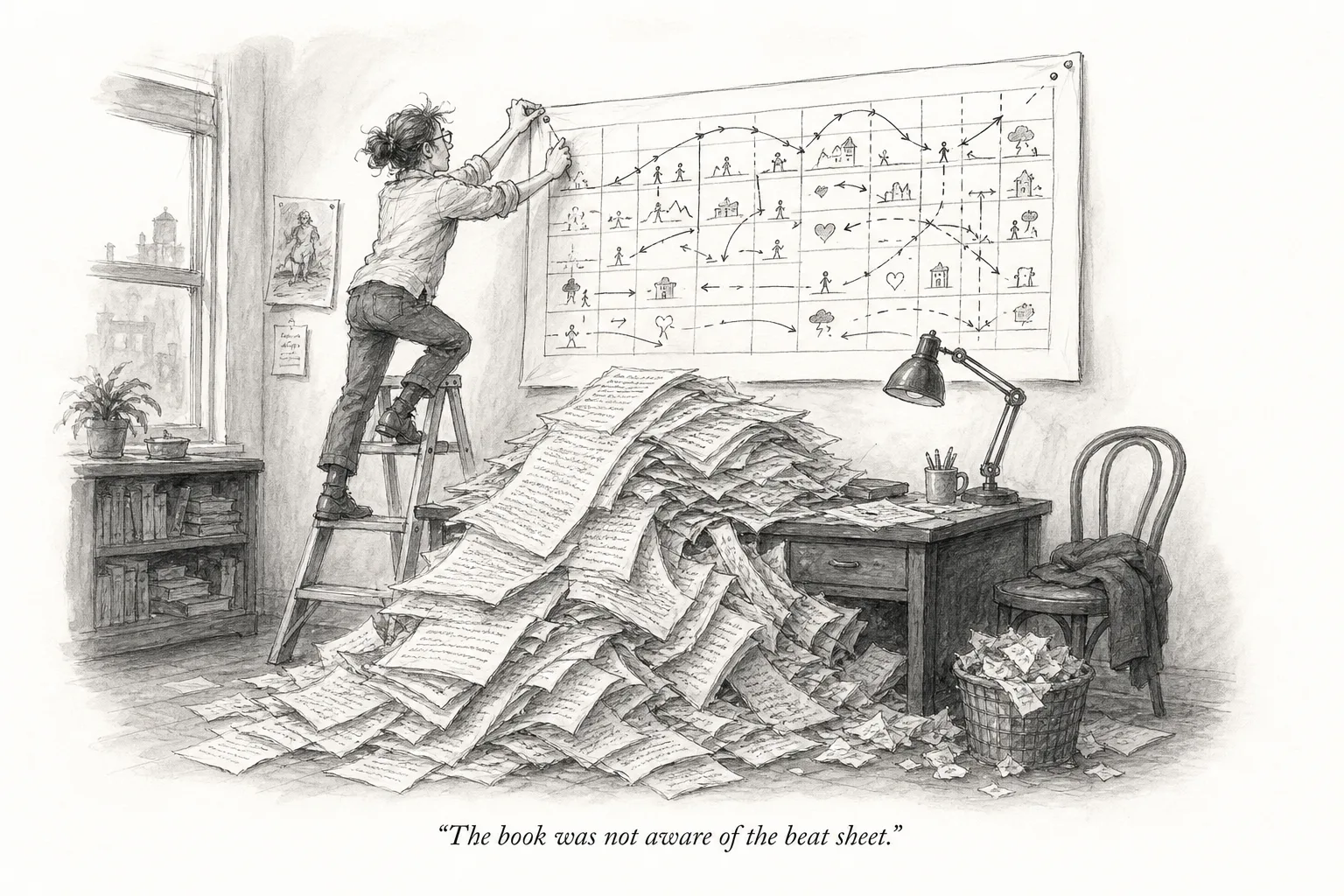
Somewhere around the second draft, most writers go looking for a structure. They come back with a beat sheet, pin it above the desk, and discover that the novel will not lie down on it.
The midpoint reversal is in the wrong place. There is no All Is Lost moment, or there are three. The book resists, and the writer concludes that the book is broken — when what has actually happened is that a template built to describe one kind of story has been asked to govern another.
Models describe, they do not legislate
Every structural model in circulation is a description of shapes that have worked. Three acts, the hero's journey, the story circle, the seven-point, Freytag's pyramid, the Fichtean curve, kishotenketsu: none of these was handed down. Somebody looked at a large number of stories that held readers and drew the shape they kept making.
That matters, because a description used as an instruction produces a very particular kind of failure. Plot points land on schedule and feel arbitrary. The reader senses the machinery — not the beats themselves, but the fact that the beats are arriving because it is their turn.
What you actually need is a shape: a sense of where pressure rises, where it turns, and what the last movement of the book is doing. Three questions get you most of the way there. Is your story driven by external events or by internal transformation? Does its power live in the crisis or in the consequences that follow? And does the reader's satisfaction come from resolution, or from a shift in understanding?
Answer those honestly and the choice narrows itself. A novel about grief forced into a commercial beat sheet reads as mechanical. A thriller built on a structure that withholds conflict lacks urgency. Neither model is wrong; they were describing different books.
Notes on the craft
Occasional letters on what actually breaks novels — and how to fix them. Written for people revising a draft.
No fixed schedule. Unsubscribe in one click. Privacy Policy
Why the mismatch is invisible from inside
Because you know what your book is trying to do, so every scene reads to you as though it is doing it.
A beat sheet, meanwhile, offers something almost irresistible to a writer halfway through a revision: a definition of correct. It converts an unanswerable question — is this working? — into an answerable one: is the catalyst on page ten? The relief is real, and it is why so many second drafts are more obedient and less alive than the first.
There is a related blindness about proportion. You experience your novel in the order you wrote it and at the speed you wrote it, so a first act that occupies nearly two-fifths of the manuscript does not feel long. It feels like the part you know best. Proportion is a whole-book property, and whole-book properties are the ones you cannot see.
How to find your shape by hand
Before you look at any model, write your book in five sentences: how it starts, what changes, what the middle is doing, what the crisis is, and what the last movement is for. Five sentences, no beat names, no jargon.
Then take your chapter list and mark three page percentages: where the story actually starts — the point after which the book could not simply stop — where the middle turns, and where the last movement begins. Do not measure them against a template yet. Just look at the three numbers.
Now compare. If your inciting incident sits at thirty-eight per cent, you have a setup problem, and it does not matter which model you were planning to use. If your climax and everything after it occupy less than a tenth of the book, you have a landing problem — every question the first two acts raised is being dispatched in a hurry.
Only then pick a model, and pick it as a lens rather than a law. Outlining the same material under two or three candidates is a genuinely useful hour: the right one produces a shape that explains scenes you already have, rather than demanding scenes you would have to invent.
What it looks like when it goes wrong
The ninety-page prologue. The first act runs to thirty-five or forty per cent of the manuscript before the story properly begins, thick with backstory and world-setting. The material is often good. It is simply arriving before the reader has a reason to want it.
The midpoint mirage. A large dramatic set piece near the middle after which the protagonist's goal, strategy and understanding are unchanged. A midpoint is not an explosion; it is the moment the character stops reacting and starts acting, or swaps one goal for another.
The sagging corridor. Second-act scenes that are individually competent but sit in sequence rather than in consequence, so the middle reads as a series of separate obstacles instead of an escalating pursuit. This is the "and then" problem at structural scale, and it is the commonest reason a middle drags.
The compressed landing. Climax and resolution together taking less than a tenth of the book, with major payoffs summarised. Every thread deserves roughly the page space its build-up earned.
The borrowed blueprint. The manuscript follows its chosen structure faithfully, beat for beat, and readers describe it as generic — as feeling like other books in the genre rather than like itself. Obedience is not the same as shape.
Where the book shows you this
Cause & Effect is the tool that tests the joins rather than the beats. It reads each pair of consecutive scenes and asks whether the second is caused by the first or merely follows it, which is a more useful structural question than whether a beat landed on the right page — because a book whose scenes cause each other has a shape whether or not it matches anybody's template, and a book whose scenes merely follow each other does not, however tidy the outline looked.
Momentum answers the proportion half: where pressure actually rises and falls across the whole manuscript, and where the long level stretches are.
Neither will tell you which structure to use, and you should be suspicious of anything that claims it can. The model is a lens. What the tools can do is show you the shape you have actually written, which is the only reliable way to find out whether it is the shape you meant.
One of these a week, give or take
If this was useful, the letters are more of it: one problem a novel runs into, what it looks like on the page, and what to do about it.
No fixed schedule. Unsubscribe in one click. Privacy Policy