Subplots that pull their weight
A subplot is not a side story. It is a second line of pressure that has to intersect the main one — and the commonest fault is not quality but proportion.
The note usually arrives with a name attached. I loved the main story, but I skimmed the Marianne chapters. Or, from an agent, more carefully: the second storyline never quite earns its place.
It stings, because the thread in question is often the writer's favourite. It was the reason the book got interesting. And the advice that follows — cut it, or cut it down — frequently makes the novel worse, because the fault was rarely the subplot's quality. It was its wiring.
A subplot is a second line of pressure
A subplot is not a side story. It is a second line of pressure that intersects the main one. That is the whole definition, and both halves of it do work.
Pressure means the thread needs its own want, its own escalation and its own resolution. A sequence of pleasant scenes involving a secondary character is not a subplot; it is a series of visits.
Intersects means the thread has to touch the main line somewhere that matters — a decision it changes, a piece of information it withholds, a cost it imposes. A subplot that runs alongside the main plot without ever crossing it is a short story bound into the same volume, and the reader feels the seam even if they cannot name it.
Two questions decide whether a thread belongs. First: does it have a reason to be in this book rather than another? Second: what does it say about the main story? A subplot is the novel arguing with itself from a second angle — the marriage plot testing the same value the murder plot is testing, in a different key.
Notes on the craft
Occasional letters on what actually breaks novels — and how to fix them. Written for people revising a draft.
No fixed schedule. Unsubscribe in one click. Privacy Policy
Why you cannot see the weighting from inside
Because you have never read your novel the way a reader reads it.
You wrote it in fragments and revised it out of order, and every thread is continuously present in your mind whether or not it is present on the page. Where a reader experiences an eighty-page silence, you experience a thread you were thinking about the whole time. That is the same blindness this series keeps coming back to, and it bites hardest here, because thread proportion is a property of the whole book — the one thing you cannot hold in your head at once.
Attention is the other distortion. You spent four months on the subplot that arrived late and three weeks on the spine of the book. Effort feels like weight. It is not weight; word count is weight, and the reader counts in pages.
How to test it by hand
Take a sheet of paper per thread. Not per character — per thread.
List every chapter the thread appears in, as a row of numbers. Then write three lines: its want, its complication, its resolution. Any thread that cannot fill all three lines is not yet a subplot, and you have just learned which half is missing.
Now look at the row of chapter numbers and find the largest gap. This is the most useful hour in the whole exercise. If the gap runs longer than about a fifth of the book, the thread has gone from dormant to abandoned — and the repair is almost never to move the resolution. It is to put one small touch inside the gap: a reference, a consequence, half a page.
Finally, count the scenes each thread occupies and set the counts side by side. You are not looking for a rule; there isn't one. You are looking for the moment when the arithmetic surprises you — when the thread you thought was a grace note turns out to hold a quarter of the book.
What it looks like when it goes wrong
The bookend subplot. A strong opening flourish in the first act, complete silence through the middle, then a return in the final chapters to deliver a resolution the reader has stopped expecting. The thread has a beginning and an end but no life in between, so the ending reads as tidying rather than payoff.
The sealed compartment. Fully formed — want, complication, resolution all present — and yet none of it ever touches a decision, revelation or consequence in the main plot. The fix is a single point of contact, deliberately chosen: one moment where the subplot's outcome causes something in the main line.
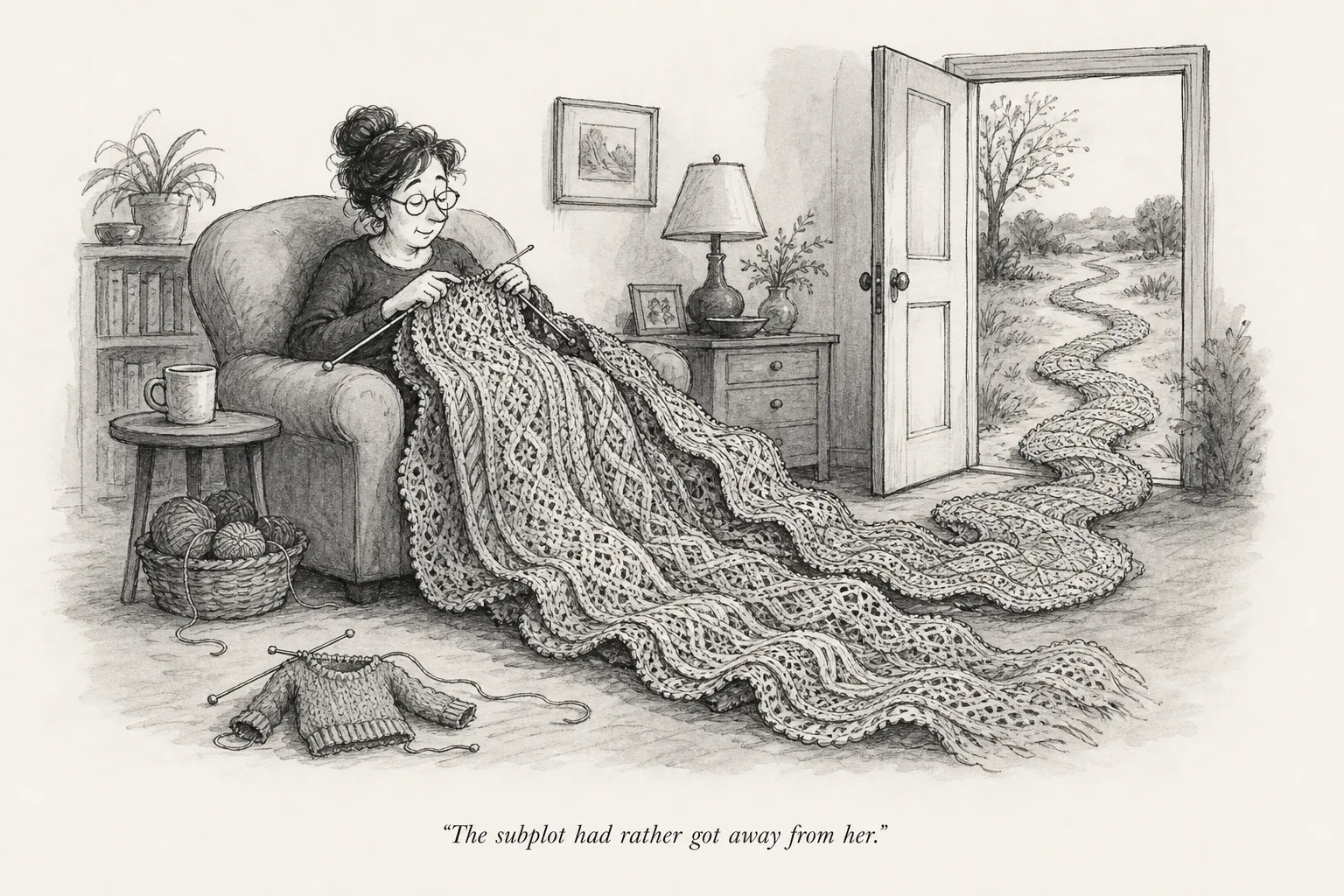
The runaway subplot. A secondary thread has grown to occupy more scenes than the story it was meant to support, and the reader begins treating the main plot as the interruption. This one requires a decision rather than a trim: promote it to a genuine second lead and restructure around two mutually dependent plots, or return it to its proportion. Doing neither is what produces the note about a book that does not know what it is.
The reintroduction paragraph. The symptom of a gap rather than a fault in itself, and the easiest to spot in your own manuscript: when a dormant thread resurfaces, the prose stops to explain who this person is and what they wanted before the scene can do anything. If you have written that paragraph, you already knew the thread had been away too long. Delete it and go back and fill the gap instead.
The off-page resolution. The payoff is reported rather than dramatised — a character mentions that it happened, or the narration summarises the outcome. Threads get resolved off-page when the writer has lost interest in them, which is itself a finding worth taking seriously.
Where the book shows you this
Two tools, and they answer different questions.
Subplots reads every thread across the whole manuscript and reports its health: how present it is, where its peak and its trough fall, and an explicit gap warning when it has been silent too long. It also names how each pair of threads behaves together — reinforcing, competing, parallel, converging or diverging — and how strongly, which is the closest thing you can get to a picture of your novel arguing with itself.
The Thread Browser does the smaller, more practical job: it lets you read one thread in isolation, in order, with the main plot stripped away. Almost nobody has ever read their own subplot that way, and it is startling. A thread that felt continuous in your head turns out to be four scenes and a rumour.
What neither can tell you is whether a thread deserves to exist. A slight, quiet thread may be exactly the counterweight your book needs, and only you know what it is for. But knowing that it disappears for a hundred and forty pages is not a matter of opinion, and it is the sort of thing that is invisible right up to the moment somebody draws it. The same goes for the promises those threads make on the way through — every one of which the reader is quietly keeping count of.
One of these a week, give or take
If this was useful, the letters are more of it: one problem a novel runs into, what it looks like on the page, and what to do about it.
No fixed schedule. Unsubscribe in one click. Privacy Policy