Rhythm is the part readers feel but never name
Prose that reads as monotonous is rarely badly written. It is evenly written — and sentence rhythm is the last thing writers examine because it is felt rather than noticed.
Two notes that look unrelated. The first: the writing is good, but it didn't grip me. The second, offered by a well-meaning friend: it felt a bit samey? — with the question mark, because they cannot justify it.
Neither reader is complaining about the story. They are describing the surface of the prose, which is the only part of a novel a reader actually touches, and they have run out of vocabulary. So has most feedback at this level, which is why the usual response is to hack every sentence in half and hope.
Not badly written — evenly written
Prose that reads as monotonous is rarely badly written. It is evenly written: sentences of similar length, built on similar constructions, paragraph after paragraph.
Rhythm is how a reader's attention is steered. A short sentence after several long ones lands like a blow. A long one after a run of short ones opens the scene out and lets the reader breathe. Neither effect exists in isolation — a short sentence is only short in the company of longer ones, which is why prose chopped uniformly into fragments reads as breathless rather than tense.
Voice, which sounds like a much grander subject, turns out to be the same subject at a longer scale: the accumulation of small, consistent decisions. How long the sentences run. How much perception is filtered through the narrator — she felt, he noticed, it seemed to her — rather than rendered directly. Whether the prose reaches for one concrete detail or three abstract ones. None of that is decoration. It is the reader's experience of being in your book.
Notes on the craft
Occasional letters on what actually breaks novels — and how to fix them. Written for people revising a draft.
No fixed schedule. Unsubscribe in one click. Privacy Policy
Why you cannot hear your own rhythm
Because you read your sentences in the cadence you meant them to have.
You know where the emphasis falls, where the pause belongs, which clause is the joke. You have also read the page thirty times, and the thirtieth reading is not a reading — the eye skates across shapes it recognises. This is the smallest and most stubborn instance of the problem this series keeps returning to: the missing information is supplied by you, invisibly, every time.
It is also why reading aloud has survived as advice for two hundred years. It works because your lungs have no memory of your intentions. Where the breath runs out, the sentence is long, whatever you meant.
How to test it by hand
Take a page you suspect is flat and write the word count of every sentence in the margin. Then ignore the prose entirely and look at the column of numbers.
What you are looking for is a run — five or more sentences sitting within a few words of each other. That is the metronome, and the repair is mechanical: split one, join two, read it aloud again.
Then a second test, which takes ten minutes and tells you more than any amount of line-editing. Print your opening two pages and your climax, and put them side by side. If they are rhythmically indistinguishable — same average length, same construction, same density of filtering — then whatever else is true, the prose is not participating in the story. The most charged passage in your novel is being delivered in the voice you use to describe a character making tea.
While you are there, mark every filter phrase and delete it, putting the perception directly on the page. She felt a chill move through her becomes the chill moved through her, and the reader is one step closer to the room.
What it looks like when it goes wrong
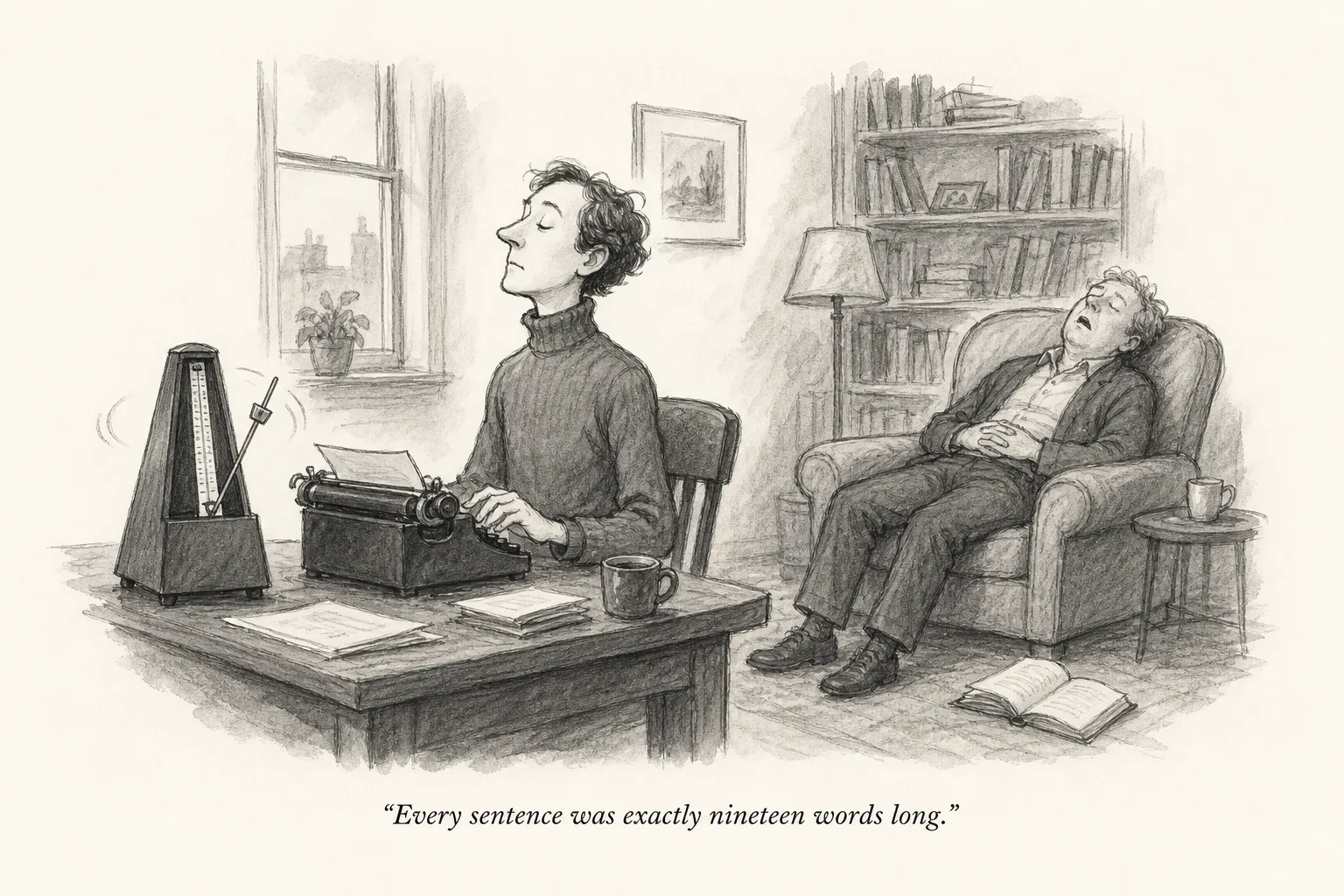
The metronome paragraph. Ten, twenty sentences in a narrow band — commonly fifteen to twenty-five words — each built on the same subject-verb-clause frame. Individually unobjectionable. Cumulatively hypnotic in the wrong sense.
The overcorrected staccato. The damage done by the note itself. Told their prose is flat, a writer chops everything into fragments, and the scene now reads exhausting rather than urgent, because unrelieved shortness has no contrast to work against. One or two long sentences per page exist to give the short ones something to land against.
The call-and-response dialogue scene. Speech, action beat of roughly the same length, speech, matching beat — a pattern so regular the reader begins to feel the machinery. Let a high-tension line sit with no beat at all, and let one pivotal moment take a longer breath than the rest.
The mismatched cadence. The subtle one. Sentence lengths vary; the page would pass any statistical test. But the variation runs against the scene's job — danger rendered in long balanced clauses, a moment of reflection delivered in clipped fragments. Before revising for rhythm, it helps to name in one sentence what the scene needs to do to the reader: accelerate, land a blow, or let them rest.
The anaesthetised narrator. Interior passages where every sensory or emotional fact is reported rather than rendered, so the reader is always one remove from the experience. Filter words are the commonest weakness in otherwise capable manuscripts, and the easiest of all these to fix.
Where the book shows you this
Prose has no diagnostic of its own, and that is deliberate: a whole-book verdict on your sentences would be worthless. The measurements live where they belong, inside a scene — in Scene Signals, alongside that scene's other readings.
What is measured there is genuinely descriptive rather than evaluative: the average sentence length, how much the lengths actually vary, the share of very short sentences and very long ones, how much of the scene is dialogue, which words echo and how close together they fall, a readability index, and the passive constructions with the sentences they occur in.
Not one of those is a grade, and any of them can be the right answer for a particular scene. Long, unvaried sentences are a legitimate instrument for tedium, ceremony or dread. The value is in comparison: this scene against the rest of your book, and your opening against your climax. What the numbers give you is the thing rereading cannot — a shape you have not memorised.
At the scale of the whole novel the same question becomes structural, and a pacing note is what it usually arrives as.
One of these a week, give or take
If this was useful, the letters are more of it: one problem a novel runs into, what it looks like on the page, and what to do about it.
No fixed schedule. Unsubscribe in one click. Privacy Policy