How long should a novel be?
Genre word-count ranges, what an over-length manuscript actually signals to an agent, and why cutting sentences never recovers the ten thousand words you need.
It is the most-asked question in writing and the one most likely to get a shrug. Long enough to tell the story, the answer goes — which is true, unhelpful, and quietly untrue in one specific circumstance: when you intend to submit the book to agents.
So here is a straight answer, with the honest caveats attached.
The numbers, by genre
These are the targets the app suggests when a writer sets a word-count goal, resolved from the book's genre. They are market conventions rather than aesthetic rules, and they exist because agents and publishers read at scale and use length as an early filter.
By family: crime and mystery around 85,000 words (75,000–95,000). Romance around 85,000 (75,000–95,000). Horror around 85,000 (75,000–95,000). General and literary fiction around 90,000 (80,000–100,000). Thriller and suspense around 95,000 (85,000–105,000). Fantasy and science fiction around 100,000 (90,000–120,000). Historical and adventure around 110,000 (90,000–130,000).
Several specific genres sit deliberately outside their family. Epic fantasy runs to about 130,000 (110,000–150,000), as do progression fantasy and family saga — the saga stretching to 160,000. Space opera, military science fiction and romantasy sit around 110,000. Cozy mystery comes down to about 75,000, cozy fantasy to 85,000, noir and romantic comedy and coming-of-age to about 80,000. Young adult is about 75,000 with a floor as low as 60,000. Where the genre is unknown, the default is 90,000.
What the number is for
Not quality. There is no relationship between word count and whether a novel works — a fact any bookshelf demonstrates in thirty seconds.
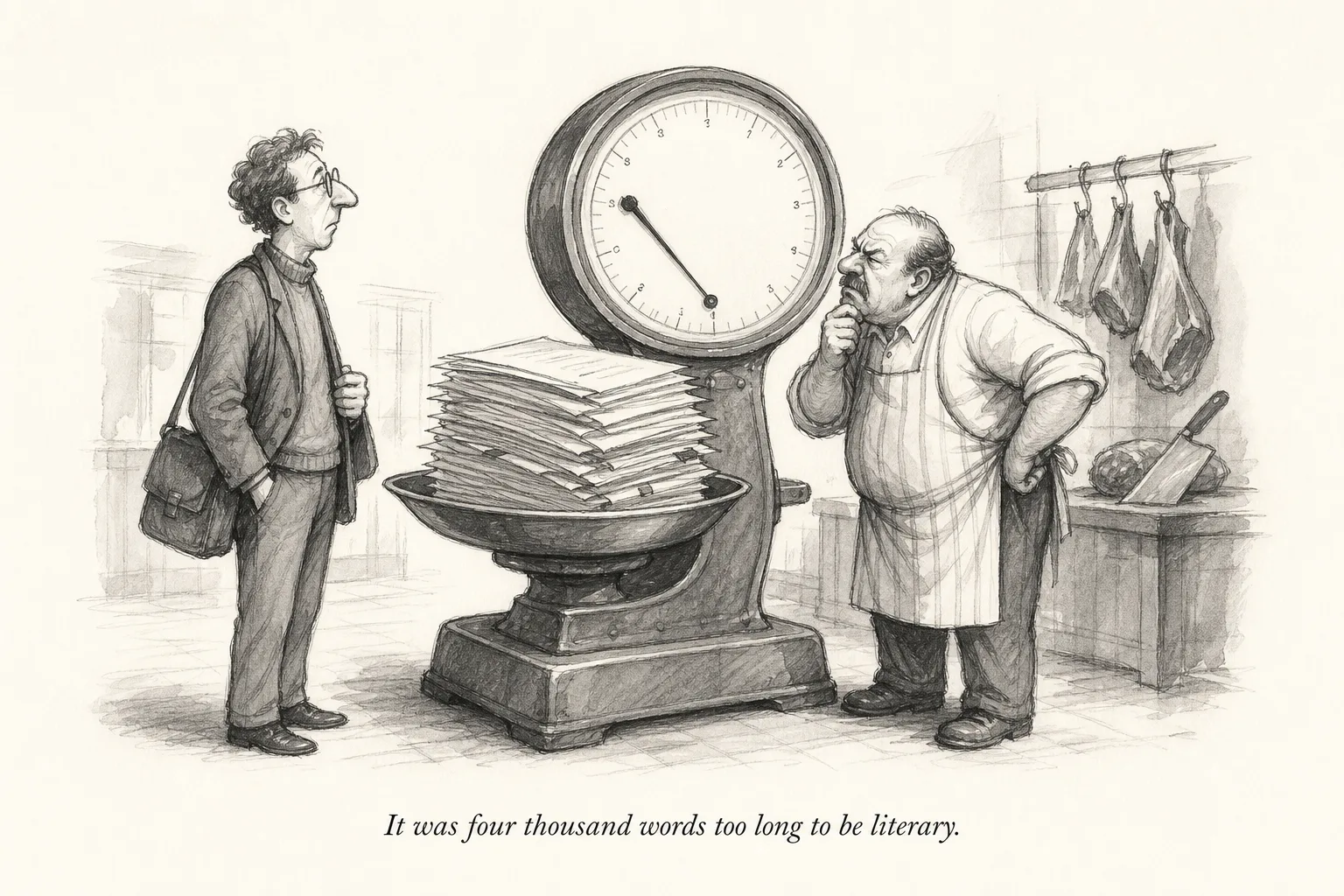
What length does tell you is something about proportion and about expectation. A crime novel at 140,000 words is not too long in some absolute sense; it is long enough that an agent will assume, before opening it, that the middle sags. Often they will be right, because an over-length manuscript in a tightly conventional genre is usually carrying material the story does not need. And a fantasy at 55,000 words signals the opposite: that the world has not been inhabited long enough for the reader to care about it.
So the useful way to hold the number is as a question rather than a verdict. If you are twenty per cent over your genre's range, something is probably in there twice. If you are far under, something the genre promises is probably missing.
Where this is a thing we measure
Word count is the plainest measurement in the app and one of the few that needs no AI at all. It is counted per scene, rolled up per chapter and per book, and — if you set a target — reported as a percentage of it.
Setting a target is optional and it is worth doing, because it converts the vaguest anxiety in revision into a number that either is or is not a problem. The control pre-fills the suggestion for your genre from the table above, so you can accept it, adjust it, or clear it.
The figure then appears in two places. On the novel's home page it sits as a progress bar against the target. And in Manuscript Readiness — the pre-submission capstone — it appears as one line of a plain checklist alongside how many revision tasks are still open, how many continuity flags remain, and whether your last full read is still current.
Why writers misjudge their own length
Because you experience the manuscript as chapters written on particular days, not as a quantity. A writer who has spent four months in the second act genuinely cannot tell that it now occupies half the book.
There is also a specific trap in cutting. Almost everybody cuts sentences when asked to cut ten thousand words, because sentences are the layer you can face. Sentence-level trimming across four hundred pages recovers perhaps two per cent and costs the prose its rhythm. The ten thousand words are nearly always a subplot, a viewpoint, or four scenes doing the same job — which is a structural judgement, and structure is exactly what you cannot see from inside.
How to test it by hand
Write down your total, then your genre's range, then the difference as a percentage. Under ten per cent either way: stop thinking about it.
If you are over, list your chapters with their word counts and find the longest quarter of the book. Length concentrates; it is rarely spread evenly. Then ask of that quarter what it would cost the ending to lose any part of it.
If you are under, do not add words. Ask instead what the genre promises that your book has not yet delivered — an obligatory scene skipped, a relationship never dramatised, a world never inhabited. Under-length manuscripts are usually missing an event rather than a description.
One caveat worth stating plainly
These ranges apply to a debut going out on submission. If you are self-publishing, the constraint is different and largely commercial. If you are writing something deliberately unusual, the constraint is that you had better be doing it on purpose — which is a legitimate answer, and one no tool can give you.
Length is downstream of what your genre has promised the reader, which is its own subject.
Notes on the craft
Occasional letters on what actually breaks novels — and how to fix them.
No fixed schedule. Unsubscribe in one click. Privacy Policy