Dialogue is something a character does
Dialogue is not information moving between two people. It is something a character does to another — persuade, deflect, threaten — and the real argument usually runs beneath the spoken one.
Every line is plausible. Nobody speaks out of character. The punctuation is impeccable. And still the note comes back: the dialogue felt a little functional.
Functional is the word to notice. It means the conversation worked — it delivered what it was built to deliver — and that the delivery was the only thing happening.
Speech as an act, not a transfer
The most useful reframing in this part of the craft is also the simplest. Dialogue is not information moving between two people. It is something a character does to another character: persuade, deflect, threaten, flatter, stall, wound, seduce, forgive.
Which means a conversation is a scene inside a scene. It has goals, resistance and an outcome. Somebody wants something from the other person at the start, and by the end they have got it, been refused it, or been forced to want something else.
The second principle follows from the first: people rarely say the thing they most want, because they are protecting something — dignity, hope, an advantage. So the real argument of a scene tends to run beneath the spoken one. That gap is subtext, and it is worth being precise about what subtext is not. It is not vagueness. The reader must be able to tell exactly what is being avoided; that legibility is what makes the avoidance readable as pressure rather than as fog.
Notes on the craft
Occasional letters on what actually breaks novels — and how to fix them. Written for people revising a draft.
No fixed schedule. Unsubscribe in one click. Privacy Policy
Why you cannot hear your own dialogue
Because you cast it.
You hear the scene performed in your head by actors who already know their intentions. You know that when she asks whether he has eaten, she is asking whether he went to the flat. The line arrives to you fully loaded — and to the reader, who has not been at rehearsals, it arrives as a question about lunch.
This is the same structural blindness that runs through every problem in this series: you supply the missing charge from memory, so the underpowered line and the loaded one feel identical on the page. And because you wrote both sides of the conversation, nobody in it can surprise you — which is precisely the sensation the reader is supposed to have.
How to test it by hand
Take one dialogue scene. Before you read it, write down what each character wants from the conversation and is not saying directly. One line each. If you cannot fill in the second character's line, you have found the problem before you started: they are in the scene to receive, not to want.
Now go through the scene and delete every line in which a character names their own feeling or want. All of them. Then rewrite each deleted line as the thing that character would actually say in order to avoid naming it — a question, a joke, a change of subject, an accusation about something smaller.
Two checks afterwards. First, read it cold, or better still hand it to someone else: can a reader still say what the scene is about? If not, you have overcorrected into obliqueness. Second, mark each speech with the tactic behind it — reasoning, appeal, needling, threat, retreat — and see whether the tactics escalate. A conversation in which nobody changes tactic is a conversation in which nobody is losing.
What it looks like when it goes wrong
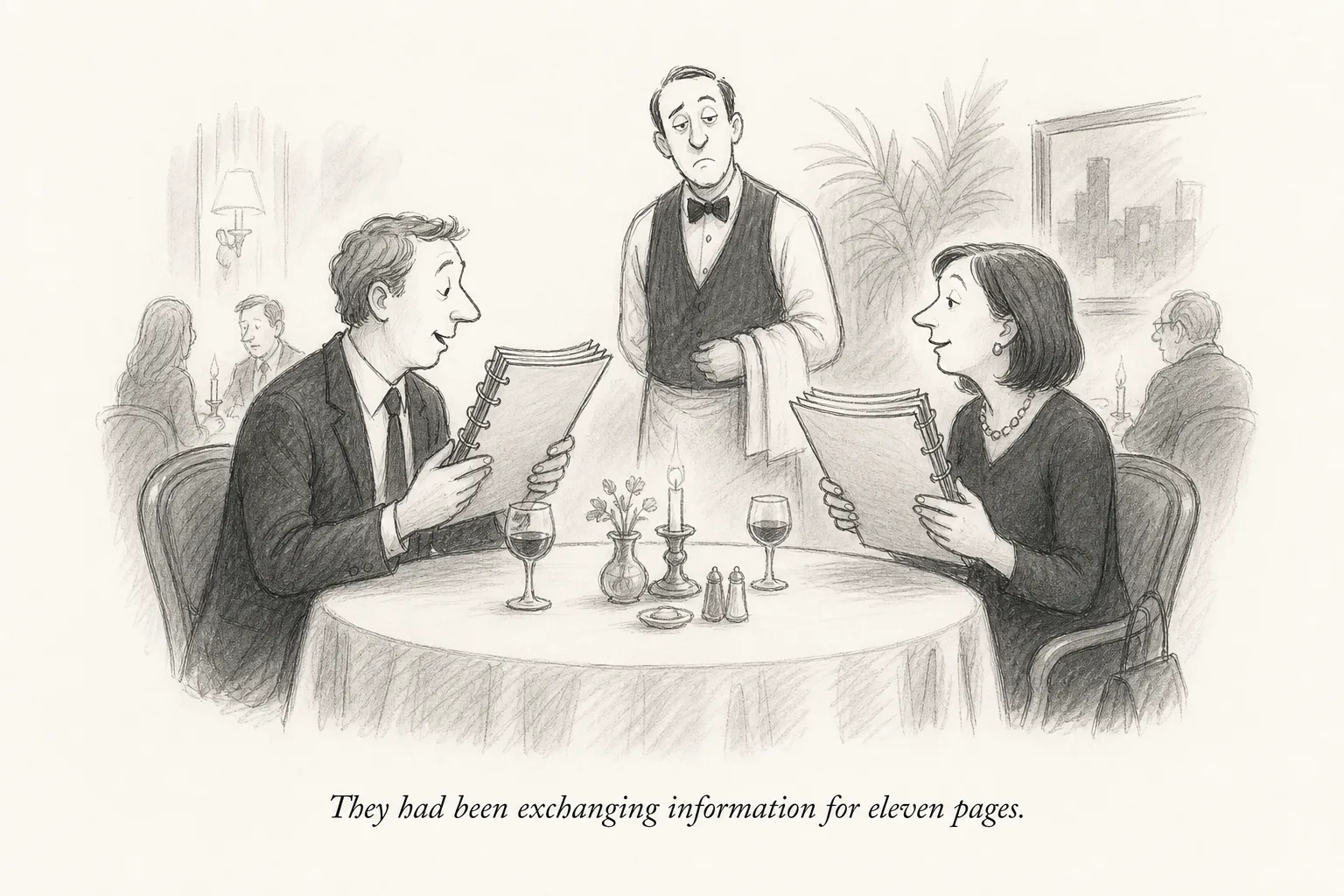
The information desk. Characters exchange facts the reader needs — backstory, plans, plot mechanics — in an exchange that reads like a briefing. Nobody withholds, nobody resists, and nobody has a stake in the telling. The repair is not less information; it is giving the teller a reason not to want to say it and the listener a reason not to want to hear it.
The confession booth. Characters state their motives plainly: I only did it because I love you. I'm frightened you'll leave. Occasionally a character has earned exactly that, and it is devastating. Nine times in ten it is the writer speaking through them, and the same need pursued indirectly — through a joke, a needling remark, an errand — would land far harder.
The debate club. Two characters trade articulate opposing positions across a page and neither bends, deflects or changes approach. It looks like conflict because there are two sides. It is not a contest, because nobody can lose.
The nodding heads. One character asks for something and gets it within two lines. Agreement arrives so easily that the exchange generates nothing. One refusal, deflection or counter-demand before the granting is usually all that is required, and it changes the value of what is finally given.
The explainer tag. A genuinely good line of subtext, followed immediately by narration explaining what the character really meant — cancelling the ambiguity the dialogue had just earned. Cut the gloss. If the line does not survive without it, the problem was never the gloss.
Where the book shows you this
Here is an honest answer: dialogue does not have a diagnostic of its own, and it is the part of this series where the tools have least to say.
What the app does measure sits inside a scene, in Scene Signals: the proportion of the scene that is dialogue against narration, how the speech is tagged — plain said and asked against showier alternatives — and how often a tag is propped up with an adverb. Those are measurements of habit, and habits are worth seeing. They are not measurements of whether a conversation is a contest, and it would be dishonest to present them as such.
For the thing that actually matters, the useful reading is sideways. A conversation that changes nothing is a scene that changes nothing, and that the Scene Ledger will find: it asks of every scene who decides, what changes and what the reader learns, and a talk scene with two empty columns is your information desk showing up in a table.
The judgement stays with you, as it should. Some conversations are meant to be flat — bureaucratic, exhausted, deliberately evasive — and a novel in which every exchange is a duel is as tiring as one in which none is. But it is worth knowing which of your scenes are contests, because a reader can tell, and they will only tell you it felt functional.
One of these a week, give or take
If this was useful, the letters are more of it: one problem a novel runs into, what it looks like on the page, and what to do about it.
No fixed schedule. Unsubscribe in one click. Privacy Policy