Continuity is a trust exercise
Readers forgive a great deal, but not a Tuesday that becomes a Thursday. Every small contradiction withdraws a little credit from the book.
Beta readers rarely lead with it. It arrives at the end of the notes, prefaced with an apology: small thing, but I think it was Tuesday earlier? Then a short list. The car changes colour. A character is thirty-four in one chapter and turns thirty in another. Somebody knows about the letter two scenes before anybody shows it to them.
None of it looks structural, so it goes to the bottom of the revision list, beneath the real work. That is a mistake, and not for the reason writers assume.
What the reader is actually telling you
Continuity is the quiet contract a novel makes: this world behaves according to rules, and the rules do not change unless the story says why. Distances take the time distances take. A letter arrives after it is sent. Above all, characters act on what they know, not on what the author knows.
Nobody abandons a novel because a journey took one day instead of two. They lose confidence because the slip tells them something about the state of the manuscript — that the writer has stopped tracking their own world, and might therefore have stopped tracking the reader's experience of it. A continuity error is almost never read as a single mistake. It is read as evidence.
And trust in fiction is asymmetric: it accrues slowly and collapses at once. The first contradiction is forgiven. The second is noticed. By the third, something has changed in how the book is being read — the reader has begun checking, and a reader who is checking is no longer inside the story. Agents read the same signal faster and less charitably, because a manuscript with drifting details is a manuscript that has not been finished.
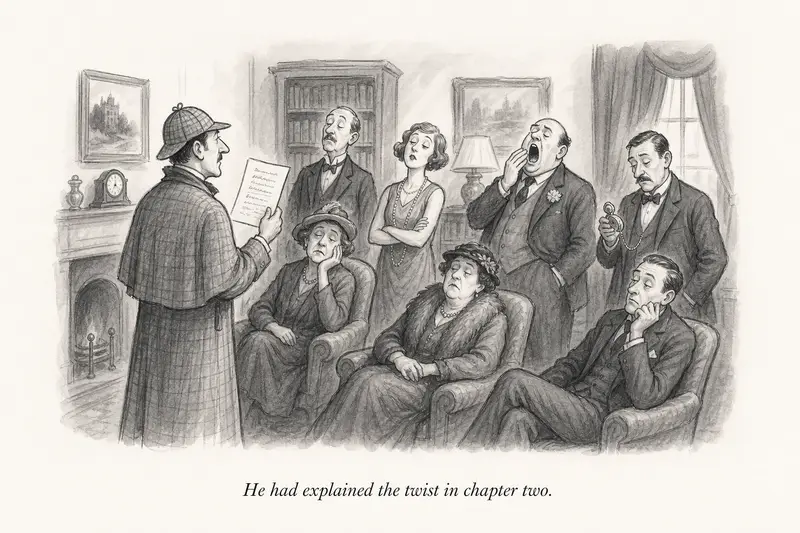
One kind matters far more than the rest. Factual drift is embarrassing; knowledge continuity is structural. If a character acts on something they were never told, the plot has stopped being earned — and nothing undermines a good twist more thoroughly than a reader working out that the surprise only functioned because somebody forgot what they knew.
Notes on the craft
Occasional letters on what actually breaks novels — and how to fix them. Written for people revising a draft.
No fixed schedule. Unsubscribe in one click. Privacy Policy
Why these errors are invisible to you specifically
Because you hold the whole world in your head, complete and consistent, and the manuscript is only a partial transcription of it. When a character reacts to news, you know how they got it. The transfer happened — in your head. The page never records it, and you are the one reader who cannot notice the omission, which is the same blindness at work in every problem this series keeps returning to.
There is a crueller mechanism underneath, too. Most continuity errors are not in the first draft. They are created by revision. You move a chapter forward for pacing and every reference written for its old position stays behind. You cut the scene where the wound was inflicted and keep the three later scenes where it aches. You rename a character in chapter two and catch nine of the eleven mentions. The better your structural editing, the more of this debris you generate — which is why continuity should be a late pass, and why doing it early is wasted effort.
How to test it by hand
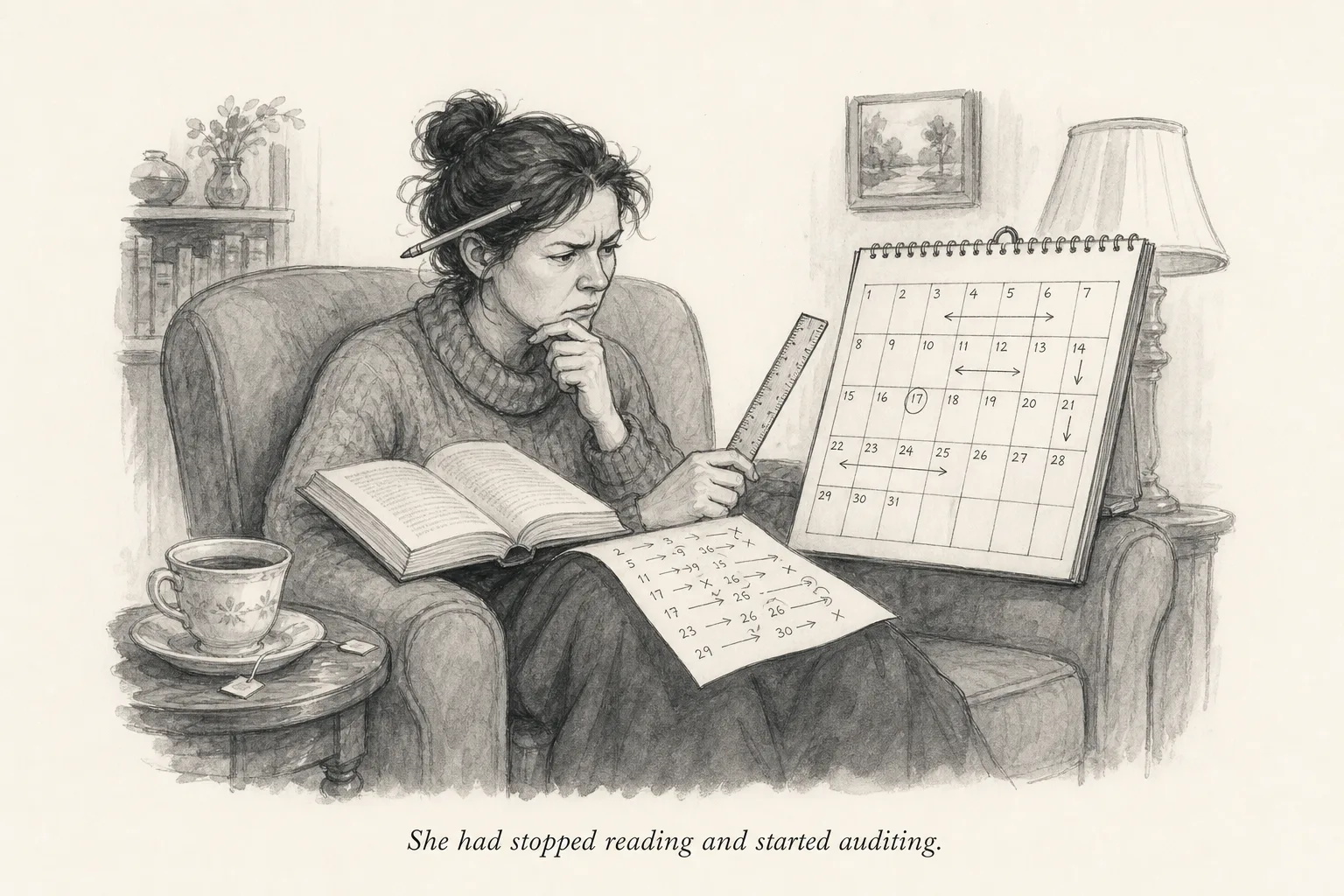
Build a spine. One line per scene, in manuscript order, four columns: day number, place, who is present, what changed.
The day number is the load-bearing one. Assign an actual day count to every scene, even where the text is vague — day 1, day 4, day 4, day 11 — and let the arithmetic do the auditing. Journeys, seasons, pregnancies, recoveries and ages all fall out of a spine like that within an hour, and the errors show up as impossibilities rather than as feelings.
Then add a fifth column, and this is the one most writers skip: learned. Whenever a character acquires information the reader considers important, write their name and the fact. Later, when somebody acts on that fact, you can find the row where they got it — or discover there isn't one.
Keep a running sheet beside all this for the rules your world has already set: how the magic costs, how long the drive takes, what the family does at Christmas. Not a bible, a list. Its purpose is not to be complete but to be checkable.
What it looks like when it goes wrong
The telepathic character. Someone references, reacts to or acts on information they were never present to receive and were never told on the page. The emotional beat demanded that they know, so they knew. This is the one to fix first, every time.
The reshuffled chapter. A detail correctly belongs to a scene that no longer sits in that position: a letter discussed before it arrives, a wound mentioned before the injury. When you move a scene, search for every reference to what happens inside it — not only in the neighbouring chapters — and check each one against the new order.
The elastic clock. Elapsed time contracts and expands to suit whatever the plot needs at the time. A two-day journey completed overnight. A season that never ends because a scene kept its old weather after being moved. A funeral described as last spring in one chapter and two years ago in another.
The shape-shifting detail. Eye colour, the spelling of a name, the make of the car, the number of siblings. Trivial individually, and the cheapest of all to repair: choose the correct version and eliminate every contradicting instance. Treat it as a find-and-replace task, not a judgement call.
Worth saying plainly, because it comes up: a narrator who contradicts themselves on purpose is a device, not an error. But it only works if the contradiction is legible as theirs rather than the book's, which usually means another character, a document or a date is available to the reader as a fixed point. Unreliability without a fixed point reads as carelessness.
Where the book shows you this
Continuity Check reads the manuscript for contradictions and reports them as pairs: the two passages that cannot both be true, quoted side by side with the scenes they came from, each with a confidence level attached. Pairs matter. A list of complaints is an argument; two quotations next to each other is a fact you can settle in ten seconds and move on.
Expect to disagree with some of them. Deliberate ambiguity, an unreliable narrator, a character lying about a date — all of these look exactly like continuity errors from the outside, and only you know which they are. The value is not the verdict. It is being handed the two passages, so that the ten minutes you spend are spent on the pairs that turn out to be real, and the plot no longer depends on somebody forgetting what they knew — which is the same discipline, viewed from a different angle, as making sure your scenes are joined by something more than "and then".
One of these a week, give or take
If this was useful, the letters are more of it: one problem a novel runs into, what it looks like on the page, and what to do about it.
No fixed schedule. Unsubscribe in one click. Privacy Policy