A setting is not a backdrop
Setting is not scenery. It is a set of forces acting on every character — and the test of any world detail is what it prevents someone from doing freely.
The setting is usually the part writers are most confident about. Months of research. A map, possibly. Weather that behaves differently in each season, a city with a history, a magic system with a cost.
Which is why this note is such a puzzle when it arrives: I never really felt like I was there. Or, from an editor, more precisely: the world is beautifully realised but it doesn't seem to matter.
A world is a pressure, not a picture
Setting is not scenery. It is a set of forces acting on every character in every scene — what they can and cannot do, what things cost, what is forbidden, what is dangerous, what is precious and why.
A world with clear rules generates story by itself. If magic costs something, that cost drives choices. If the society forbids something, that prohibition manufactures desire. If the harvest fails every third year, everybody in the book is making decisions about the third year whether or not you write a scene about it.
Which gives you a simple test for any piece of world-building, and it is a brutal one: what does this detail prevent a character from doing freely? If the honest answer is nothing, it is decoration. Decoration is not worthless — a novel with no texture is thin — but a world made entirely of it will produce exactly the note above.
The other half of the principle is that the best world-building is invisible. It makes the reader feel the air and the pressure without stopping the story to explain them.
Notes on the craft
Occasional letters on what actually breaks novels — and how to fix them. Written for people revising a draft.
No fixed schedule. Unsubscribe in one click. Privacy Policy
Why you cannot feel your own world
Because you are the only reader who has been living in it.
You know what the currency is worth, so a character paying three marks for a bed reads to you as a small extravagance. To the reader it reads as three of something. The economy exists in your notes, in enormous detail, and its consequences never reach the page because to you they are too obvious to write down.
That is the same blindness at work throughout this whole series, with one extra turn of the screw: research makes it worse. The more you know about your world, the more of it you assume, and the more likely you are to mistake the sensation of a fully imagined place for the reader's experience of a fully rendered one.
Rules are the other casualty. You invented the rule, so you feel its force in every scene — even the ones where the story quietly needed the character to be allowed to act, and you let them.
How to test it by hand
Pick one rule of your world. Physical, social, magical, economic — one.
Now trace it in three lines. What does it forbid? What does it make precious? What does it make dangerous? A rule that cannot fill all three lines is not yet a rule; it is a fact.
Then do the harder pass. Search your manuscript for every scene the rule touches and check whether it applied. Not whether it was mentioned — whether it cost somebody something. You are looking for the scenes where a character got what they wanted without paying the price your world charges, and those scenes will cluster around the moments when the plot was in a hurry.
Keep the results as a list — a rules sheet, kept exactly as you would keep a character fact sheet. Not a bible. A page. Its value is not completeness but checkability: the next scene that touches a rule gets checked against it before you move on.
What it looks like when it goes wrong
The briefing scene. A mentor, an outsider or a conveniently curious newcomer is told how the world works, in a scene whose only job is delivering that information. Nothing in the scene depends on it. The repair is not to cut the information but to replace the explanation with a collision: let a character want something the rule denies them, and the reader learns the rule by watching it bite.
The toothless rule. A carefully established cost, prohibition or limit that quietly stops applying whenever the plot needs the character to act without it. Readers may not be able to name what has happened, but they stop believing the world, and after that they stop worrying about anything that happens in it.
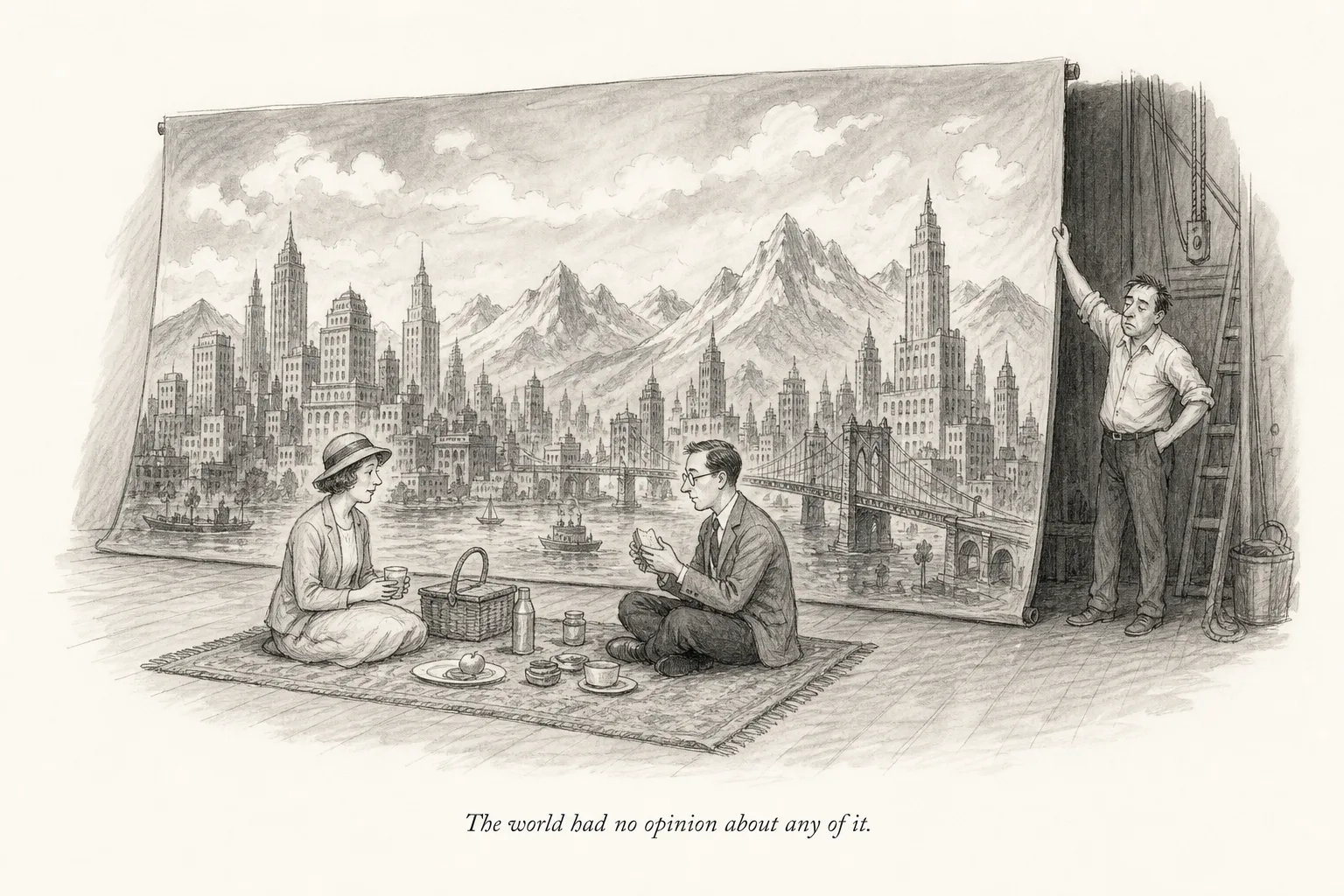
The postcard setting. Vivid, specific, sensory detail that never forecloses a choice or raises a cost for anyone. Often the most admired writing in the manuscript, which is why it survives every revision.
Rule drift. A world mechanic — a currency, a magic cost, a social prohibition — behaving differently late in the book from how it behaved when introduced, with nothing in the story to explain the change. This is a continuity fault as much as a world-building one, and it is created by revision at least as often as by drafting.
Where the book shows you this
World-building has no diagnostic of its own, and the tool that catches most of the damage is the one you would not think to look in: Continuity Check.
It reads the manuscript for contradictions and reports them as pairs — the two passages that cannot both be true, quoted side by side with the scenes they came from and a confidence level attached. Rule drift shows up there as a matter of fact rather than of taste: the passage where the crossing takes three days, next to the passage where it takes an afternoon; the cost paid in chapter four, next to the moment it was waived in chapter twenty-nine.
What the tool cannot judge is whether a rule was worth having. A world that constrains nobody is a stylistic choice, and there are fine novels whose settings are pure atmosphere. But if your reader has told you the world did not seem to matter, the fastest route to the cause is not more description. It is the list of rules, and the scenes where they were not charged.
Genre expectations are the other force acting on all of this, since a reader arriving at a world arrives with a set of expectations about what it will demand of its characters.
One of these a week, give or take
If this was useful, the letters are more of it: one problem a novel runs into, what it looks like on the page, and what to do about it.
No fixed schedule. Unsubscribe in one click. Privacy Policy