Your scene is not bad, it is below your own average
Scene scores are not grades. There is no correct level of tension for chapter nine, which is why every measure is read against your own book rather than a standard.
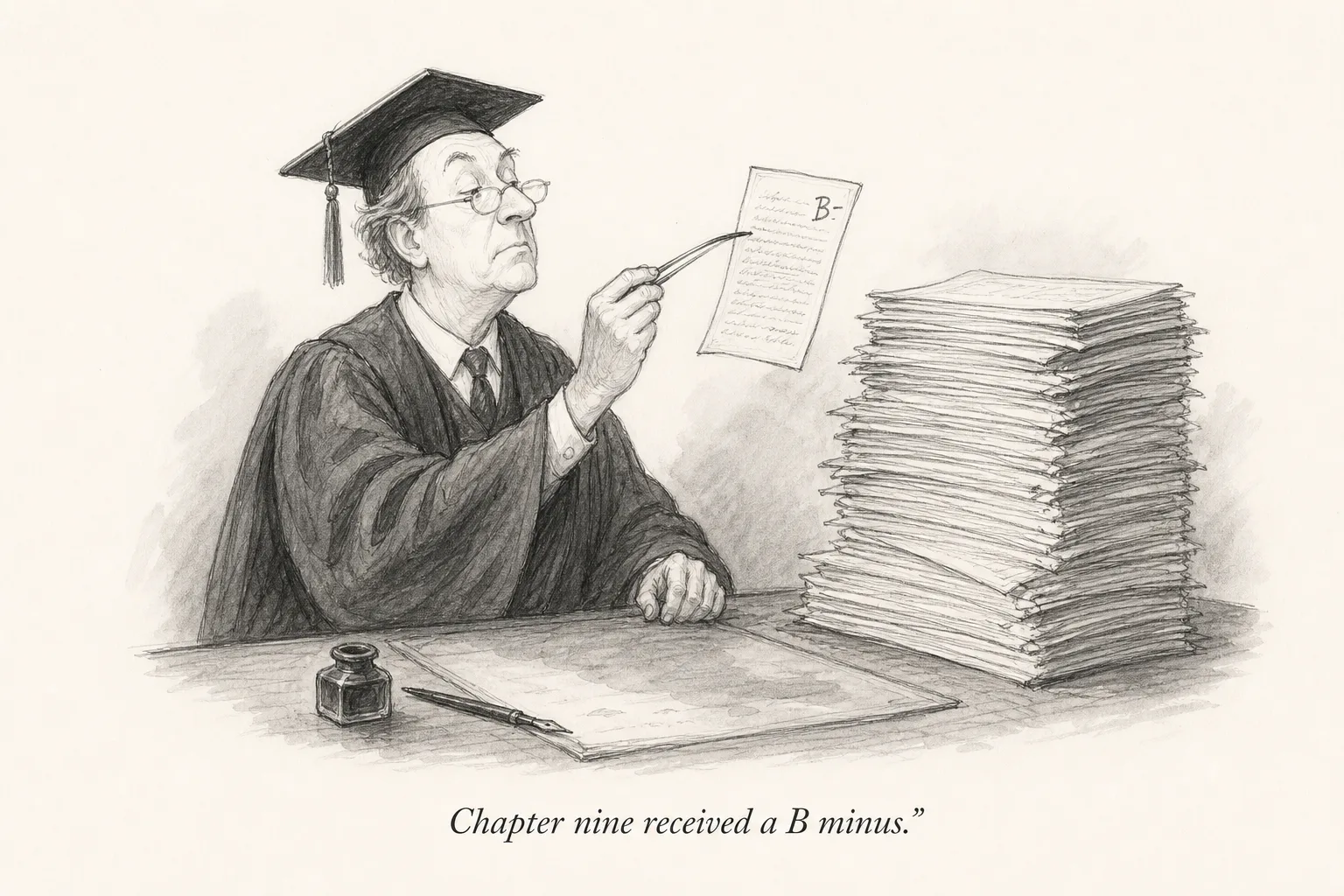
The first thing writers do with a scene score is treat it as a mark. Chapter nine got a four out of ten, so chapter nine is a bad chapter, and the afternoon disappears into improving a number.
This is the wrong instinct, and it is worth spending a thousand words on, because it is the difference between a measurement that helps you revise and one that just makes you anxious.
There is no correct score for chapter nine
The per-scene numbers in the app — tension, conflict, stakes, agency, revelation, emotional intensity — are impressionistic readings on an unanchored scale. There is no calibrated standard behind them: no external corpus, no grade boundary, nothing that says a well-made scene scores seven.
Which is why the app never shows them as absolute grades. Every one of those six is presented against your book's own average, and the sentence a writer gets is comparative: this scene sits below where your manuscript usually sits, or about where it usually sits.
That is not a hedge. It is the only reading that carries information. A novel is a system of contrasts, and a quiet scene is not a failure — it is the thing that makes the next loud one land. A book scoring a uniform seven everywhere would be exhausting and strange. What you want to know is not how good is this scene but where does this scene sit in my own range, and is that where I intended it to sit?
How the comparison is actually drawn
Three details worth knowing, because they explain what you see.
A scene is flagged for attention when a measure falls to or below the lower of two thresholds: your book's average for that measure, or 3.5. So in a high-tension thriller the bar is your own average; in a quiet literary novel it is the absolute floor, and the tool does not tell a deliberately restrained book that every scene is under-tensioned.
"About average" means within one point either way. Anything inside that band is not a finding, and treating it as one is how writers end up revising noise.
And the comparison is suppressed entirely until at least five scenes have been scored, because an average drawn from three scenes is not an average.
The one genuine exception
Exactly one scene measure does have an expected value, and it is the interesting one: value charge — whether the scene ends better or worse for the protagonist than it began.
That one is positional. The story shape your genre and ending imply produces an expected charge at each point in the manuscript: a negative charge at the opening lack, a positive one at commitment, a swing at the midpoint, a hard negative at the all-is-lost beat, positive at the climax turn and the resolution. So a scene can be described as on the expected shape or running counter to it, which no unipolar measure can support.
The consequence surprises people. A scene scoring strongly negative at the all-is-lost position is correct. The shape expects it. A tool that graded that scene down would be misreading the book. Conversely, a neutral scene where the shape expects a real turn is a finding — and a neutral scene where the shape also expects roughly neutral is not.
Why you need the comparison at all
Because your sense of your own range is unreliable. You remember scenes by how hard they were to write, not by how they read, and the ones you laboured over feel eventful regardless of what is on the page.
You also cannot hold a distribution in your head. Whole-book properties are precisely what a writer cannot see, and "below my own average" is a whole-book property by definition. It requires the average.
How to use it without misusing it
Look for runs, not points. One low scene is a decision. Five consecutive low scenes is a structural finding.
Ask whether the intention matches the position. If a scene reads low on tension and you wrote it as a lull after a disaster, the measurement has confirmed the design. Close the panel. If you wrote it as the moment everything tightens, you have learned something real.
Ignore the one-point band. Genuinely.
And never treat an unscored scene as a zero. Roughly a quarter of scenes across the app are unmeasured at any moment — too short, not yet analysed, or a front-matter page — and an empty measurement is an absence of information, not a bad result. The app renders nothing rather than a zero for exactly this reason, and you should read it the same way.
Where the book shows you this
Scene Signals, the second tab of the scene slide-out, is where all eight of a scene's measurements sit together: the six Narrative Pulse measures read against your book's own averages, theme presence and value charge in The Value Arc — the charge shown against what the shape expects at that position — and the prose metrics beneath. Each carries a line explaining what that scale actually measures, and any threshold crossing can be promoted straight to a revision task.
Narrative Pulse is the same information at book scale, which is where runs become visible. Use the scene panel to understand one scene and Pulse to find the stretch that needs attention.
The habit worth building is to stop asking the number whether the scene is good. It does not know. Ask it where the scene sits in your own book, and then decide — because that decision was always going to be yours.
Notes on the craft
Occasional letters on what actually breaks novels — and how to fix them.
No fixed schedule. Unsubscribe in one click. Privacy Policy