The character who appears in three scenes
Presence is arithmetic: how many scenes, what share of the book, and — the figure that actually predicts the note you get — the longest absence.
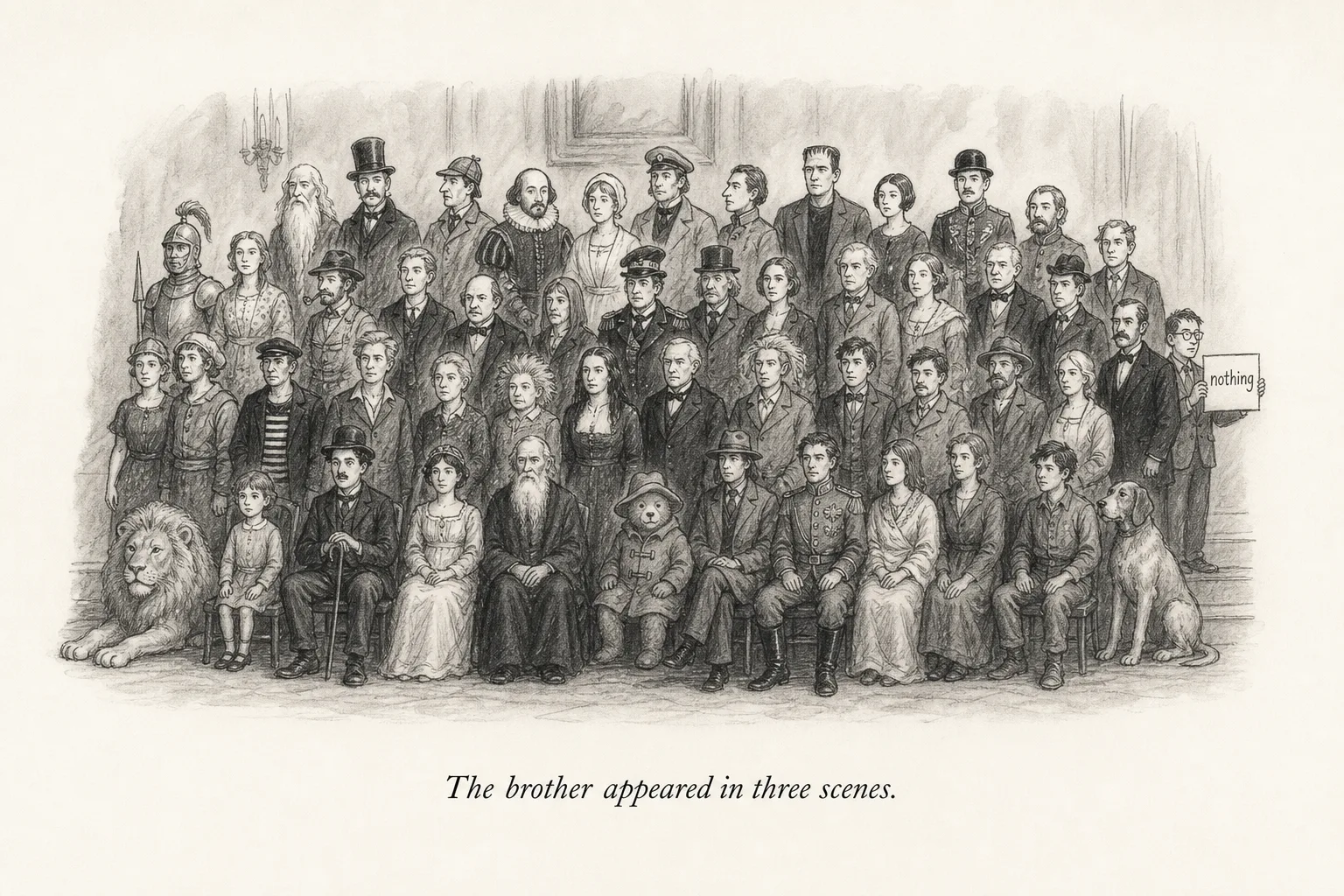
Every novel has one. A named character, introduced with care, given a history and a manner of speaking — and present, across four hundred pages, in three scenes.
Sometimes that is exactly right. A three-scene character can carry enormous weight. But often it is a fossil: someone who was central in the outline, or in the first draft, and whose role drained away in revision without anybody noticing, because nobody reads their own novel counting appearances.
Presence is measurable, and it is arithmetic
For every character in a manuscript, the app computes presence directly from the text rather than asking a model: how many narrative scenes they appear in, what percentage of the book that is, where they first appear, and — the most useful figure of the four — their longest absence.
That last one is worth dwelling on. A character can appear in forty per cent of a novel and still be badly deployed if thirty of those appearances are in the first third. Total presence tells you how much of the book someone is in. Longest absence tells you whether the reader has had time to forget them, which is the number that actually predicts the note you will get.
These figures are deliberately recomputed live from the manuscript every time, never served from a stored analysis, for a reason worth knowing: presence is a fact about the text, and a fact about the text should never be reported from a snapshot that might have been taken before the text was finished.
Why you cannot count your own cast
Because your characters are all continuously present to you. They do not stop existing between their scenes; you know what the antagonist is doing during the chapters in which he does not appear, because you decided it.
The reader has only the appearances. And the reader's memory of a character decays at a rate you have no access to — which is why the note "I'd forgotten about the brother" lands as such a surprise, and why the writer's instinct is to argue rather than to check.
There is a related blindness about the front of the book. Introducing five named characters in the first two chapters feels efficient when you know all five. To a stranger it is five strangers, and the cost is that no single one gets bonded with.
How to test it by hand
Take your chapter list and a row per named character. Tick every scene they appear in. It takes an hour for a novel and it is one of the highest-yield hours in revision.
Then read across each row rather than down the columns, and note three things: the total, the longest unbroken run of blanks, and whether the ticks cluster at one end.
Finally, sort the cast by total appearances and look at the bottom half. For each one, answer in a sentence what the reader would lose if that character were folded into somebody else. If the sentence is hard to write, you have found a merge — and merging two thin characters into one substantial one is the single most reliable improvement available to an over-populated novel.
What it looks like when it goes wrong
The vanishing villain. An antagonist who is vivid early, absent for a long stretch of the middle, and back for a climax that is supposed to feel inevitable. The contest was not being fought in the interval, so the confrontation arrives without accumulated pressure — and the writer, sensing the gap, often patches it with cameo scenes that do not move the contest either.
The reintroduction stumble. A character returns late and the prose has to pause to remind the reader who they are. That pause is the diagnostic: if the narration needs to reintroduce someone, they have been gone too long.
The crowded curtain. Four or five named characters in the opening chapters before the reader has bonded with any one of them, producing early confusion that readers usually describe as difficulty getting into it.
The freeloader. A character present in many scenes who never decides anything, never changes anything, and never gives the reader new information. High presence, no function — the exact opposite of the three-scene character, and much harder to spot, because frequency looks like importance.
Where the book shows you this
The Ensemble is the cast-level diagnostic. It reports presence per character with those four figures, and raises issues where the distribution itself is the problem: absences long enough to break the reader's hold, roles that overlap, characters whose appearances do not add up to a function.
Each character's own card carries the same presence summary, so you can go from a book-level pattern to one person and back again.
What the tool will not do is tell you that a three-scene character is wrong. Some of the best characters in fiction appear briefly. It tells you the distribution, and then the question is yours: is this the shape I intended, or is this a character the revision quietly abandoned?
The related fault — two characters who are both present, both busy, and doing the same job — is its own piece.
Notes on the craft
Occasional letters on what actually breaks novels — and how to fix them.
No fixed schedule. Unsubscribe in one click. Privacy Policy