How much of your book is people talking?
Writers are consistently wrong about their own dialogue ratio. What the app counts, the two characteristic failures at either extreme, and the read-the-speech-alone test.
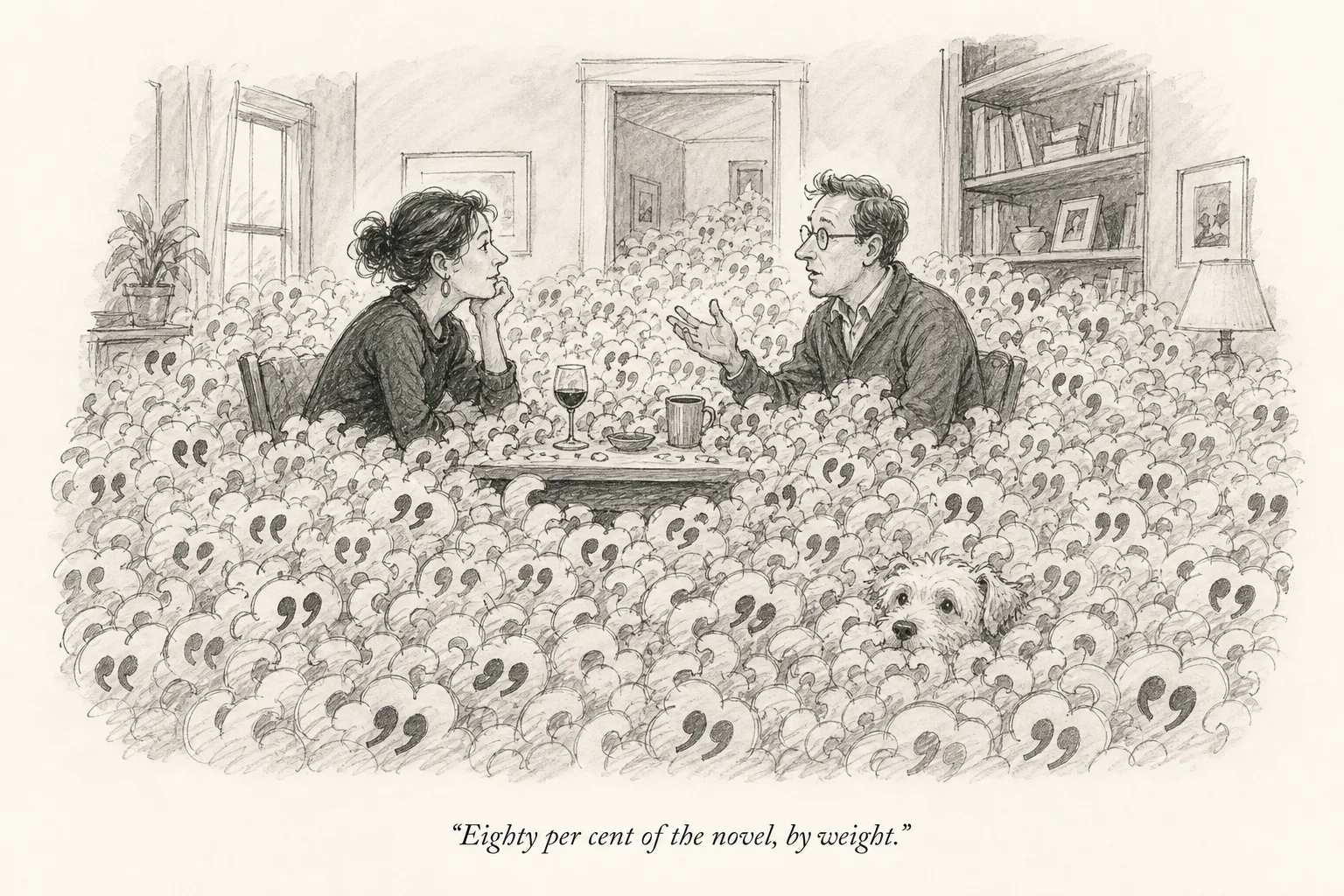
Here is a measurement most writers have never taken and can rarely guess: what proportion of your novel, by word count, sits inside quotation marks?
Writers are consistently wrong about this. Dialogue is the part you remember writing, because it is the part that moves fastest and feels most alive, so a book that is eighteen per cent dialogue can feel, from the inside, like a talky book.
What is actually counted
For every scene, the app counts the words inside quotation marks and expresses them as a ratio of the scene's total. Alongside that it counts a few related things: how many dialogue tags use said or asked, how many reach for a more elaborate verb — whispered, growled, hissed, exclaimed and their relatives — how many attach an adverb to the tag, and how many paragraphs the scene breaks into.
All of it is arithmetic. No model is involved, nothing is inferred, and it takes no time at all. Which also means it has no taste: it is describing your page, not judging it.
The app does carry a working reference band of roughly a quarter to a half — around 25 to 55 per cent of a scene's words as speech — and treats a scene well outside that as worth a look. Take that band for exactly what it is: a rough convention for contemporary commercial and literary fiction, not a rule. Plenty of admired novels sit permanently outside it in both directions.
Why the ratio is worth knowing
Because both extremes have a characteristic reading experience, and the ratio is the fastest way to find them.
A very low ratio over a long stretch usually means the story is being reported rather than staged. Things are described as having happened; nobody is in a room wanting something from somebody. Readers describe this as distant or dense, and the note that follows is often "I couldn't get close to them".
A very high ratio over a long stretch produces the opposite complaint: floating heads. Voices trade lines in an unspecified space with no bodies, no place and no consequence, and the reader loses hold of where they are. It is common in a second draft, because dialogue is the easiest thing to add when a scene feels slow.
Neither is a fault in a single scene. A two-hander interrogation should be eighty per cent speech. A journey chapter might be five. The finding is in the run — twelve consecutive scenes at the same extreme.
Why you cannot judge this yourself
Because you know what everybody in the room means, so the lines do more for you than they can do for a stranger. And because you hear the whole scene as you read it — the pauses, the glance, the room — while the page may contain only the words.
The tag counts are similarly invisible from inside. Nobody notices their own habit of reaching for a more expressive verb than said; the fifth growled in a chapter feels, at the moment of writing, like precision. It is generally the sign of a line that is not carrying its own weight — the verb propping up dialogue that should have been doing the work itself. The same goes for the adverb attached to the tag: she said angrily is usually a note to yourself that the line did not sound angry.
How to test it by hand
Take one chapter you think is dialogue-heavy and one you think is not, and estimate the split before you look. Then look. The gap between your guess and the number is the useful part, because that gap is your calibration error, and it applies to the whole manuscript.
Then do the harder test, which no tool can run for you: read the speech alone. Strip everything that is not inside quotation marks, so you have nothing but the lines. Two things become obvious immediately — whether you can tell who is speaking without the attributions, and whether anyone in the conversation is trying to get something. Speech in which nobody resists, withholds or deflects is usually information delivery wearing quotation marks.
Where the book shows you this
The prose metrics — dialogue ratio, tag counts, sentence length and its variation, word echoes, readability, passive constructions — sit on the Scene Signals tab of the scene slide-out, gathered with the scene's other measurements so all of a scene's numbers are in one place.
They are deliberately descriptive. There is no diagnostic that judges dialogue, and there is not going to be one, because whether a line of speech works is a question about character and subtext, not about proportions. What the numbers can do is point you at the twelve-scene run where everything is talking, or the fifty pages where nobody says anything at all.
What to do once you are looking at those scenes is a craft question, and it starts from the principle that dialogue is something a character does rather than something they say.
Notes on the craft
Occasional letters on what actually breaks novels — and how to fix them.
No fixed schedule. Unsubscribe in one click. Privacy Policy